The Dutch self-employment visa is formally the residence permit for self-employed persons (verblijfsvergunning arbeid als zelfstandige). The Immigration and Naturalisation Service (IND) grants it to non-EU nationals whose business serves an essential Dutch interest, after advice from the Netherlands Enterprise Agency (RVO) based on a points system. The main exceptions: US and Japanese nationals can use treaty routes, Turkish nationals are assessed under separate criteria, and self-employed artists are assessed on advice from the Ministry of Education, Culture and Science.
The permit is issued for a maximum of two years and can be extended. Below we explain the conditions, the points test, the procedure and the most common reasons for refusal.

Table of contents
What does the permit allow?
The permit allows you to work in the Netherlands as a self-employed person: as a business owner, freelancer or independent contractor, without a separate work permit. It does not allow paid employment; for that an employer needs a work permit or you need another residence purpose.
The legal basis is Article 3.30 of the Aliens Decree 2000 (Vreemdelingenbesluit 2000, Vb). The permit is valid for at most two years per term (Article 3.58 Vb), and can be extended as long as the business still meets the conditions.
Who can apply?
You need a nationality from outside the EU, the EEA and Switzerland, a valid passport and no public-order objections. Under Article 3.30(1) Vb your business must also:
- serve an essential Dutch interest, in the opinion of the Minister;
- provide you with sufficient and lasting income;
- meet the professional and business requirements for the activity, such as licences or registrations.

How does the RVO points test work?
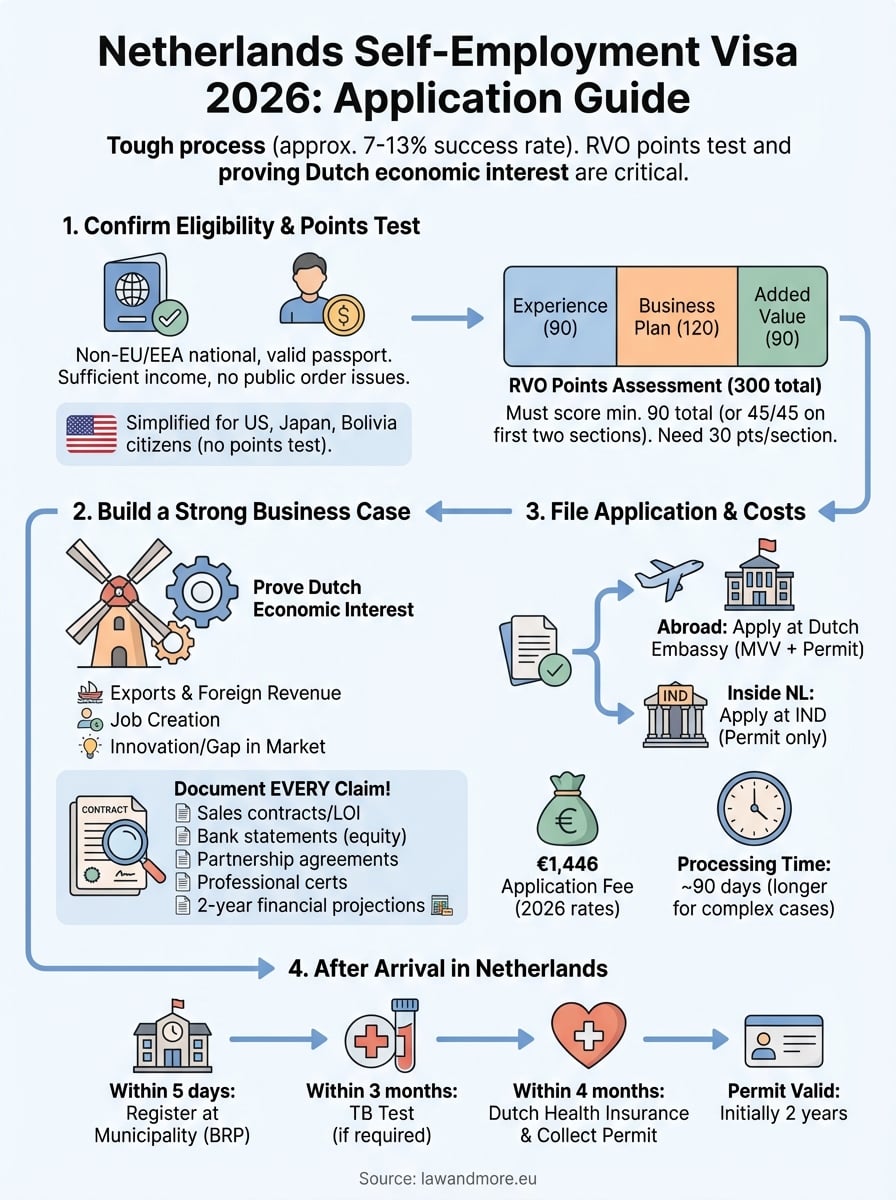
The RVO scores three criteria: your personal experience, your business plan and the added value for the Dutch economy. Your business serves an essential Dutch interest if you score at least 30 points on each criterion (Article 3.20a(2) of the Aliens Regulation 2000, Voorschrift Vreemdelingen 2000).
If you score fewer than 30 points on added value, you can still qualify with at least 45 points for personal experience and at least 45 points for the business plan (Article 3.20a(3)). The scoring table is in Annex 8a to that regulation. The RVO awards points only for claims that are supported by documents.
The points test does not apply to Turkish nationals, who are assessed under separate criteria in Annex 8aa (Article 3.20a(4)). For self-employed artists, the advice comes from the Minister of Education, Culture and Science (Article 3.20a(5)). US nationals (Dutch-American Friendship Treaty) and Japanese nationals rely on treaty routes with a capital investment requirement instead of points.
What must the business plan prove?
The plan must show both that the business is viable and that the Netherlands benefits from it beyond your own income. Activities that bring in foreign revenue, create jobs for people already living here, introduce something new to the Dutch market or add innovation carry the most weight.
Every claim needs a document behind it. Revenue projections are supported by signed contracts or letters of intent, capital by bank statements in your own name, cooperation by a signed agreement with the Dutch partner’s Chamber of Commerce (KVK) number, and expertise by diplomas and references.

Documents in a language other than Dutch, English, French or German need a sworn translation, and foreign official documents usually need legalisation or an apostille. Arrange this early; it often causes delays.
How much income do you need?
Your business must provide sufficient and lasting income so that you do not depend on public funds. The IND bases the income standard on the statutory minimum wage, which changes on 1 January and 1 July; check the current amount on ind.nl on the day you file.
Have an accountant or bookkeeper prepare profit forecasts for the full permit period, linked to the contracts in your file. The application fee is also published on the IND website and is usually adjusted on 1 January.
How does the procedure work?
If you live abroad, you usually file a combined application for a provisional residence permit (MVV) and the residence permit through the Dutch embassy or consulate, under the MVV and TEV procedure. The IND asks the RVO for advice and you travel only after the MVV has been issued.
If you already live in the Netherlands on another permit, such as a student or orientation year permit, you apply to the IND to change your residence purpose. Whether you may keep working during the procedure depends on the endorsement on your current permit; see also our page on work visa requirements.

The IND must decide within 90 days (Article 25 of the Aliens Act 2000, Vw), a period it can extend. Since 15 April 2025 the IND no longer owes an administrative penalty for a late decision; you can still appeal to the court against the failure to decide. If your file is incomplete, the IND gives you a short period to supplement it.
What do you arrange after arrival?
You register with your municipality in the Personal Records Database (BRP) and receive a citizen service number (BSN), which you need for banking, tax and health insurance. You collect your residence document at an IND desk by appointment and, if your nationality requires it, take a tuberculosis test at the municipal health service (GGD).
Your business must keep meeting the conditions on which the permit was granted. Changes such as a new legal form, other activities or a lasting fall in profit matter for the extension, which requires the same kind of evidence as the first application.
Why are applications refused?
Refusals usually concern the file, not the entrepreneur. The common causes are:
- ambitions in the business plan without evidence;
- profit forecasts not prepared or checked by an accountant;
- a Dutch interest described in general terms instead of demonstrated;
- capital held in an account in someone else’s name;
- late translations or legalisations;
- an activity that is in fact employment for a single client.
Against a refusal you can file an objection (bezwaar) with the IND within four weeks (Article 69 Vw). Request the RVO advice: it shows per criterion where points were missed. If the business plan itself is weak, a new, better substantiated application is often faster.
What should you check before applying?
- Whether you fall under the points test, a treaty route (US, Japan), the Turkish criteria or the artist route.
- Whether your plan scores at least 30 points on each criterion, or 45 on experience and 45 on the plan.
- Whether every claim is supported by a signed contract, letter of intent, bank statement or diploma.
- Whether your forecast profit meets the current IND income standard.
- Whether you need an MVV, and whether translations and apostilles are ready.
What can we do for you with a self-employment visa?
Our immigration lawyers assist entrepreneurs from the first assessment to an appeal; our wider immigration law practice also covers permits for family members and staff.
- We assess whether the points test, a treaty route or another residence purpose fits best.
- We test your business plan against the RVO criteria before filing.
- We organise the supporting evidence, translations and apostilles.
- We file the application with the IND or through the embassy.
- We draft the objection and file it with the IND within the four-week deadline, or appeal a late decision.
Summary
- The self-employment permit (Article 3.30 Vb) requires a business that serves an essential Dutch interest and provides sufficient income.
- The RVO points test requires 30 points per criterion, or 45 + 45 on experience and business plan.
- US, Japanese and Turkish nationals and artists follow different routes.
- The permit is valid for up to two years; the IND decides within 90 days.
- Object to a refusal within four weeks.
Frequently asked questions
Who can apply for a self-employment visa in the Netherlands?
Non-EU/EEA/Swiss nationals who want to run their own business here, if the business serves an essential Dutch interest, provides sufficient and lasting income and meets the professional requirements (Article 3.30 Vb).
How many points do I need in the RVO test?
At least 30 points for each of personal experience, business plan and added value for the Dutch economy, or at least 45 points for experience and 45 for the business plan if added value scores lower (Article 3.20a Voorschrift Vreemdelingen 2000).
How long is the permit valid?
At most two years per term (Article 3.58 Vb). You can apply for an extension if the business still meets the conditions.
How long does the IND take to decide?
The statutory decision period is 90 days (Article 25 Aliens Act 2000), which the IND can extend. The RVO advice is obtained within that period.
What can I do if my application is refused?
File an objection with the IND within four weeks (Article 69 Aliens Act 2000) and request the RVO advice to see where points were missed. Sometimes a new, better documented application is faster.