An employer who wants to employ someone from outside the EU, the EEA or Switzerland usually needs work authorisation for that person. For work of up to 90 days, the employer applies for a work permit (tewerkstellingsvergunning, TWV) at the UWV; for longer work, a single permit (GVVA) combining residence and work authorisation is applied for at the IND. Highly skilled migrants and EU Blue Card holders are the main exception: they need a residence permit, but no separate work authorisation, and a salary threshold applies instead. For employment of more than 90 days, a single permit (GVVA) is therefore the standard route.
British nationals have been third-country nationals since the end of the Brexit transition period on 31 December 2020 and fall under these rules like any other non-EU citizen. The exception is British citizens who already lived in the Netherlands before that date: they keep their position under the Withdrawal Agreement between the United Kingdom and the European Union.
Table of contents
What changed for British citizens after Brexit?
Since 1 January 2021, British citizens need a residence and work permit to start working in the Netherlands. Their position is no longer governed by EU free movement but by the Trade and Cooperation Agreement between the EU and the United Kingdom.
That agreement contains few specific rules on working in the Netherlands. As a result, the Foreign Nationals Employment Act (Wet arbeid vreemdelingen, WAV) applies to British citizens as it applies to other non-EU citizens: the employer needs work authorisation before you start.
Which permit does your employer need?
The type of authorisation depends on how long you will work in the Netherlands. The two main options are:
- a work permit (TWV) from the UWV, if you will work in the Netherlands for 90 days or less; only the employer can apply;
- a single permit (GVVA) from the IND, combining residence and work authorisation, if you will work in the Netherlands for longer than 90 days.
A single permit is valid for a maximum of three years. According to the IND, if you have already held a valid residence permit for work for five years, it can be granted for up to five years.
Is there no suitable candidate on the Dutch or European labour market?
The employer must first show there is no “priority supply” in the Netherlands or the EEA. In practice, the employer registers the vacancy with a UWV employer service point and recruits actively before offering you the job.
The UWV reviews this labour market test as part of its assessment of the TWV or GVVA application. The test is applied less strictly for staff transferred within an international group, and for academic staff, artists, guest lecturers and interns, because these groups are not expected to enter the Dutch labour market permanently.
Do you have a valid residence permit?
A second condition is that you hold, or will receive, a residence permit that allows you to work in the Netherlands. For work shorter than 90 days, a short-stay visa (Schengen visa) usually suffices, applied for at the Dutch embassy or consulate in your country of residence.
For work longer than 90 days, the residence permit depends on the type of work. Nationals of most countries also need an entry visa (MVV), which the IND assesses in the same procedure as the residence permit.
What are the main routes for longer stays?
- Transfer within a company. If you work for a group company outside the EU and are transferred to its Dutch branch as a trainee, manager or specialist, a residence permit for intra-corporate transfer applies. The IND requires, among other things, a valid passport and an employment contract with the company outside the EU.
- Highly skilled migrant (kennismigrant). For senior or specialist positions. The employer must be a recognised sponsor with the IND and applies for the residence permit; no TWV or labour market test is needed. The minimum gross monthly salary for 2026, excluding holiday allowance, is €5,942 for migrants of 30 and older, €4,357 for migrants under 30, and €3,122 for graduates who apply within three years of graduating. See our page on the knowledge migrant scheme for the full conditions. A separate regime applies to researchers under Directive (EU) 2016/801.
- European Blue Card. A combined residence and work permit for highly qualified non-EU migrants with a higher education qualification. For 2026, the minimum gross monthly salary is €5,942, or €4,754 for recent graduates. After 12 months of legal residence with a Blue Card in one EU country, you may move to another participating member state under that state’s conditions.
- Other paid employment. Work in art and culture, as a correspondent for a foreign media outlet or in other specific roles falls under separate residence purposes, each with its own IND conditions.
When is no work permit required?
In some cases you do not need a TWV or GVVA, although you usually still need a valid residence document. The two most relevant exceptions are:
- British citizens who lived in the Netherlands before 31 December 2020. Under the Withdrawal Agreement, you can continue to work without a work permit, provided you hold a valid residence document under that agreement, issued by the IND.
- Self-employed professionals. You need a residence permit for self-employment instead. Your activities must serve an essential Dutch interest; the Netherlands Enterprise Agency (RVO) advises the IND using a points system based on your experience, your business plan and the added value of your activities for the Netherlands.
How do you prepare the application?
For the highly skilled migrant route, the recognised sponsor files the application with the IND, often together with the application for an entry visa (MVV) where you need one. Your role is to provide complete and correct documents.
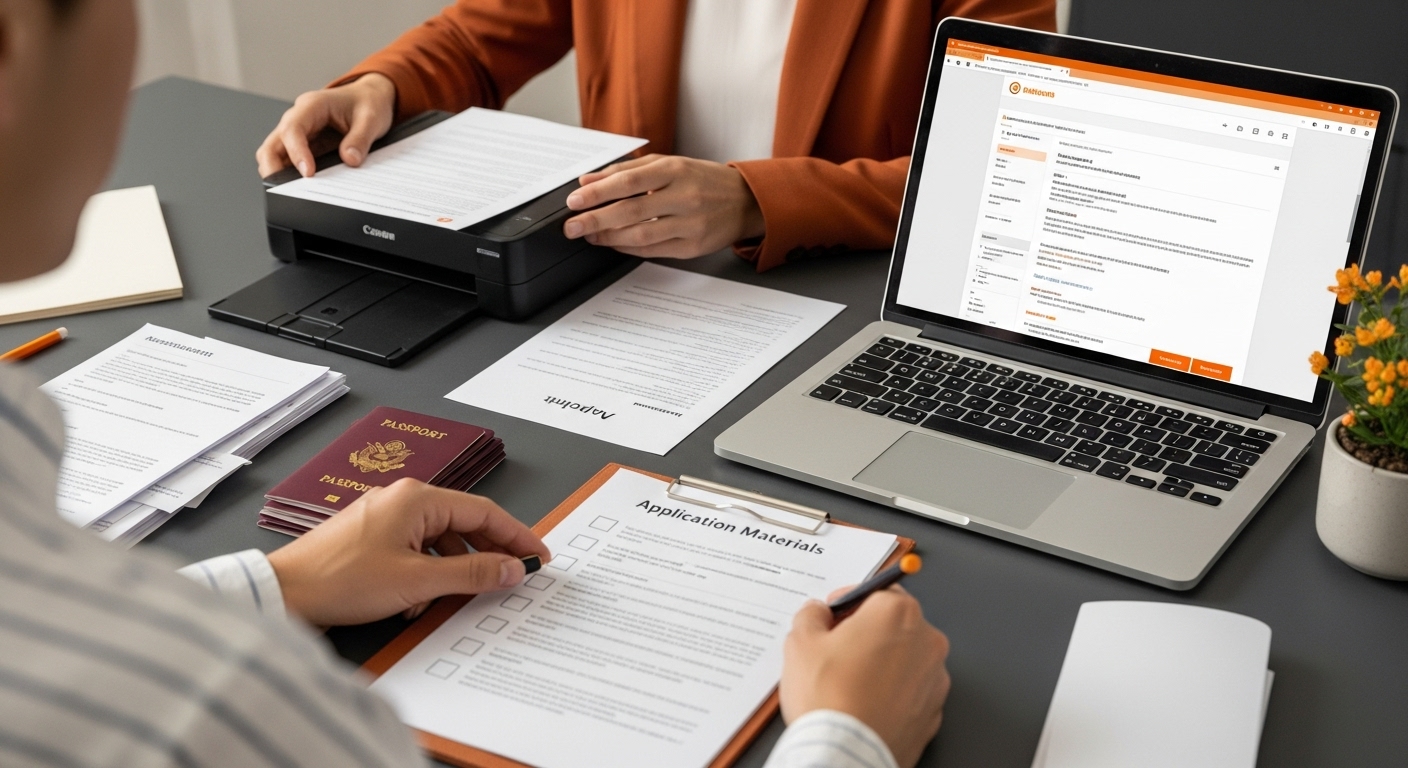
- A valid passport.
- The signed employment contract, stating the salary, position and duration.
- Diplomas, where the route requires them (for example the EU Blue Card), with an evaluation or apostille where asked.
- Birth and marriage certificates for family members who come with you, legalised or with an apostille.
- Proof of tuberculosis testing where the IND requires it for your nationality.

The IND has a statutory decision period, but since 15 April 2025 it no longer owes an administrative penalty (dwangsom) if it decides late. If the IND does not decide in time, you can give it notice of default and then go to court, which can order a decision within a set period. If the application is refused, you can file an objection (bezwaar) within four weeks.
What must you arrange after arrival?
If you expect to spend at least two thirds of the next six months in the Netherlands, you must register in person with the municipality where you live no later than the fifth day after arrival (Article 2.38 of the Personal Records Database Act, Wet BRP). You then receive a citizen service number (burgerservicenummer, BSN), which your employer needs for payroll.
If you live or work in the Netherlands, you are generally obliged to take out Dutch basic health insurance. Under Article 5(5) of the Health Insurance Act (Zorgverzekeringswet) a policy taken out within four months after the obligation arose applies retroactively to that date; after that you pay premiums only from the start date and risk a fine. Tax questions, such as the 30% facility for incoming employees, are a matter for the Tax Administration (Belastingdienst) and a tax adviser.
How do you keep your right to work?
A highly skilled migrant permit is linked to employment with a recognised sponsor at or above the salary threshold. The sponsor must report relevant changes, such as the end of employment, to the IND.
If your employment ends, you get a search period to find a new sponsor, but you may only start with the new employer once that employer is also a recognised sponsor and meets the conditions. A change of employer with a TWV or GVVA requires a new permit, because the permit is linked to a specific employer (Article 2(1) Wav). Check the end date on your residence card and apply for extension in time.
What should you check as an employee?
- Whether your work will last 90 days or less (TWV) or longer (GVVA, highly skilled migrant or Blue Card).
- Whether your gross monthly salary meets the 2026 IND threshold for your route and age.
- Whether you need an entry visa (MVV) before travelling to the Netherlands.
- Whether your residence document states that work is permitted, and under which conditions.
- As a British citizen: whether you lived in the Netherlands before 31 December 2020 and hold a Withdrawal Agreement residence document.
What should you check as an employer?
- Whether you need a TWV from the UWV or a GVVA from the IND, and who files the application.
- Whether you have registered the vacancy with the UWV and can document your recruitment efforts in the Netherlands and the EEA.
- Whether you are a recognised sponsor with the IND, which is required for highly skilled migrants.
- Whether the employee has a valid permit on the first working day, and that you keep a copy of the identity document in your records.
- That employment without the required permit is an offence under the WAV, for which the Netherlands Labour Authority can impose a fine per employee; since 1 February 2025 this ranges from €2,250 to €11,250.
What can we do for you with a work permit?
Our immigration lawyers work with both employers and employees on residence and work permits. We can:
- determine which permit or exception applies to your situation, based on the duration of work, salary and nationality;
- check whether the salary in the employment contract meets the current IND threshold;
- prepare and file the TWV, GVVA, highly skilled migrant or Blue Card application;
- help an employer apply for recognised sponsor status with the IND;
- file an objection (bezwaar) within the four-week deadline if an application is refused;
- advise an employer on a fine notice from the Netherlands Labour Authority.
Summary
- Work of up to 90 days usually requires a TWV from the UWV; longer work requires a single permit (GVVA) from the IND, valid for up to three years.
- Highly skilled migrants and Blue Card holders need no separate work authorisation, but must meet a salary threshold: €5,942 gross per month in 2026 for the standard criterion.
- For a TWV or GVVA, the employer must first show that no suitable candidate is available in the Netherlands or the EEA.
- British citizens who lived in the Netherlands before 31 December 2020 keep their position under the Withdrawal Agreement.
- Self-employed professionals need a separate residence permit, assessed by the IND with advice from the RVO.
Frequently asked questions
Can I apply for a work permit myself?
Not for a TWV: only the employer can apply for it at the UWV. A single permit (GVVA) can be filed by the employer or by the employee, but in practice the employer usually files it, because the employer must show the labour market and salary conditions are met.
What happens if I start working without the right permit?
Working without the required permit breaches the Foreign Nationals Employment Act (WAV). The Netherlands Labour Authority can fine the employer between €2,250 and €11,250 per employee since 1 February 2025, and it can also affect your own residence status. Check your position before your first working day.
Does meeting the conditions guarantee approval?
No. The IND and the UWV assess each application individually against the conditions, such as the labour market test and the salary threshold. If an application is refused, you can file an objection (bezwaar) within four weeks of the decision.