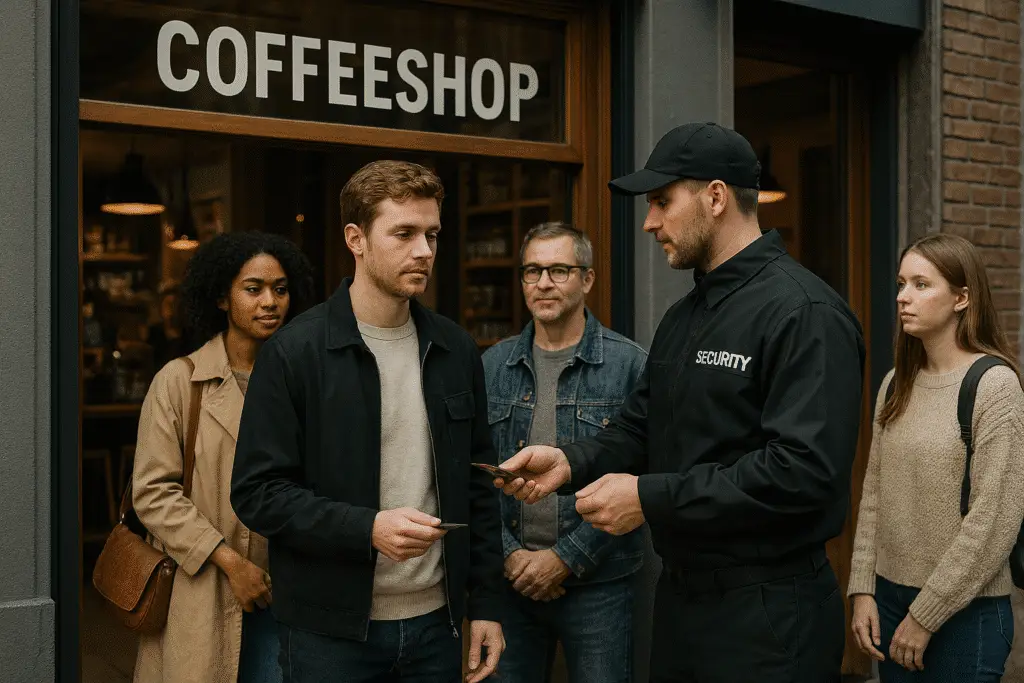
A Dutch coffeeshop may sell small amounts of cannabis to adults because the authorities tolerate it under strict conditions, not because cannabis is legal. Selling and possessing cannabis remain offences under the Opium Act (Opiumwet); the Public Prosecution Service (OM) simply does not prosecute a coffeeshop that complies with the national toleration criteria and the rules of its municipality.
The most important exception is local: each municipality decides whether coffeeshops are allowed at all and how strictly it enforces the rules, including the rule that only residents of the Netherlands may buy. Below we explain the toleration policy, the rules for customers and operators, enforcement by the mayor and the Public Prosecution Service, and the closed supply chain experiment.
Table of contents
What does the toleration policy mean?
Toleration (gedoogbeleid) means that conduct remains a criminal offence, but the Public Prosecution Service has decided not to prosecute it if strict conditions are met. For coffeeshops, those conditions are laid down in the Opium Act Instruction (Aanwijzing Opiumwet) of the Public Prosecution Service.
The Opium Act distinguishes between hard drugs on List I, such as cocaine, heroin and ecstasy, and soft drugs on List II, which include cannabis products such as marijuana and hashish. The toleration policy only covers the sale of soft drugs in a coffeeshop. There is no toleration for hard drugs.
For individuals, the Public Prosecution Service does not in principle prosecute the possession of up to 5 grams of cannabis or up to 5 cannabis plants for personal use. The police will still confiscate the cannabis or remove the plants. Possession of more than 5 grams is no longer tolerated. Under Article 11 of the Opium Act, possession of up to 30 grams of cannabis is a minor offence, and possession of larger quantities is a more serious criminal offence with a higher maximum penalty.
The government explains the criteria on rijksoverheid.nl. The policy aims to protect public health and to keep users of soft drugs away from the criminal circuit in which hard drugs are sold.
What are the rules for customers?
You must be 18 or older, you may buy no more than 5 grams per day, and in many municipalities you must show that you live in the Netherlands. Minors are not allowed inside at all.
A coffeeshop must check your age and, where the residency rule is enforced, your residency. Bring a valid identity document, such as a passport, a Dutch driving licence or an identity card. In municipalities that enforce the residency rule, the coffeeshop will usually also ask for an extract from the Personal Records Database (Basisregistratie Personen, BRP) that shows your registration at a Dutch address.
The 5-gram limit applies per person per day. Buying several times in one day to get around the limit, or buying for others, puts the coffeeshop at risk and can lead to confiscation of your purchase. Coffeeshops do not serve alcohol, and hard drugs are never sold.
Toleration only covers the sale inside the coffeeshop. Buying from a street dealer or through a delivery service falls outside the toleration policy entirely, both for the seller and for you.
What is the residency criterion?
The residency criterion (ingezetenencriterium, the I in AHOJGI) means that only residents of the Netherlands may enter a coffeeshop and buy there. A resident is someone who is registered at an address in a Dutch municipality.
The criterion was introduced nationally in 2013 to combat drug tourism and the nuisance and crime associated with it. Its enforcement is left to local policy: the mayor, the chief public prosecutor and the police agree in the local tripartite consultation (driehoeksoverleg) whether and how it is enforced. Municipalities in the south, close to the Belgian and German borders, including Maastricht, apply it strictly. Large cities such as Amsterdam have so far not used it to exclude tourists, although the debate returns regularly.
For a coffeeshop that must apply the criterion, it is part of the daily door policy. Admitting a non-resident where the rule is enforced counts as a breach of the toleration criteria, with the consequences described below.
Which criteria must a coffeeshop operator meet?
An operator must comply with the AHOJGI criteria every day, keep no more than 500 grams of stock on the premises and serve no alcohol. The municipality can add its own conditions.
The criteria are:
- A (affichering): no advertising, other than a brief indication of the business at the premises.
- H (harddrugs): no sale or presence of hard drugs.
- O (overlast): no nuisance in the vicinity, such as parking problems, noise, litter or loitering customers.
- J (jeugdigen): no sale to persons under 18 and no admission of minors.
- G (grote hoeveelheden): no sale of more than 5 grams per person per day.
- I (ingezetenen): admission and sale only to residents of the Netherlands, where the municipality enforces this.
On top of these criteria, the trading stock may not exceed 500 grams, and a coffeeshop may not sell alcohol. The municipality can impose additional requirements, for example on opening hours, a minimum distance from schools or the maximum number of coffeeshops in the municipality.
Good compliance is built into daily operations: trained door staff, a logbook of ID checks, clear house rules and careful stock management. The staff you employ fall under ordinary Dutch employment law; see our overview of Dutch employment law for the rules on contracts and dismissal.
How do you open or take over a coffeeshop?
Only in a municipality that allows coffeeshops, and usually only by taking over an existing business, because many municipalities have capped or reduced the number. You need the municipality’s permission and must pass an integrity screening.
Start with the municipal coffeeshop policy, which states whether coffeeshops are allowed, how many, where and under which conditions. Many municipalities have a zero policy and allow no coffeeshops at all. In others, the number is fixed and a new operator can only take over an existing location.
Where coffeeshops are allowed, the municipality usually issues a toleration decision or an operating permit for the premises, often in combination with the rules for catering establishments in its local by-law. Before granting or transferring it, the municipality can screen the applicant, the financiers and the landlord under the Public Administration Probity Screening Act (Wet Bibob). If there is a serious risk that the permit will be used to commit criminal offences or to benefit from criminal proceeds, the permit can be refused or withdrawn. Because of that risk, the origin of the money used to take over a coffeeshop is examined closely; our article on recognising and preventing money laundering explains the obligations that apply.
The business itself is registered in the usual way. See our article on registering a business in the Netherlands. Discuss your plans with the municipality at an early stage, because a takeover without prior permission can lead to immediate enforcement.
How are coffeeshops inspected and what are the penalties?
The municipality and the police carry out inspections, often unannounced. The main sanction is administrative: the mayor can close the coffeeshop, temporarily or for good, and withdraw its permit.
The mayor’s power to close premises is based on Article 13b of the Opium Act. It allows the mayor to impose an order for administrative enforcement, such as closure, if drugs are sold, delivered or present for that purpose in or at premises. Most municipalities have a published enforcement policy that sets out the consequences of a first, second and third breach, starting with a warning or a short closure and ending with permanent closure. Closure decisions can be challenged by filing an objection with the mayor and then an appeal with the administrative court, and in urgent cases by asking the court for a provisional ruling.
Besides this, the Public Prosecution Service can prosecute the operator if the toleration criteria are breached, for example for keeping too much stock or selling hard drugs. Stock exceeding the permitted amount will be confiscated. A breach of the criteria also means that the operator loses the protection of the toleration policy for the conduct concerned.
The same closure power applies to homes and other premises. A mayor can close a home in which drugs are found or in which cannabis is grown, and a tenant who grows cannabis risks eviction by the landlord. Such cases require a quick response, because the time limits for objection and appeal are short.
What about the supply to coffeeshops?
The toleration policy only covers the sale at the front door. Cultivation and wholesale supply at the back door remain illegal, which means that a tolerated coffeeshop has to buy its stock from an illegal supplier.
This contradiction has been criticised for years because it keeps the supply in criminal hands. Commercial cultivation is prosecuted under Article 11 of the Opium Act, and under Article 11a preparatory acts for large-scale cultivation, such as supplying equipment or premises, are also punishable.
To test a regulated alternative, the government started the experiment with a closed coffeeshop chain (experiment gesloten coffeeshopketen). Its experimental phase began on 7 April 2025 in ten participating municipalities. There, coffeeshops may only sell cannabis produced by growers designated by the government. The experiment is temporary and is being evaluated by researchers on behalf of the government. Outside the participating municipalities, the ordinary toleration policy continues to apply unchanged.
For operators in a participating municipality, the experiment means that they may only buy from designated growers and must meet the additional requirements of the experiment rules. The age limit, the ban on hard drugs and alcohol and the rules against nuisance continue to apply.
Where and how may you use cannabis?
You may use cannabis in a coffeeshop and in private, but municipalities can ban use in public places. Smoking tobacco is not allowed inside a coffeeshop, and driving under the influence is a criminal offence.
Many municipalities have designated areas in which smoking cannabis in public is prohibited, for example in city centres or around schools. The rules are in the local by-law (Algemene Plaatselijke Verordening, APV), and a breach can lead to a fine. Check the signs and the local rules before you use cannabis outside.
The Tobacco and Smoking Products Act (Tabaks- en rookwarenwet) prohibits smoking tobacco in catering establishments, including coffeeshops. Joints mixed with tobacco may therefore not be smoked inside.
Driving after using cannabis is prohibited under the Road Traffic Act 1994 (Wegenverkeerswet 1994). Since 2017 there are statutory limits for THC and other drugs in the blood, and the police can use a saliva test at the roadside. Exceeding the limit can lead to a fine, a driving ban and loss of your licence.
Finally, the toleration policy only applies in the Netherlands. Taking cannabis across the border is a criminal offence in neighbouring countries and under Dutch law.
What should you check as a customer?
The toleration policy protects the sale inside the coffeeshop, not every purchase or use.
- You are 18 or older and carry a valid identity document.
- In a municipality that enforces the residency criterion, you can show a BRP extract with a Dutch address.
- You buy no more than 5 grams per day, and only for yourself.
- You check the local by-law (APV) before using cannabis in public.
- You do not drive after use: the THC limits of the Road Traffic Act 1994 apply.
What should you check as a coffeeshop operator?
One breach of the AHOJGI criteria can lead to closure under Article 13b of the Opium Act.
- Door staff check age and, where enforced, residency at every entry, and keep a logbook.
- Stock on the premises never exceeds 500 grams.
- No alcohol and no hard drugs are present, and tobacco is not smoked inside.
- You know your municipality’s enforcement policy and the sanction for a first, second and third breach.
- Financiers and the landlord can pass a Bibob screening before a takeover.
What can we do for you with coffeeshop law?
Our criminal lawyers assist coffeeshop operators, landlords and individuals with permits, closure orders under the Opium Act and criminal proceedings.
- We file an objection against a closure order with the mayor within the six-week deadline.
- We ask the administrative court for a provisional ruling (voorlopige voorziening) against an immediate closure.
- We prepare a takeover with the municipality, including the permit transfer and the Bibob questionnaire.
- We defend you in criminal proceedings for possession or cultivation under Articles 11 and 11a of the Opium Act.
- We advise landlords and tenants on a home closure or eviction after cannabis is found.
Summary
- Cannabis is not legal in the Netherlands; coffeeshops are tolerated if they meet strict criteria.
- Customers must be 18 or older and may buy no more than 5 grams per day; many municipalities admit residents only.
- Operators must comply with the AHOJGI criteria, keep no more than 500 grams of stock and serve no alcohol.
- The mayor can close a coffeeshop or a home under Article 13b of the Opium Act; objection and appeal deadlines are short.
- The closed coffeeshop chain experiment tests regulated supply in ten municipalities from 7 April 2025.
Frequently asked questions
Is cannabis legal in Dutch coffeeshops?
No. Cannabis remains illegal under the Opium Act. The Public Prosecution Service tolerates the sale of small amounts in coffeeshops that meet strict criteria, and does not in principle prosecute possession of up to 5 grams for personal use.
How much cannabis can I buy or possess?
A coffeeshop may sell you no more than 5 grams per day. Possession of up to 5 grams is not prosecuted in principle, but the police will confiscate it; possessing more is not tolerated.
Do coffeeshops follow the same rules everywhere in the Netherlands?
The national criteria apply everywhere, but each municipality decides whether coffeeshops are allowed and how strictly the residency rule is enforced. Border towns such as Maastricht admit residents only.
Can coffeeshops sell hard drugs or alcohol?
No. The sale or presence of hard drugs is never tolerated and coffeeshops may not sell alcohol. A breach can lead to closure by the mayor and to prosecution.