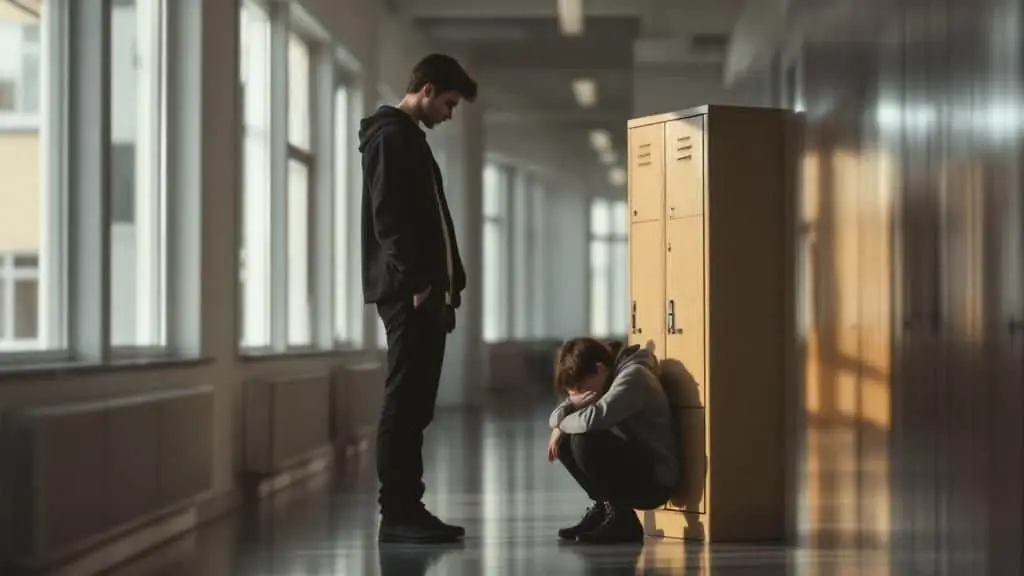
In the Netherlands, bullying is not a criminal offence in itself, but many acts that make up bullying are, and schools and employers have a legal duty to act against it. Since the Social Safety at School Act (Wet veiligheid op school) came into force in 2015, primary and secondary schools must pursue an active anti-bullying policy and appoint a point of contact for bullying.
Bullying is a repeated pattern of behaviour in which one person or a group deliberately harms another, sustained by an imbalance of power. Assault, threats, defamation and stalking are criminal offences whoever commits them. A school or employer that fails to act on signals it knew or should have known about can be liable for damages. Below we explain what bullying looks like, what schools must do, how you report it and when the police or a court can step in.
Table of contents
What counts as bullying?
Bullying is harmful behaviour that is intentional, repeated and based on an imbalance of power. That is what separates it from an ordinary conflict between equals.

Three elements are usually present:
- Intentional harm. The behaviour is meant to cause physical or emotional pain, through words, actions or exclusion.
- An imbalance of power. The target feels unable to defend themselves.
- Repetition. It is not a one-off, but a pattern over time.
Bullying also happens at work, in sports clubs and online. Which rules apply depends on the setting: schools have duties under the education acts, employers under the Working Conditions Act (Arbowet).
Which forms of bullying are there?
Bullying can be physical, verbal, social or online. Some forms leave visible marks; others cause harm that is harder to see but just as real.
| Type of bullying | Description | Examples |
|---|---|---|
| Physical | Using force or objects to intimidate or hurt. | Hitting, pushing, tripping, stealing or damaging belongings. |
| Verbal | Using spoken or written words to taunt, threaten or insult. | Name-calling, threats, insults about appearance or background. |
| Social | Damaging someone’s reputation or relationships. | Exclusion, public humiliation, spreading rumours. |
| Online | Using digital platforms to harass, threaten or humiliate. | Abusive messages, false posts, sharing embarrassing images. |
Online bullying, or cyberbullying, can follow a child home and continue day and night. Several online acts are separate offences, such as sharing sexual images without consent (Article 139h Sr) and doxing (Article 285d Sr), which we discuss below.
For schools, clear rules on the use of phones and social media are part of an effective safety policy. Dutch schools must also pay attention to online conduct in their teaching. For victims, the first practical step is to preserve evidence: screenshots of messages, posts and profiles, with dates.
What about bullying based on background or religion?
Bullying that targets someone’s ethnicity, skin colour, culture or religion is also discrimination. It attacks a person’s identity and can be a criminal offence in its own right.

Discriminatory bullying can be overt, such as racial slurs or mocking an accent, or covert, such as a pupil who is consistently left out because of their background. The school’s participation council (medezeggenschapsraad) must monitor non-discrimination and equal treatment at the school, and teachers must respond rather than dismiss incidents as a disagreement between pupils.
Outside school, you can report discrimination to a local anti-discrimination service (antidiscriminatievoorziening), which every municipality must make available. Adults who face comparable behaviour at work can read more about transgressive behaviour in the workplace and the employer’s obligations.
What must a Dutch school do against bullying?
Every primary and secondary school must have a social safety policy that includes an anti-bullying approach, and it must check whether that policy works. The school must also appoint a point of contact for bullying.
These duties follow from the Social Safety at School Act, which amended the Primary Education Act (Wet op het primair onderwijs) and the Secondary Education Act (now the Wet voortgezet onderwijs 2020) with effect from 1 August 2015. In summary, a school must:
- pursue a social safety policy, including measures against bullying, online and offline;
- monitor how safe pupils actually feel, on a regular basis;
- appoint a point of contact for bullying (aanspreekpunt pesten), to whom pupils and parents can turn, and a person who coordinates the anti-bullying policy;
- have a complaints procedure and be affiliated to a complaints committee.
The central government’s page on the approach to bullying at school (in Dutch) describes these obligations. Schools must also discuss social safety, shared norms and online conduct with their pupils. The school cannot adopt or change its safety policy without the involvement of the participation council.
The Inspectorate of Education (Inspectie van het Onderwijs) supervises whether schools meet these obligations. It does not decide individual bullying disputes, but it can act against a school that structurally falls short.
How do you report bullying at school?
Start inside the school: the teacher or mentor, then the point of contact for bullying, then the school board. If that does not help, you can file a formal complaint with the complaints committee and inform the Inspectorate.
The table below shows the usual order.
| Step | Who to contact | Purpose |
|---|---|---|
| 1 | Teacher or mentor (leerkracht or mentor) | Alert the school and look for a quick solution. |
| 2 | Point of contact for bullying or confidential adviser (vertrouwenspersoon) | Support, explanation of the school’s procedure, help with next steps. |
| 3 | School management and school board (schoolbestuur) | Formal request for action when earlier steps have not worked. |
| 4 | Complaints committee (klachtencommissie) | Independent assessment of a formal complaint about the school. |
| 5 | Inspectorate of Education (Onderwijsinspectie) | Supervision where a school structurally fails in its duties. |
The first steps within the school
Ask for a meeting with the teacher or mentor, bring a written log of dates, incidents and names, and agree a plan: what the school will do, who is responsible and when you meet again. Confirm the agreements by email. If the bullying continues, contact the point of contact for bullying or the confidential adviser, who can make sure the school’s anti-bullying protocol is followed.
When to escalate beyond the school
If internal steps do not stop the bullying, address the school board in writing. Describe what happened, what was agreed and what did not happen, and ask for specific measures within a reasonable period.
You can also file a formal complaint with the complaints committee to which the school is affiliated. Its details are in the school’s complaints procedure, usually published in the school guide. The committee assesses the complaint and advises the board.
The Inspectorate of Education has confidential inspectors (vertrouwensinspecteurs) whom you can contact about serious incidents, such as physical or psychological violence, discrimination or sexual harassment. They advise and can help you find the right route, but they do not take over the handling of your individual case.
When does bullying become a criminal offence?
When the behaviour meets the definition of an offence in the Dutch Criminal Code (Wetboek van Strafrecht, Sr). Bullying as such is not an offence, but many of its components are.

The following acts can be reported to the police (aangifte doen):
- Assault (mishandeling, Article 300 Sr). Deliberately causing someone pain or injury, from a hard shove to hitting. Injury is not required; pain is enough. Our article on assault charges in the Netherlands explains this offence in more detail.
- Threats (bedreiging, Article 285 Sr). Threatening someone with, for example, public violence, serious assault or killing.
- Insult, defamation and slander (belediging, smaad and laster, Articles 261, 262 and 266 Sr). Deliberately damaging someone’s honour or reputation, for instance by spreading false accusations.
- Stalking (belaging, Article 285b Sr). Systematically and unlawfully intruding on someone’s privacy to force them to act or to frighten them.
- Discriminatory insult (Article 137c Sr). Publicly insulting a group of people because of their race, religion, sexual orientation or disability.
- Sharing sexual images without consent (Article 139h Sr) and doxing (Article 285d Sr), the publication of personal data to intimidate someone.
Some of these offences are prosecuted only if the victim files a complaint (klacht). That applies to insult, defamation and slander (Article 269 Sr) and to stalking. For a child under 16, a parent or guardian can file the complaint. Simple assault and threats do not require a complaint.
Age matters too. Children under 12 cannot be prosecuted (Article 486 of the Code of Criminal Procedure, Sv). For young people between 12 and 18, juvenile criminal law applies, with an emphasis on education and correction. The police can still record the report and involve youth care or the school.
A criminal investigation runs separately from anything the school does. Where the bullying takes the form of persistent following, messages or unwanted contact, our article on how to handle stalking legally and effectively sets out the options, including a restraining order.
Can you claim damages?
Yes, if the bullying is an unlawful act. You can claim from the person responsible and, in some cases, from the school, the employer or the parents of a young child.
Under Article 6:162 of the Dutch Civil Code (BW), anyone who commits an unlawful act against another person must compensate the damage. That includes financial damage, such as the costs of therapy or a change of school, and in some cases non-material damage for mental harm. For children under 14, parents are liable for the child’s unlawful behaviour under Article 6:169 BW.
A school can be liable if it failed in its duty of care: it knew or should have known about the bullying and did not take reasonable measures. Such claims require careful evidence. Your record of reports, emails and agreements with the school is essential. A court will look at what the school knew, when it knew it and what it did.
What about bullying at work?
Employers must protect employees against bullying. Under Article 3(2) of the Working Conditions Act (Arbeidsomstandighedenwet), they must have a policy to prevent or limit psychosocial workload, which expressly includes bullying, aggression, discrimination and sexual harassment.
In practice that means a risk assessment, a code of conduct, a confidential adviser and a complaints procedure. If an employee suffers damage because the employer did not take adequate measures, the employer can be liable under Article 7:658 BW or the general duty to be a good employer (Article 7:611 BW). An employee who is bullied should report it in writing to a manager or HR, keep a record of incidents and, where needed, contact the company doctor.
How does it work in practice?
Most cases are resolved within the school or workplace, provided the problem is reported early and the facts are well documented. The law becomes relevant when the organisation does not act.
An example to illustrate: a child is excluded and mocked online by classmates for months. The parent keeps a log, saves screenshots and meets the mentor; when the plan fails, the parent writes to the school board, files a complaint with the complaints committee and, because intimate images were shared, reports to the police under Article 139h Sr. The sooner a school is formally informed in writing, the harder it is to argue later that it did not know.
Deadlines and next steps
There is no single deadline, but acting early helps. The school’s complaints procedure may set a period within which a complaint must be filed, so check it.
For criminal complaints, the time limit is three months for offences that are prosecuted only on complaint (Article 66 Sr); the period runs from the moment the person entitled to complain knew of the offence. For civil claims, a claim for damages in principle becomes time-barred five years after you became aware of the damage and the person responsible (Article 3:310 BW). If you are considering legal steps, keep all evidence and seek advice in good time.
What should you check as the parent of a bullied child?
Listen first and take the story seriously; then document and involve the school in writing, so your child does not have to solve it alone.
- Keep a log of dates, incidents and names, and save screenshots of messages, posts and profiles instead of deleting them.
- Ask the school for its anti-bullying protocol and the name of the point of contact for bullying.
- Confirm every agreement with the school by email.
- Check the complaints procedure in the school guide for any deadline to file a complaint.
- For a complaint offence such as defamation or stalking, file the complaint within three months (Article 66 Sr).
- Involve the family doctor or the school’s care coordinator if your child’s wellbeing suffers; children can also talk anonymously to De Kindertelefoon.
What should you check if your child is accused of bullying?
The school must act against bullying, but it must also treat the pupil concerned fairly, and serious measures are subject to rules and procedures.
- Ask the school for the specific incidents it relies on and for its plan.
- Talk to your child about what happened before drawing conclusions.
- Check whether a suspension or expulsion followed the school’s procedure, and object or file a complaint where it did not.
- If the police are involved, make sure your child has a lawyer during the police interview; juvenile criminal law applies from age 12.
- For a child under 14, note that parents are liable for the child’s unlawful acts (Article 6:169 BW).
What can we do for you with bullying?
We assist parents, pupils and employees with complaints against schools and employers, criminal reports and claims; for criminal cases, see our criminal lawyer page.
- We review the school’s safety policy and your correspondence, and draft a written request to the school board.
- We draft and file a complaint with the school’s complaints committee.
- We prepare a police report or a formal complaint within the three-month deadline.
- We assess whether a school or employer is liable under Article 6:162 or 7:658 BW and send a liability letter.
- We assist your child during a police interview or in a dispute about suspension or expulsion.
Summary
- Bullying is intentional, repeated and based on an imbalance of power; it is not an offence in itself, but acts such as assault, threats and defamation are.
- Since 2015, Dutch schools must pursue an anti-bullying policy, monitor pupils’ safety and appoint a point of contact for bullying.
- Report inside the school first, in writing, then escalate to the school board, the complaints committee and, where needed, the Inspectorate.
- Defamation and stalking are prosecuted only on complaint, within three months; assault and threats are not complaint offences.
- Schools and employers that fail to act on known bullying can be liable for damages.
Frequently asked questions
What is the first step if my child is being bullied at a Dutch school?
Listen to your child without judgement and start a log with dates, incidents and names. Then ask for a meeting with the teacher or mentor, ask about the school’s anti-bullying protocol and agree on a plan. Confirm the agreements in writing.
Is cyberbullying a crime in the Netherlands?
Cyberbullying is not a separate offence, but many online acts are: threats (Article 285 Sr), defamation and slander, stalking, sharing sexual images without consent (Article 139h Sr) and doxing (Article 285d Sr). Save screenshots and report to the police. Defamation and stalking are prosecuted only on a complaint by the victim, within three months.
What are a Dutch school’s responsibilities in preventing bullying?
Under the Social Safety at School Act, in force since 1 August 2015, primary and secondary schools must pursue a social safety policy with measures against bullying, monitor how safe pupils feel, appoint a point of contact for bullying and have a complaints procedure. The Inspectorate of Education supervises compliance.
Which support organisations are available in the Netherlands?
Children can talk confidentially to De Kindertelefoon. Parents can turn to Ouders & Onderwijs for information about their rights at school. If the bullying is discriminatory, you can contact the local anti-discrimination service that every municipality must provide.