Victims’ rights after a criminal case: how do you claim compensation under Dutch civil law?

Victims’ Rights in Dutch Civil Law After a Criminal Case

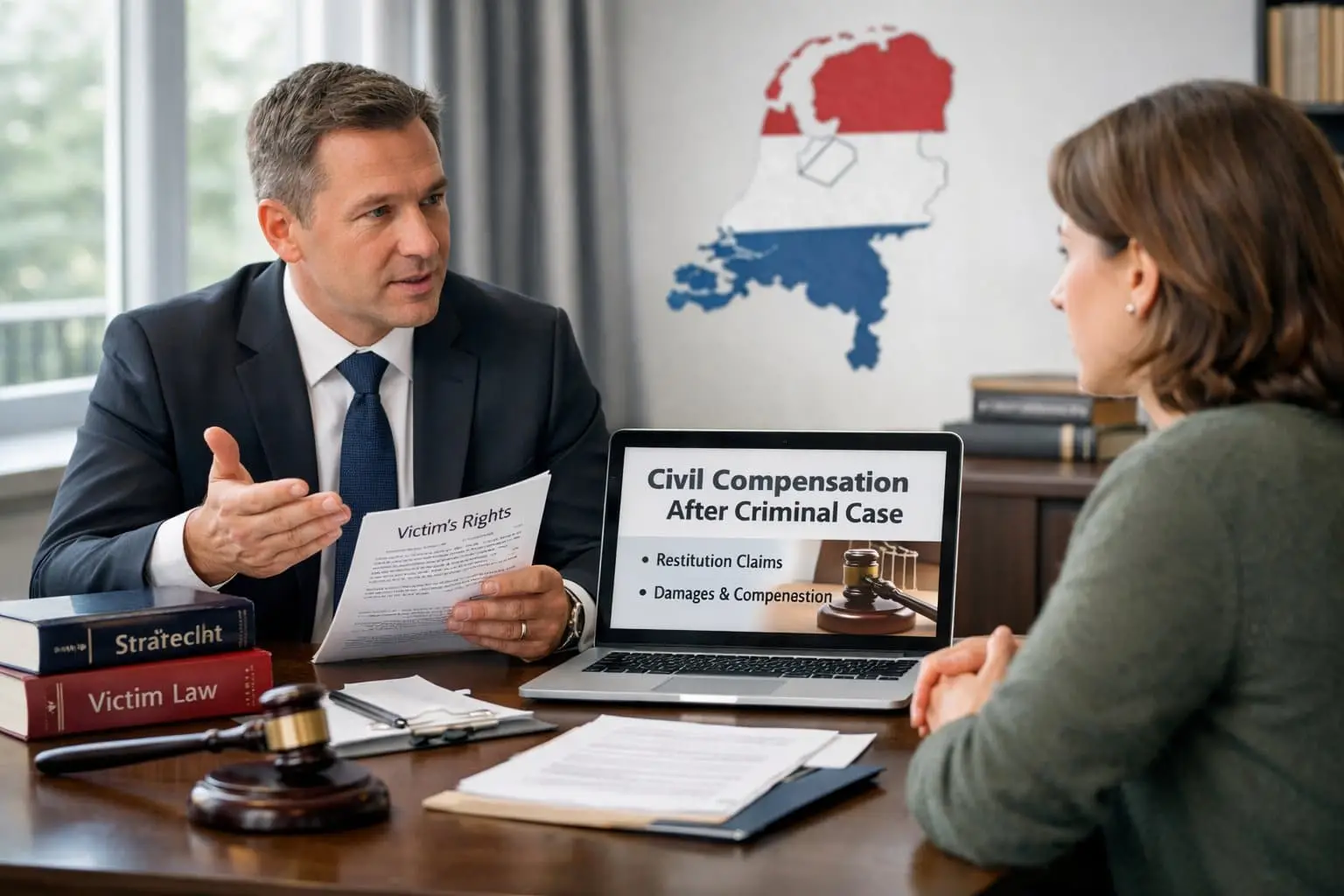
A lawyer consulting with a victim in a modern legal office with legal documents and a gavel on the table, with Dutch symbols in the background.

After a criminal case, you can still claim compensation from the offender under Dutch civil law, even if the criminal court did not award your claim or there was no prosecution at all. The main exception: if the criminal court has already decided your claim on the merits, you cannot bring the same claim again before the civil court.

Below you will find the routes to compensation, what you must prove, which time limits apply, and which protection and information rights you have as a victim.

A criminal case rarely gives a victim everything he or she is entitled to, and Dutch civil law provides the rest. The two routes are connected. Under Article 161 of the Dutch Code of Civil Procedure (Rv), a final criminal conviction is binding evidence in later civil proceedings that the convicted person committed the offence; the offender may still try to prove otherwise, but that is rarely successful. A conviction therefore does most of the evidential work in a later civil claim.

Three situations lead a victim to the civil court. First, the criminal court declared the claim inadmissible because dealing with it would place a disproportionate burden on the criminal case. That is a decision about the forum, not about the substance, so the claim remains intact. Second, the claim was only partly awarded and the rest remains. Third, there was no prosecution, for example because the offender was never identified or the public prosecutor decided not to prosecute. Liability for a wrongful act (onrechtmatige daad) under Article 6:162 of the Dutch Civil Code (BW) can then still be established, under the civil rules of evidence rather than the criminal ones.

What you can claim is broader than many victims expect: material loss, loss of income, reasonable costs of establishing the damage and liability (Article 6:96 of the Dutch Civil Code), non-material loss under Article 6:106 of the Dutch Civil Code and, for close relatives in the cases defined by law, compensation for grief (affectieschade). Statutory interest runs from the day the damage arose.

Time limits are the practical constraint. A claim for damages is in principle time-barred five years after the day on which the victim became aware of both the damage and the person liable (Article 3:310 of the Dutch Civil Code). A written notice to the offender can interrupt that period.

Law & More does not handle personal injury claims (letselschade). If your claim mainly concerns physical or psychological injury, we refer that part to a specialised personal injury lawyer; we can assist with the criminal case and with other civil claims.

What rights do victims have under Dutch civil law?

A lawyer discussing legal documents with a man and woman in a modern office, showing a serious and supportive consultation.

As a victim you can claim compensation from the offender, both within the criminal case and in separate civil proceedings. You also have rights to information, protection and support during the criminal proceedings.

In the Netherlands, victims of crime have rights that extend beyond criminal proceedings into civil law. Dutch civil law provides ways to claim compensation after the criminal case has ended. The rights of victims in the criminal process are laid down mainly in Articles 51a to 51h of the Dutch Code of Criminal Procedure (Sv), which implement European rules.

Who counts as a victim after a criminal case?

Under Article 51a of the Dutch Code of Criminal Procedure, a victim is a person who has suffered financial loss or other damage as a direct result of a criminal offence. For a victim who has died, close relatives can exercise certain rights.

The damage can consist of physical injury, psychological harm, damage to property or financial loss. Both natural persons and legal entities, such as companies, can be victims in this sense.

For some rights, relatives of a deceased victim are treated as victims, for example the spouse or registered partner, children, parents and brothers and sisters. The law sets out who may exercise those rights.

Your status as a victim does not end when the criminal case ends. You keep the right to claim compensation in civil proceedings, even if the criminal court has already given its judgment. A civil claim is also possible if the offender was not convicted, although you will then have to prove the facts yourself.

How do civil and criminal proceedings differ?

Criminal proceedings are about guilt and punishment and are led by the public prosecutor. Civil proceedings are about compensation, and you as claimant control them.

Criminal proceedings focus on investigating the offence, prosecuting the suspect and establishing guilt. The Public Prosecution Service (Openbaar Ministerie, OM) decides whether to prosecute, and the court decides on conviction and punishment.

Civil proceedings have a different purpose. You can start civil litigation to claim compensation from the offender. You decide whether and when to bring the claim, what you claim and whether to settle.

The rules of evidence also differ. In a criminal case the court must be convinced, on the basis of lawful evidence, that the suspect committed the offence (Article 338 of the Dutch Code of Criminal Procedure). In a civil case the party who relies on a fact must in principle prove it (Article 150 of the Dutch Code of Civil Procedure), and the court assesses the evidence freely. Common-law concepts such as ‘beyond reasonable doubt’ or ‘balance of probabilities’ are not part of Dutch law, but in practice the civil threshold is easier to meet.

There is no maximum amount for a claim in the criminal case. The limit that used to apply was abolished long ago. The choice between the routes therefore depends on the complexity of the claim, not on its size.

Which legislation and European rules apply?

The main rules are in the Dutch Civil Code, the Dutch Code of Civil Procedure and the Dutch Code of Criminal Procedure. European Directive 2012/29/EU on victims’ rights sets minimum standards.

Dutch civil law, also called private law, provides the framework for disputes between individuals and legal entities. The Dutch Code of Civil Procedure governs how you bring a claim against an offender.

The European Victims’ Rights Directive (2012/29/EU) requires in Article 16 that victims can obtain a decision on compensation by the offender within a reasonable time in the course of criminal proceedings, unless national law provides for such a decision in other proceedings. The Netherlands implemented the directive in the Code of Criminal Procedure. Earlier, the Act strengthening the position of victims in criminal proceedings took effect on 1 January 2011 and laid the basis for the current rules.

The directive also ensures that you receive information about your rights and about available support services. Dutch law further reflects international human rights standards on access to justice and effective remedies for victims.

Which routes to compensation do you have after a criminal case?

A lawyer and client discussing legal documents in a modern office with a map of the Netherlands on the wall.

You have three routes to claim damages: joining the criminal case as an injured party, a separate civil claim, or an application to the Violent Offences Compensation Fund. They can partly be combined, but you will not be compensated twice for the same loss.

Each route has its own requirements, costs and timelines. The table below gives an overview; the sections that follow explain each route.

RouteCostsMain advantageMain limitation
Joining the criminal caseNo court feesFast; the State collects the compensationOnly simple claims; complex parts are declared inadmissible
Civil proceedingsCourt fees and lawyer’s costsSuitable for complex and large claimsTakes longer; you enforce the judgment yourself
Violent Offences Compensation FundFreePayment even if the offender cannot pay or is unknownOnly violent and sexual offences with serious injury; fixed amounts

When should you bring a separate civil claim?

A separate civil claim is appropriate if your claim is complex, if the criminal court declared it inadmissible or if there was no prosecution. The court can then examine the damage in full.

You can start separate civil proceedings against the offender. This route suits claims with complicated calculations, for example future loss of income, or claims that require an expert report.

A criminal conviction is strong evidence of the wrongful act in your civil case. The civil court can then focus on the extent of the damage. It can obtain expert reports on the damage and determine fair compensation for material loss, such as damage to property, costs and loss of income, and for non-material loss.

Points to consider in civil proceedings:

  • you pay court fees (griffierecht), which depend on the amount of the claim and on whether you are a natural person or a company;
  • the procedure takes longer than joining the criminal case;
  • if the offender does not pay, you must have the judgment enforced by a bailiff;
  • the court examines your claim in full, including complex parts.

If you win, the court will usually order the offender to pay part of your legal costs according to fixed rates. Collecting the amount awarded remains your responsibility; you can instruct a bailiff for this.

How do you join the criminal case as an injured party?

Under Article 51f of the Dutch Code of Criminal Procedure you can join the criminal case as an injured party (benadeelde partij). You submit your claim with a form before the hearing or state it at the hearing itself.

The Public Prosecution Service sends the form to the court. At the hearing you or your lawyer can explain the claim, and the public prosecutor usually gives an opinion on it. The court decides on the claim together with the criminal charges.

Requirements for joining the criminal case:

  • the suspect is prosecuted for the offence that caused your damage, or the offence is taken into account in the judgment;
  • you suffered direct damage as a result of that offence;
  • the claim is simple enough to be dealt with in the criminal case; if it would place a disproportionate burden on the criminal proceedings, the court declares it (partly) inadmissible (Article 361 of the Dutch Code of Criminal Procedure);
  • the suspect is convicted or receives a measure for the offence.

This route has no court fees, which makes it accessible for most victims. If the court finds the offence proven and awards the claim, it can also impose a compensation order (schadevergoedingsmaatregel, Article 36f of the Dutch Criminal Code).

With a compensation order, the Central Judicial Collection Agency (CJIB) collects the payment for you, so you do not have to pursue the offender yourself. If the offender has not paid in full within eight months of the final judgment, the State advances the amount under the advance payment scheme (voorschotregeling): in full for victims of violent and sexual offences, and up to €5,000 for victims of other offences. The State then recovers the amount from the offender.

The court may declare complex parts of your claim inadmissible to avoid delaying the criminal case. You can then bring those parts before the civil court.

When can you apply to the Violent Offences Compensation Fund?

The Violent Offences Compensation Fund (Schadefonds Geweldsmisdrijven) pays a fixed amount to victims of violent and sexual offences with serious physical or psychological injury. It does not require that the offender was convicted or can pay.

The main conditions are:

  • you were the victim of an intentional violent or sexual offence, or you are a close relative of a victim who died;
  • you suffered serious physical or psychological injury as a result;
  • the offence took place in the Netherlands, or on board a Dutch ship or aircraft;
  • you apply in time; the application must generally be made within ten years of the offence;
  • you did not contribute substantially to the offence yourself.

You must make the offence plausible, for example with a police report, a judgment, witness statements or medical information. It is not always required that there has been a court case. The fund assesses the seriousness of the injury using an injury list (letsellijst) with categories of severe damage and pays a fixed amount per category.

The payment from the fund is often lower than what a court might award against the offender. You may apply to the fund and also claim from the offender, but you will not be compensated twice for the same loss: an amount you receive from the offender is taken into account, and the fund can recover what it paid from the offender. Victim Support Netherlands can help you with the application.

Which legal representation and support can victims get?

You can be assisted by a lawyer, and depending on the offence and your income, legal aid may be available. Victim Support Netherlands offers free practical and legal help.

After a criminal case, victims have access to different forms of legal representation and support. These help you through civil proceedings, secure compensation and make sure your voice is heard.

What do lawyers and legal aid offer?

A lawyer can file your claim, represent you in court and explain the procedures. For victims of serious violent and sexual offences, legal aid is available regardless of income.

You can work with specialised lawyers who focus on victims’ rights in civil proceedings after criminal cases. They help you file compensation claims, represent you in court and guide you through the procedures.

The Legal Aid Board (Raad voor Rechtsbijstand) subsidises legal assistance. In general, whether you qualify and what contribution you pay depends on your income and assets. Victims of serious violent and sexual offences receive free legal aid regardless of their income.

If you qualify, you receive free or subsidised legal assistance. Your lawyer can help you with all three routes: joining the criminal case, applying to the fund or starting separate civil proceedings.

A victim’s lawyer does more than handle the paperwork. The lawyer explains your rights, prepares you for the hearing and helps you with your victim impact statement. The lawyer can also coordinate with other support services, so that both your legal and personal needs receive attention.

What does Victim Support Netherlands do?

Victim Support Netherlands (Slachtofferhulp Nederland) offers free practical, emotional and legal help to victims of crime, traffic accidents and disasters. You can use its services even if you did not report the offence to the police.

Its services include emotional support, information about your rights and guidance through the criminal proceedings. Its legal staff can help you prepare a claim as an injured party.

For complex cases, the organisation advises you to engage a lawyer. You can contact it by telephone or online. Its help is confidential.

How can you have your say in the proceedings?

In the criminal case you can give a victim impact statement, and in civil proceedings you describe your damage yourself. The court takes this into account when assessing compensation.

In the criminal case, victims of certain serious offences, and in some cases their relatives, have the right to speak at the hearing (spreekrecht, Article 51e of the Dutch Code of Criminal Procedure). You can describe how the offence affected you financially, physically and emotionally.

In civil proceedings you are a party yourself. Through your lawyer, and at the hearing, you set out your damage and respond to the offender’s defence. The court must take your submissions into account when it determines the compensation.

If you fear intimidation or harm, you can ask for protection measures. Examples in criminal cases are giving evidence without the suspect being present, a separate waiting room at the court and shielding your address details. The authorities must keep you informed about the progress of the case and about decisions that affect your interests.

How do civil proceedings after a criminal case work?

You issue a summons against the offender at the competent court and prove your damage. A criminal conviction makes the question of liability much easier.

After a criminal case, you can start civil proceedings against the offender to claim damages that were not, or not fully, dealt with in the criminal case. Civil proceedings give you more control over your case and have no restrictions on the complexity of the claim, but they involve court fees and usually take longer.

How do you start a civil claim against the offender?

You start the case with a summons, usually on the basis of a wrongful act under Article 6:162 of the Dutch Civil Code. A criminal offence against you will in almost all cases qualify as a wrongful act.

A criminal offence generally gives you legal grounds for a civil claim. Claims up to €25,000 are dealt with by the subdistrict court (kantonrechter), where you do not need a lawyer; larger claims go to the civil section of the district court, where representation by a lawyer is mandatory (Article 93 of the Dutch Code of Civil Procedure).

You usually bring the claim before the court for the place where the offender lives (Article 99 of the Dutch Code of Civil Procedure) or where the harmful event took place (Article 102). Both natural persons and companies can be held liable, and in some cases others can be liable too, such as the parents of a young offender or an employer.

Your claim must specify the damage you seek. You can claim property damage, costs, loss of income and non-material loss. You pay court fees when the case starts; the amount depends on the size of the claim and on whether you are a natural person or a legal entity. The current rates are published on the website of the Dutch judiciary (rechtspraak.nl).

What must you prove in a civil case?

You must prove the wrongful act, the damage and the causal link between the two. A final criminal conviction counts as binding evidence of the offence.

In civil proceedings you bear the burden of proof for the facts you rely on (Article 150 of the Dutch Code of Civil Procedure). A final criminal conviction considerably strengthens your position, because under Article 161 of the Dutch Code of Civil Procedure it is binding evidence of the facts on which it is based, subject to evidence to the contrary.

You must show:

  • that the offender committed the wrongful act;
  • that you suffered damage;
  • that there is a causal link between the act and the damage;
  • that the amount you claim is justified.

You can use witnesses, medical information, police reports, photographs, receipts and expert reports. If the offender was acquitted or not prosecuted, you can still bring a civil claim, but you then have to prove the wrongful act yourself.

The standard of proof differs from the criminal case. In a criminal case the court must be convinced on the basis of lawful evidence; in a civil case the court assesses the evidence freely. In practice this means that a civil claim can succeed even after an acquittal.

What does a civil case cost, and how long does it take?

You pay court fees and usually a lawyer. If you win, the offender pays part of your legal costs according to fixed rates, rarely all of them.

Civil proceedings involve several costs. Court fees depend on the amount of the claim, and before the district court you need a lawyer, which adds to your costs.

If the offender does not pay voluntarily after the judgment, you will have extra costs for a bailiff to enforce it. The losing party is usually ordered to pay the legal costs of the other side, but according to fixed rates (liquidatietarief), which rarely cover your actual costs.

Civil proceedings take considerably longer than joining the criminal case. A simple case often takes a year or more from summons to judgment; cases with several parties, extensive evidence or expert reports can take longer.

In cases with injuries, the court often orders an expert report on the seriousness of the injury, treatment costs and long-term consequences. That helps to reach fair compensation, but requires patience. For personal injury claims, we refer you to a specialised personal injury lawyer.

Which protection measures and safeguards do victims have?

You can be protected by a temporary restraining order from the mayor, a contact or area ban from the civil or criminal court, and measures that prevent further harm during the proceedings.

Dutch law offers several protection measures for victims in and after criminal cases, including restraining orders and safeguards against secondary victimisation. These protections are particularly important for victims of domestic violence and sexual offences, and for relatives of victims who died.

Which restraining orders and protective measures are available?

There are three main instruments: the temporary restraining order imposed by the mayor, a civil injunction and conditions or measures in the criminal case.

  • Temporary restraining order (tijdelijk huisverbod): under the Temporary Restraining Order Act (Wet tijdelijk huisverbod), the mayor can order a person who poses a threat to people in the same house to leave the home for ten days and not to contact them. The order can be extended to a maximum of four weeks.
  • Civil injunction: in summary proceedings (kort geding) you can ask the civil court to prohibit the offender from contacting you or from coming near your home or work, on pain of a penalty payment (dwangsom). The court sets the scope of the ban, for example a distance or a specific area.
  • Criminal measures: the public prosecutor can issue a behavioural order (gedragsaanwijzing, Article 509hh of the Dutch Code of Criminal Procedure), such as a contact or area ban, and the criminal court can impose such bans as a condition or as a measure (Article 38v of the Dutch Criminal Code).

A civil injunction in summary proceedings can be obtained quickly if there is an urgent interest. Collect evidence: police reports, medical information, photographs of injuries and witness statements strengthen your position. The municipality, Veilig Thuis and Victim Support Netherlands can help you.

How is secondary victimisation prevented?

Secondary victimisation is further harm caused by contact with the authorities, the proceedings or publicity. The law contains safeguards, such as limiting the number of interviews and protecting your personal details.

The European Victims’ Rights Directive requires that the number of interviews is kept to a minimum and that victims can be accompanied by a person of their choice. You can ask to be accompanied by a lawyer or a confidential adviser during interviews.

At court, you can ask for a separate waiting room so that you do not meet the suspect. Your address details can be shielded in the criminal file in many cases; ask the police or the public prosecutor about this in good time.

If you feel that you have been treated badly by the police, the Public Prosecution Service or the court, you can file a complaint with that organisation. Victim Support Netherlands can guide you through this.

What applies in sensitive cases, such as domestic violence, sexual offences or homicide?

For victims of violent and sexual offences there are extra protections and specialised support. For domestic violence you can call Veilig Thuis on 0800-2000, day and night.

Veilig Thuis is the advice and reporting centre for domestic violence and child abuse. It provides confidential support and can refer you to local services, such as women’s shelters (vrouwenopvang). After sexual violence, the Centres for Sexual Violence (Centrum Seksueel Geweld) offer medical, forensic and psychological help in one place, which limits the number of examinations and interviews.

Victims of sexual violence can ask to be interviewed by a person of the same sex where possible. Hearings in cases involving sexual offences can be held behind closed doors if the court so decides, and hearings in cases against minors are in principle not public.

In homicide cases, the relatives have specific rights to information about the investigation and the trial, and they can use the right to speak at the hearing. They can also attend the hearing even if they are not called as a witness.

Violent and sexual offences are serious crimes under the Dutch Criminal Code, with penalties ranging from fines to long prison sentences depending on the offence. The court can also impose conditions, such as treatment or probation supervision, or community service.

Which rights to information and participation do you have?

You have the right to information about the investigation, the prosecution and the judgment, and you can inspect relevant documents. That information can also be used in a later civil claim.

Dutch law gives victims specific rights to information and participation. These rights apply mainly in the criminal case, but they also help you prepare a civil claim.

What information can you obtain?

The police and the Public Prosecution Service must inform you about the progress of the case. As a victim you can ask to inspect documents in the file that are relevant to you (Article 51b of the Dutch Code of Criminal Procedure).

You have the right to information about the outcome of the investigation, prosecution decisions and the final judgment. The authorities must also inform you about your rights at each stage.

If you want to use documents from the criminal file for a civil claim, you can ask the Public Prosecution Service to provide them. The public prosecutor assesses the request and may withhold certain documents, for example to protect the investigation or the privacy of others.

Police reports, forensic reports and witness statements can be very useful for your civil claim. In civil proceedings you can submit such documents as evidence; the civil court assesses their value. You make the request through the proper channels, preferably with the help of your lawyer.

How do you challenge a decision not to prosecute or a judgment?

If the public prosecutor decides not to prosecute, you can file a complaint with the court of appeal under Article 12 of the Dutch Code of Criminal Procedure. You cannot appeal against the criminal judgment yourself.

In an Article 12 procedure the court of appeal reviews the decision not to prosecute. If it finds the complaint well-founded, it can order the prosecution. You must file the complaint within three months of the day you learned of the decision.

If you disagree with decisions in the criminal case, keep in mind that only the Public Prosecution Service and the suspect can appeal against the judgment itself. You can ask the public prosecutor to consider an appeal. As an injured party, you have more limited options to appeal against the decision on your claim; strict time limits apply, so seek advice quickly.

If the criminal court acquits the suspect or imposes a light sentence, you can still bring a civil claim. The outcome of the criminal case does not automatically determine civil liability, because the civil court applies its own rules of evidence.

How do you use your victim impact statement in a civil claim?

Your statement in the criminal case can help document the harm you suffered. In the civil case you support it with further evidence, such as medical reports and financial documents.

A victim impact statement describes the physical, emotional and financial consequences of the offence. The civil court can take it into account as part of the evidence, but it does not replace proof of the extent of the damage.

Document all consequences carefully: medical expenses, loss of income and ongoing treatment costs. The more specific your evidence, the stronger your claim.

In civil proceedings you can submit evidence beyond what was used in the criminal case, such as updated medical reports, expert reports and new financial documents. The civil court assesses this evidence according to the rules of civil law.

In summary

  • After a criminal case, you can claim compensation from the offender in civil proceedings, even after an acquittal or if there was no prosecution.
  • A final criminal conviction is binding evidence of the offence in civil proceedings (Article 161 of the Dutch Code of Civil Procedure).
  • Joining the criminal case is free and fast; the CJIB collects and, after eight months, the State advances the compensation in full for violent and sexual offences and up to €5,000 for other offences.
  • The Violent Offences Compensation Fund pays fixed amounts for serious injury after violent or sexual offences; apply in principle within ten years.
  • A civil claim is in principle time-barred five years after you learned of the damage and the person liable (Article 3:310 of the Dutch Civil Code).

Frequently asked questions

What forms of compensation are available to victims in Dutch civil law following a criminal case?

You can claim material and non-material damage. Material damage covers financial loss, such as medical costs, loss of income, damage to property and other costs caused directly by the offence, including reasonable costs of establishing the damage and liability (Article 6:96 of the Dutch Civil Code). Non-material damage covers harm that is not financial, such as pain, suffering and loss of quality of life; under Article 6:106 of the Dutch Civil Code you are entitled to it in the cases the law describes, for example physical injury or harm to your person in another way. The court determines the amount based on the nature and seriousness of the harm and on comparable cases. You can also claim future loss if the offence has long-term consequences. For personal injury claims, we refer you to a specialised personal injury lawyer.

How does one initiate a civil lawsuit for damages after the conclusion of a criminal trial in the Netherlands?

You have two main options. You can join the criminal case as an injured party under Article 51f of the Dutch Code of Criminal Procedure and submit your claim in that case, or you can start separate civil proceedings. The civil route is necessary if the criminal court declared your claim (partly) inadmissible, if you did not join the criminal case or if there was no prosecution. You start with a summons at the subdistrict court (claims up to €25,000) or the district court. Collect evidence of your damage, such as receipts, medical information and the criminal judgment. A lawyer can prepare the documents and represent you.

What rights do victims have regarding information and support through the Dutch legal process?

Under Articles 51a to 51h of the Dutch Code of Criminal Procedure, you have the right to information from the police and the Public Prosecution Service about your case, for example whether the suspect is prosecuted, when the hearing takes place and what the outcome is. You have the right to be treated correctly, to be assisted by a lawyer, to have an interpreter if needed and to inspect documents in the file that are relevant to you. Victims of certain serious offences may address the court at the hearing. You can ask for translations of important documents. Victim Support Netherlands provides free help and can refer you to psychological support and legal aid.

What is the statute of limitations for filing a civil claim in relation to a criminal case in the Netherlands?

Under Article 3:310 of the Dutch Civil Code, a claim for damages is time-barred five years after the day on which you became aware of both the damage and the person liable, and in any case twenty years after the event that caused the damage. For personal injury and death, the twenty-year limit does not apply in the same way. If the damage was caused by a criminal offence, the civil claim does not become time-barred as long as the right to prosecute that offence has not lapsed. You can interrupt the limitation period with a written notice in which you clearly reserve your right to compensation. There is no special short deadline for bringing a civil claim after the criminal court declared your claim inadmissible, but do not wait too long: have your lawyer check the limitation period in your case.

How are psychological and emotional harms addressed in civil claims for victims within the Dutch legal system?

Psychological harm can be compensated as non-material damage under Article 6:106 of the Dutch Civil Code. You must in principle show that you suffered psychological injury, usually with medical information from a psychologist or psychiatrist. If the nature and seriousness of the offence make the harm obvious, the court may assume the harm without such evidence. The court considers the intensity and duration of the suffering and the impact on your daily life. Costs of psychological treatment can be claimed as material damage, provided they are reasonable. Because this is a personal injury matter, we refer you to a specialised personal injury lawyer for the claim itself.

In what ways can a victim’s privacy be protected during civil proceedings that follow a criminal case?

Civil hearings are in principle public, but the court can order a hearing behind closed doors, for example to protect privacy (Article 27 of the Dutch Code of Civil Procedure). Published judgments are anonymised, so your name and address do not appear in them. If you fear for your safety, your lawyer can ask the court for additional measures, for example to keep your address out of the documents where the rules allow this. In cases involving sexual offences or domestic violence, courts take privacy into account more readily. Your lawyer can make these requests when the case starts.

Law & More assists victims in criminal cases and with civil claims against offenders; for personal injury claims we refer you to a specialist. Unsure where you stand? Tell us about your situation. We will let you know your options within one working day.

How Law & More can help you with this is explained on our criminal lawyer page.

Jade Vaneerdewegh
Jade Vaneerdewegh is an attorney-at-law at Law & More in Eindhoven and Amsterdam. She works on criminal and administrative law matters, building her advice on thorough analysis of the facts and the legislation.

Need Legal Assistance?

Have you received a letter, a writ of summons or a judgment? Send us the documents. We will check which deadlines apply and what your options are.

This article provides general information and is not a substitute for advice on your specific situation.

Related articles

Serious bodily injury, in Dutch criminal law zwaar lichamelijk letsel, is the legal qualification that

As a suspect in the Netherlands you are never obliged to answer police questions about

Speeding in the Netherlands is dealt with in one of two ways. Most offences are

Dutch criminal procedure runs in fixed stages: investigation, the prosecutor’s decision, the trial and, if

A decision not to prosecute, known in Dutch as a sepot, means the Openbaar Ministerie

Under Dutch and European law an algorithm cannot be criminally responsible. Criminal liability requires a

Stay Updated on Dutch Law

Subscribe to our newsletter for the latest legal insights, regulatory updates, and practical advice.