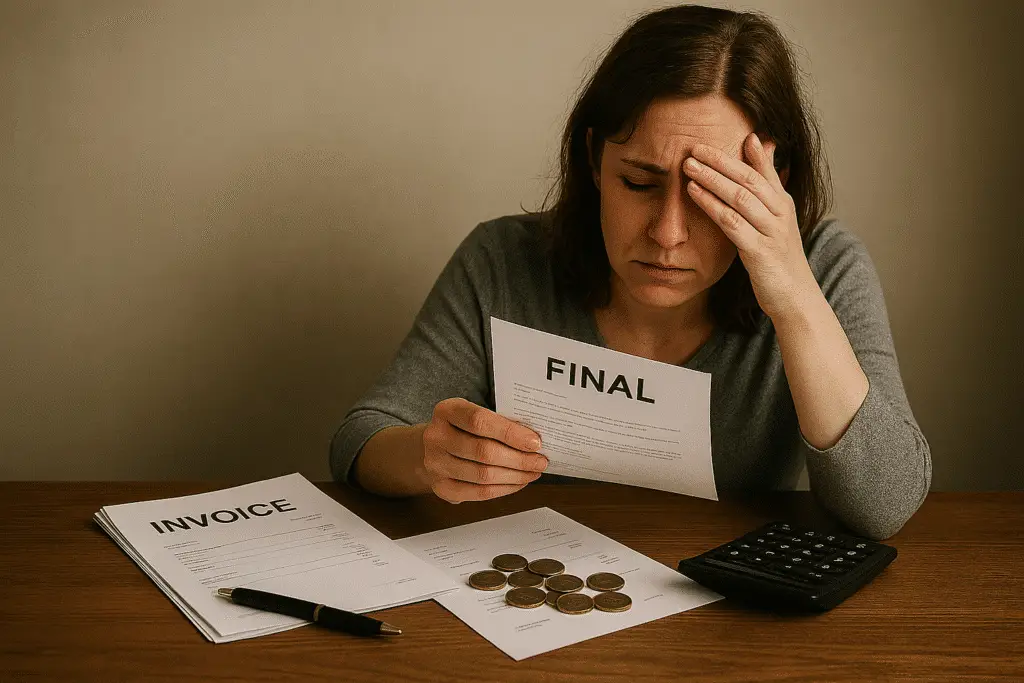
Your partner’s debts from before your relationship stay your partner’s debts under Dutch law. You only become liable if you sign for them, guarantee them or refinance them in both names, or, if you are married or registered partners, for ordinary household debts under Article 1:85 of the Dutch Civil Code (BW). What does change when you live together is what a creditor can reach in practice: a joint account, goods in your shared home and, after marriage, assets of the community of property.
Table of contents
Can your partner’s old debt become yours?
It depends on your relationship form. Unmarried cohabitants have no statutory liability for each other’s debts; you are only liable for contracts you signed yourself, such as a joint lease, a co-signed loan, a guarantee or a joint mortgage.
Spouses and registered partners are jointly and severally liable for debts the other enters into for the ordinary running of the household, such as groceries and the energy bill (Article 1:85 BW). Business debts and debts outside the ordinary household do not bind the other partner. On request and for good reasons, the court can exclude this liability for future debts (Article 1:86 BW).
Since 1 January 2018 a marriage or registered partnership without prenuptial conditions creates a limited community of property (Article 1:94 BW). Debts your partner had before the marriage stay private debts. A creditor may still recover a private debt from community assets (Article 1:96(1) BW), but you can point to your partner’s own assets that offer enough recourse, and recovery from the community is limited to half the proceeds (Article 1:96(2) and (3) BW). See our article on property within and after marriage.
Article 1:88 BW protects you the other way. A spouse or registered partner needs your written consent to give a guarantee outside the normal course of business or to sell or mortgage the family home. Without that consent, you can annul the act.
When is an old debt time-barred?
Most claims to perform a contract are time-barred five years after the day following the day they became due (Article 3:307 BW). The same five-year period applies to rent, interest and other amounts payable annually or more often (Article 3:308 BW).
A damages claim is time-barred five years after you became aware of both the damage and the person liable, and in any event twenty years after the event (Article 3:310 BW). Under Article 7:28 BW the claim for the purchase price in a consumer sale is time-barred after only two years, which covers many webshop and retail debts.
If a court has already ruled, the creditor can enforce the judgment for twenty years, with five years for periodic amounts such as interest (Article 3:324 BW). Tax debts, benefit recoveries and administrative fines follow public-law rules, and the Belastingdienst can enforce without going to court.
What resets the limitation period?
Under Article 3:317 BW a written reminder or a written notice in which the creditor unambiguously reserves its right to performance interrupts limitation. Legal action and acknowledgement of the debt by you (Article 3:318 BW) also interrupt it, and a new period then starts (Article 3:319 BW).
Acknowledgement does not require a formal document. A part payment, a payment plan, an email asking for more time or a wage deduction accepted without protest can all count. So verify before you respond: ask for the contract, the invoices, proof of any assignment of the claim and dated evidence of earlier interruptions, and do not make a goodwill payment on an unverified claim.
The creditor must prove the interruption. Where a file has passed through several collection agencies, that evidence is often incomplete.
Does a time-barred debt simply disappear?
No. Under Article 3:322 BW the court may not apply limitation of its own motion; you must invoke it. If you ignore a summons, the court can still give judgment on an expired claim, and the creditor then has twenty years to enforce.
A time-barred debt becomes a natural obligation (natuurlijke verbintenis): it can no longer be enforced, but a payment you make anyway counts as performance of that obligation and cannot be reclaimed (Articles 6:3 and 6:4 BW). A collector may still ask you to pay, but may not threaten enforcement it cannot lawfully carry out.
What may a collection agency charge?
For a consumer, collection costs are only owed after a correct fourteen-day letter (Article 6:96(6) BW). That letter must give you fourteen days from the day after it was received and state the costs that will be added if you do not pay.
The amount follows the Decree on extrajudicial collection costs (Besluit vergoeding voor buitengerechtelijke incassokosten): 15% of the first €2,500 of the principal, with lower percentages above that, a minimum of €40 and a maximum of €6,775. Only one set of collection costs can be charged for the same debt, however many agencies handled it. Ask in writing for a statement that separates principal, interest and costs.
What happens when a bailiff comes?
A court bailiff (gerechtsdeurwaarder) can only enforce with an enforceable title, usually a judgment served on the debtor, or a writ from a public body such as the Belastingdienst. First ask for the title and proof of service.
The most common measure is an attachment with the employer, benefits agency or bank. For income, the debtor keeps a protected amount (beslagvrije voet) under Article 475d of the Dutch Code of Civil Procedure (Rv), calculated from official income data. The bailiff can also attach movable goods in the home.
This is where a new partner is affected. The bailiff may attach goods found in the debtor’s home, and you must prove which goods are yours. Keep invoices, bank transfers and a dated inventory signed by both of you; you can raise a dispute about the attachment before the court under Article 438 Rv.
If the door is not opened, Article 444 Rv allows the bailiff to enter only in the presence of the mayor or a police officer acting for the mayor. Enforcement can be suspended in summary proceedings if the title is defective, the wrong person is pursued or enforcement would be an abuse of right. These cases are urgent, so act the same day.
How do you protect yourself when you move in together?
Take the measures before there is pressure. Record who owns what in a dated inventory signed by both of you, and keep the invoices and bank statements that show who paid.
Keep separate accounts for separate income. A creditor of one partner can attach the whole balance of a joint account, and the other partner must then prove what was theirs. Put contracts such as the lease or energy contract in the name of the partner without arrears, and never co-sign, guarantee or refinance an old debt into a joint loan; refinancing is the most common way one partner’s debt becomes a debt of both.
A cohabitation agreement (samenlevingscontract) drawn up by a notary records separate ownership, how costs are shared and what happens with the home if you separate. Prenuptial or partnership conditions do the same for spouses and registered partners. Transferring assets to your partner for nothing while a creditor is waiting can be annulled under Article 3:45 BW (actio pauliana); see our article on asset protection in the Netherlands, our note on the family business and our checklist to sign a contract and avoid hidden legal issues.
How does credit registration affect joint borrowing?
Dutch lenders report loans, credit cards and arrears to the Credit Registration Office (Stichting BKR), and for a joint mortgage the lender checks both applicants. Each partner can request their own BKR overview and dispute an incorrect entry with the lender that reported it.
A correct registration can sometimes be removed. Because it is processing of personal data, a request for erasure is assessed under the General Data Protection Regulation (GDPR), weighing the interest of preventing over-indebtedness against your interests, such as whether the arrears have been paid and the concrete harm the registration causes now. Such a claim can also be brought in summary proceedings, which helps when a mortgage offer has a deadline.
What if the debt comes from abroad?
Two questions arise: is the claim still valid under the law that governs it, and can it be enforced here? A judgment from another EU member state is enforceable in the Netherlands without a separate procedure, with a certificate from the court of origin.
Outside the EU, without a treaty, the creditor must start new proceedings in the Netherlands under Article 431 Rv. Within the EU, a consumer can in principle only be sued in the member state where he lives, so check a foreign summons rather than ignore it. An acknowledgement given abroad can also restart the limitation period.
What if the debts cannot be paid?
The route out is debt assistance, not concealment. The municipality must offer debt assistance and can try to reach an amicable settlement with the creditors.
If that fails, the court can admit the debtor to the statutory debt restructuring scheme for natural persons (Wsnp). Under Article 349a of the Bankruptcy Act the scheme normally lasts eighteen months and ends with a clean slate if the debtor complies. Under Article 288 of that Act the debtor must have acted in good faith regarding the debts in the three years before the request, so moving assets to a partner can close this exit. The scheme concerns the debtor’s income and debts, not yours, as long as your finances are kept separate.
What should you check as the partner without debts?
- Are you being asked to sign, guarantee or refinance any debt of your partner?
- Can you prove ownership of your goods with invoices and a signed inventory?
- Is your income paid into an account in your own name only?
- If you marry, have you considered prenuptial conditions and recorded what each of you brings in?
- Is the lease, energy contract or phone contract in your name only, or in both names?
What should you check as the partner with debts?
- Is each claim still enforceable, or is it time-barred under Articles 3:307, 3:308 or 7:28 BW?
- Can the collector prove an interruption of limitation?
- Were collection costs charged only after a correct fourteen-day letter?
- Is there already a judgment, and has it been served on you?
- Is municipal debt assistance or the Wsnp an option, and do you meet the good-faith test?
What can we do for you with old debts in a new relationship?
As family lawyer we advise individuals and couples, and we also act for creditors, so we know how the other side builds its file.
- We check whether an old claim is time-barred and whether an alleged interruption holds.
- We check the collection costs and the fourteen-day letter.
- We respond to the collector or bailiff on your behalf, without acknowledging the debt.
- We start summary proceedings against an attachment of your goods or income.
- We draft or review a cohabitation agreement or prenuptial conditions.
- We assess a request to remove a BKR registration.
Summary
- Your partner’s old debts stay your partner’s, unless you sign, guarantee or refinance them.
- Spouses and registered partners are jointly liable for ordinary household debts (Article 1:85 BW).
- Most debts are time-barred after five years, consumer purchase prices after two (Article 7:28 BW), but any acknowledgement restarts the period.
- The court does not apply limitation by itself: you must invoke it (Article 3:322 BW).
- Separate accounts, a signed inventory and a cohabitation agreement protect the partner without debts.
Frequently asked questions
Am I liable for my partner’s debts if we only live together?
No. Unmarried cohabitants have no statutory liability for each other’s debts. You are only liable for contracts you signed yourself, such as a joint lease, a co-signed loan or a guarantee.
Does a payment plan restart the limitation period?
Yes. Agreeing to a payment plan or making a part payment usually counts as acknowledgement of the debt (Article 3:318 BW), and a new limitation period starts. Check whether the claim is still enforceable before you agree to anything.
Can the bailiff take my belongings for my partner’s debt?
The bailiff may attach goods found in the debtor’s home. You must then prove that they are yours, for example with invoices and bank statements. You can bring the dispute before the court under Article 438 Rv.
Can I get my money back if I paid a time-barred debt?
No. A time-barred debt becomes a natural obligation. A payment on it counts as performance of that obligation (Articles 6:3 and 6:4 BW), so it cannot be reclaimed as undue. Check the limitation position before paying.