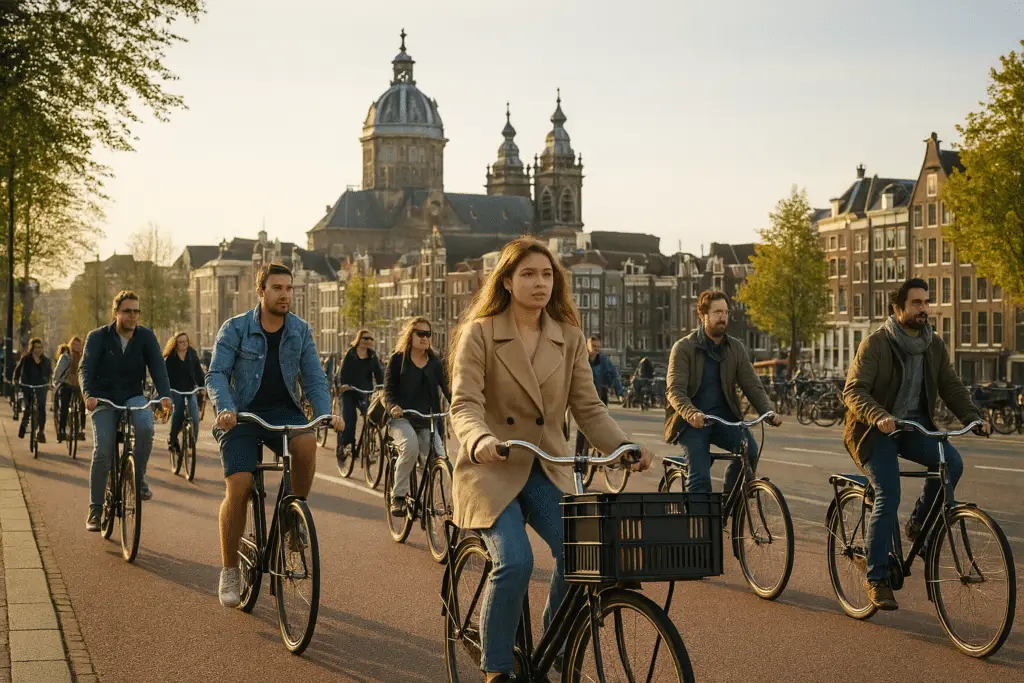
Moving to the Netherlands legally comes down to three steps: the right residence status, registration with your municipality, and Dutch health insurance. If you are an EU, EEA or Swiss citizen, you need no permit at all; if you are not, you generally need a residence permit for any stay longer than 90 days, and often an entry visa before you travel.
The order matters, because each step unlocks the next. Without registration you get no citizen service number (BSN), and without a BSN it is hard to open a bank account, receive a salary or claim allowances.
Table of contents
Do you need a visa or residence permit?
That depends on your nationality and on how long you intend to stay. For a stay of up to 90 days in any 180-day period, the Schengen rules apply; for a longer stay, non-EU nationals need a Dutch residence permit issued by the Immigration and Naturalisation Service (IND).
The Netherlands is part of the Schengen area. Nationals of some countries can visit visa-free for short stays, while others need a short-stay Schengen visa. A short-stay visa or visa-free entry does not allow you to work or to settle.
EU, EEA and Swiss citizens
If you have the nationality of an EU or EEA country or Switzerland, you may live and work in the Netherlands without a residence permit or work permit. This follows from the free movement rules of EU law.
You must, however, register with the municipality (gemeente) where you live if you stay longer than four months within a six-month period. You may ask the IND for a document confirming your right of residence, but this is voluntary. Your family members who are not EU citizens usually do need a residence document.
Non-EU citizens
If you come from outside the EU, you need a residence permit that matches the purpose of your stay: for example work as a highly skilled migrant, an EU Blue Card, study, self-employment or living with a partner or family member. Each purpose has its own conditions, including income requirements that the IND adjusts regularly.
Many nationals also need a provisional residence permit (machtiging tot voorlopig verblijf, MVV) to enter the Netherlands for a long stay. Nationals of a number of countries, including the United States, Canada, Australia, Japan and the United Kingdom, are exempt from this requirement. You can check whether you need an MVV on the IND website.
For work, your employer is often the one who applies for you. If your employer is a recognised sponsor (erkend referent), the IND usually decides faster, and the employer handles most of the paperwork. For a highly skilled migrant permit, your employer must be a recognised sponsor.
American and Japanese entrepreneurs
If you have American nationality, you can start a business in the Netherlands under the Dutch-American Friendship Treaty (DAFT). The IND requires, for most legal forms, a minimum investment of 4,500 euros in your business, which must remain in the business. Japanese nationals can use a comparable scheme.
Other self-employed people from outside the EU must show that their business serves an essential Dutch interest. The IND assesses this with a points system that looks at your personal experience, your business plan and the added value for the Netherlands.
What if the IND decides late?
The IND generally has 90 days to decide on a residence permit application, and it may extend this period. If the IND misses the deadline, you can send a written notice of default (ingebrekestelling) and then appeal to the court against the failure to decide.
Since 15 April 2025, the IND no longer owes you a penalty payment (dwangsom) for deciding late in immigration cases. An appeal against a late decision can still force a decision, because the court can order the IND to decide within a set period. See the IND website for the current conditions per permit.
Which documents should you prepare before you move?
Bring the original civil status documents you will need to register: at least your birth certificate and, if applicable, your marriage or registered partnership certificate. Documents from outside the EU usually need to be legalised or provided with an apostille, and translated by a sworn translator if they are not in Dutch, English, German or French.
Which formalities apply depends on the country that issued the document. Under an EU regulation, many public documents issued in another EU country no longer need an apostille, and a multilingual standard form can often replace a translation. The municipality decides whether it accepts a foreign document, so check its requirements before you travel.
Collect the documents that support your permit as well, such as your employment contract, diplomas or proof of income. If you have ongoing medical treatment, bring your medical records and prescriptions, so that a Dutch GP (huisarts) can continue your care.
How do you register with the municipality?
You must register in the Personal Records Database (Basisregistratie Personen, BRP) within five days of your arrival if you expect to stay at least four months within a six-month period. You do this in person at the municipality where you live, by appointment.
You need a valid passport or identity card, proof of your address such as a rental contract or written consent from the main occupant, and your civil status documents. Non-EU nationals may be asked for their residence document or the IND letter confirming their application. Some cities, including Amsterdam, Eindhoven, Rotterdam and The Hague, have an expat centre where you can combine your municipal registration with collecting your residence permit.
After registration you receive your BSN. You need this number for your employer, your bank, your health insurer, your doctor and the Tax and Customs Administration (Belastingdienst). With your BSN you can also apply for DigiD, the digital identity you use to log in to government services.
If you work in the Netherlands but stay for less than four months, you can register as a non-resident in the Register of Non-Residents (Registratie Niet-Ingezetenen, RNI) at one of the designated municipalities. This also gives you a BSN.
Opening a bank account
Most Dutch banks require your BSN, a valid identity document and proof of address before they open a full current account. Under anti-money laundering rules, banks must also check who you are and where your money comes from, so they may ask about your source of funds or your employment.
Some banks let you open an account before you have a BSN and add the number later. Your employer may pay your salary into a foreign account, but for rent, direct debits and allowances a Dutch or SEPA account is usually more practical.
When must you take out Dutch health insurance?
If you live or work in the Netherlands, you are in principle insured under the Long-Term Care Act (Wlz) and must take out Dutch basic health insurance (basisverzekering) under the Health Insurance Act (Zorgverzekeringswet). You have four months from the moment the obligation starts to do so, and the insurance then covers you retroactively from that date.
The obligation usually starts when you begin working or register as a resident. If you take out the insurance late, you pay the premiums retroactively and you may receive a fine from the Central Administration Office (CAK), which supervises the obligation. There are exceptions, for example for some international students who do not work and for employees who remain insured in their home country under EU social security rules or a treaty.
The basic package is set by law and is the same at every insurer. Insurers compete on premium, service and supplementary cover, such as dental care or physiotherapy. You also pay a compulsory excess (eigen risico) each year for most care, although GP visits are exempt.
With a lower income, you may be entitled to a healthcare allowance (zorgtoeslag). You apply for this with the Benefits Office (Dienst Toeslagen) of the Tax and Customs Administration, using your DigiD. The government’s page on health insurance explains who must take out insurance and when.
What should you know about renting a home?
Housing is scarce in the larger cities, but Dutch rental law protects you strongly. Residential tenancy is governed by Title 7.4 of the Dutch Civil Code (BW), and several common practices in the private market are not allowed.
Since 1 July 2023, the Good Landlordship Act (Wet goed verhuurderschap) limits the deposit to twice the basic monthly rent, and requires the landlord to give you written information about, among other things, the deposit, service costs and a contact person. A letting agent who works for the landlord may not also charge you agency fees.
Since 1 July 2024, a landlord may in principle only offer a permanent rental contract for independent housing. Temporary contracts are still allowed for specific groups, such as students and young people in housing designated for them. A permanent contract can only be terminated by the landlord on limited statutory grounds.
Many homes fall under rent regulation, which sets a maximum rent based on a points system. If you think your rent is too high or the home has serious defects, you can ask the Rent Tribunal (Huurcommissie) for a ruling. For the initial rent, you must file that request within six months of the start of your tenancy (Article 7:249 BW).
Watch out for fraud. Do not pay a deposit or rent before you have seen the home, in person or by live video, and before you have checked that the person letting it is entitled to do so. You can check the owner in the Land Registry (Kadaster).
How does tax work for newcomers?
If you live in the Netherlands, you are generally taxed on your worldwide income here, subject to tax treaties with other countries. Your employer withholds wage tax (loonheffing) and social security contributions from your salary.
The 30% ruling allows your employer to pay part of your salary tax-free as compensation for the extra costs of working abroad. It applies for a maximum of five years. You must have been recruited from abroad and have lived more than 150 kilometres from the Dutch border for more than 16 of the 24 months before you started, and your salary must exceed a threshold that is adjusted each year. You and your employer apply together; if the application reaches the Tax and Customs Administration within four months of the start of your employment, the ruling applies from your first day.
The conditions of the ruling have changed several times; from 1 January 2027 the maximum tax-free allowance falls from 30% to 27%. We do not advise on tax planning, so a tax adviser should assess your own position.
Which allowances and benefits can you receive?
Depending on your income and situation, you may be entitled to the healthcare allowance, a rent allowance (huurtoeslag) for regulated rental homes, a childcare allowance (kinderopvangtoeslag) and a child budget (kindgebonden budget). You apply for these with the Benefits Office using your DigiD.
Child benefit (kinderbijslag) is a separate scheme. It is paid by the Social Insurance Bank (SVB), not by the Tax and Customs Administration, to parents who live or work in the Netherlands, regardless of income. It is paid each quarter for children up to the age of 18.
Be careful with allowances if you are a non-EU national. Receiving certain public funds can affect a residence permit that depends on having sufficient independent income, and some allowances require that everyone in your household has lawful residence.
What about school for your children?
Children who live in the Netherlands must attend school from the first school day of the month after they turn five, under the Compulsory Education Act (Leerplichtwet). This applies regardless of nationality or residence status.
You can choose a Dutch school or, in many cities, an international school or a state-funded Dutch international school with an English-language programme. International schools often have waiting lists, so apply as early as possible. The municipality supervises compulsory attendance, and you need permission from the school to take your child out of school during term time.
Do you have to integrate and learn Dutch?
Not everyone is obliged to take the civic integration exam (inburgering). The obligation applies mainly to people who come to live with a partner or family member and to refugees; EU citizens, highly skilled migrants, students and most other labour migrants are exempt.
If you are obliged to integrate under the Civic Integration Act 2021 (Wet inburgering 2021), you generally have three years to complete your integration, and your municipality helps you draw up a personal plan. Some family migrants must already pass a basic civic integration exam abroad before they can receive an MVV.
Even if you are exempt, you must meet the integration requirement if you later apply for permanent residence or Dutch citizenship. DUO, the agency that runs the exams, can tell you which language level applies to you.
Can you use your own driving licence?
A driving licence from an EU or EEA country remains valid in the Netherlands until it expires. With a licence from outside the EU, you may drive for 185 days after you have registered with your municipality.
After that period, you need a Dutch licence. Some foreign licences can be exchanged directly at the national vehicle authority (RDW), depending on the country that issued them. If you have the 30% ruling, you may usually exchange your licence without taking a test. In other cases you must pass the Dutch theory and practical exams.
When can you stay permanently or become a Dutch citizen?
After five years of uninterrupted lawful residence, you can apply for a permanent residence permit, provided that you meet the conditions. These include sufficient and lasting income, passing the integration requirement and not posing a threat to public order.
Not every period of residence counts. Years spent on a temporary permit, such as a study permit or a permit for a seasonal worker, often count only partly or not at all. Plan ahead if permanent residence matters to you.
Naturalisation as a Dutch citizen usually also requires five years of uninterrupted residence with a valid permit, passing the integration requirement and, as part of the procedure, attending a naturalisation ceremony. In principle you must give up your current nationality, but there are exceptions, for example if you are married to a Dutch citizen.
Which problems do newcomers run into most often?
In our experience, most problems arise from timing: a permit that expires before an extension is decided, a registration that cannot happen because the landlord does not allow it, or a health insurance obligation that started earlier than expected.
Apply for an extension of your residence permit in good time, and never later than the expiry date. If you apply on time, you may usually stay and, in many cases, continue to work while the IND decides. If you apply after expiry, you may lose that right and the IND treats the application as a new first application.
If your landlord refuses to let you register at the address where you actually live, remember that registration is a legal obligation for you, not an option for the landlord. The municipality registers you at your actual address, and you can report a refusal to the municipality.
Keep copies of all documents and correspondence with the IND, the municipality and your employer. If the IND refuses an application, you have four weeks to file an objection (bezwaar), and a complete file makes that much easier.
What can we do for you with moving to the Netherlands?
Our immigration lawyers assist expats, families and employers with the legal side of a move to the Netherlands. After your move, our expat legal services cover your contract, your home and your family.
- We check which residence permit fits your purpose of stay and whether you need an MVV.
- We prepare your permit application or extension for the IND, or review the application your employer submits as recognised sponsor.
- We send the IND a notice of default and file an appeal with the court if the IND misses its decision period.
- We draft an objection (bezwaar) against a refusal and file it within the four-week deadline.
- We review your rental contract and ask the Rent Tribunal to assess your initial rent within the six-month period.
Summary
- EU, EEA and Swiss citizens need no permit; non-EU nationals need a residence permit for stays over 90 days and often an MVV.
- Register with the municipality within five days of arrival if you stay at least four months; this gives you your BSN.
- Take out Dutch basic health insurance within four months of the obligation arising; it then covers you retroactively.
- As a tenant you are protected: the deposit is capped at twice the basic rent and most new contracts are permanent.
- Apply for extensions on time, and check early whether an integration obligation applies to you.
Frequently asked questions
How soon after arrival must I register with the municipality?
Within five days of arrival, if you expect to stay in the Netherlands for at least four months within a six-month period. You register in person, by appointment, with the municipality where you live.
Do I need a residence permit as an American citizen?
Yes, for a stay longer than 90 days. As an American you do not need an MVV to enter, so you can apply for your residence permit after arrival. American entrepreneurs can use the Dutch-American Friendship Treaty, with a minimum investment of 4,500 euros for most legal forms.
Can I work while my residence permit application is pending?
That depends on the permit and your situation. For an extension applied for on time, you may often continue to work under your existing conditions. For a first application, you usually need to wait for the decision or for a document from the IND that states you may work.
Does the IND pay a penalty if it decides too late?
No. Since 15 April 2025, penalty payments for late decisions no longer apply in immigration cases. You can still give the IND notice of default and, after two weeks, appeal to the court against the failure to decide.