
Legal compliance means following the rules that apply to your business. These rules come from laws, regulations, industry standards, and internal policies that govern how you operate. When you run a company, you need to comply with requirements ranging from employment law and data protection to environmental regulations and tax obligations. Getting this right protects your business from fines, lawsuits, and reputation damage.
Most business owners know compliance matters, but many struggle to understand which types apply to them and how to manage them effectively. Different categories of compliance overlap and interact, creating complexity that can seem overwhelming. This guide breaks down the main types of legal compliance your business needs to address. You’ll learn the difference between internal and external compliance, see practical examples from key areas like employment and data protection, and understand specific requirements that apply to companies operating in the Netherlands. By the end, you’ll have a clear framework for approaching compliance in your organization.
Why legal compliance should be a priority
Your business faces real financial consequences when you ignore compliance requirements. Regulators impose hefty fines for violations, and these penalties can reach millions of euros depending on the severity and type of breach. Beyond monetary penalties, you risk losing your operating license, facing criminal charges, or dealing with lawsuits from customers, employees, or business partners.

The reputation damage from compliance failures often costs more than the fines themselves. When news breaks about violations, customers lose trust, partners reconsider relationships, and investors pull funding. Your competitors gain an advantage while you spend years rebuilding credibility. Understanding the various types of legal compliance helps you identify where your biggest risks lie and allocate resources appropriately.
Non-compliance doesn’t just threaten your bottom line; it puts your entire business at risk.
Proactive compliance creates competitive advantages too. You attract better talent when employees see you follow employment laws and maintain safe working conditions. Customers prefer doing business with companies that handle their data responsibly and operate ethically. Investors value businesses that demonstrate strong governance and risk management. Making compliance a priority protects what you’ve built while positioning your company for sustainable growth.
Legal vs. regulatory compliance: what’s the difference?
Legal compliance means following the general laws that apply to all companies (civil code, tax, employment, environment). Regulatory compliance is the narrower set of sector‑ or topic‑specific rules issued by regulators or standard‑setters to address specific risks (e.g., AVG/GDPR for data protection, SOX for listed companies, PCI DSS for card data, HIPAA in healthcare). In practice, you need both: legal sets the floor; regulatory adds targeted obligations and reporting. Map obligations by law vs. regulation so controls fit the risk.How to approach legal compliance in your business
You need a systematic approach to manage compliance effectively rather than reacting to problems as they arise. Start by identifying which types of legal compliance apply to your specific business based on your industry, location, size, and activities. A structured framework helps you track requirements, assign responsibilities, and maintain documentation that proves your compliance efforts.
Start with a compliance audit
Begin by conducting a comprehensive audit of your current compliance status. Review your business operations against applicable laws and regulations in areas like employment, data protection, health and safety, environmental standards, and industry-specific requirements. This audit reveals gaps and vulnerabilities that need immediate attention. Document your findings and prioritize issues based on risk level and potential impact.

You should involve department heads and key personnel in this process because they understand the practical realities of daily operations. Their input helps you identify compliance challenges you might otherwise miss. External legal advisors can provide valuable perspective, especially for complex regulatory requirements or when you operate across multiple jurisdictions.
Build a compliance framework
Create written policies and procedures that clearly explain how your business meets each compliance requirement. These documents serve as your roadmap, guiding employees through proper processes for everything from handling personal data to reporting workplace incidents. Your framework should include regular review schedules to ensure policies stay current as laws change and your business evolves.
Strong documentation protects your business by proving you took compliance seriously before problems occurred.
Implement monitoring systems that track compliance activities and flag potential issues early. Regular internal audits, employee training records, and incident reports all form part of this monitoring. Technology solutions can automate much of this tracking, but you still need human oversight to interpret results and make decisions.
Assign clear responsibilities
Designate specific individuals or teams to own compliance in each relevant area. Someone needs accountability for data protection, another for employment law, and so on depending on your business structure. These compliance owners should have the authority and resources to implement necessary changes and escalate serious concerns to leadership. Regular reporting keeps everyone aligned and ensures compliance stays visible at all management levels.
Main types of legal compliance and examples
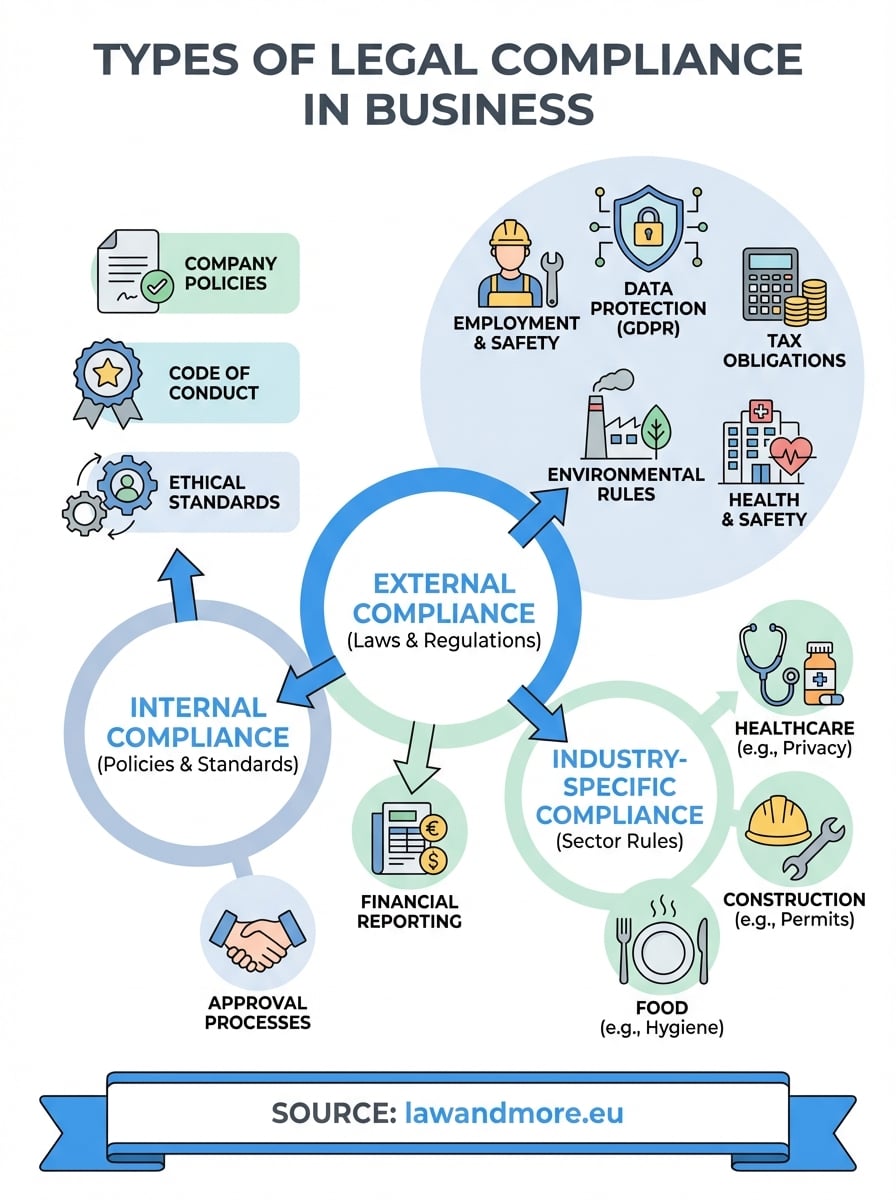
Understanding the main types of legal compliance helps you organize your approach and allocate resources effectively. Businesses typically face two broad categories: internal compliance (your own policies and standards) and external compliance (laws and regulations imposed by authorities). Within these categories, specific types emerge based on the nature of the requirements. You’ll encounter regulatory compliance for laws that apply across industries, industry-specific compliance for sector regulations, and functional compliance areas like data protection, employment, or environmental rules.
Internal compliance vs external compliance
Internal compliance refers to the policies, procedures, and ethical standards you create within your organization. You develop these rules based on your company values, business objectives, and risk tolerance. Examples include codes of conduct for employees, approval processes for purchases, internal audit requirements, or quality control standards that exceed legal minimums. Your board and management team set these standards and enforce them through internal mechanisms.
External compliance involves following laws, regulations, and requirements imposed by governmental bodies, regulatory agencies, or industry organizations. These rules are mandatory regardless of your preferences. Tax laws, employment regulations, environmental permits, and data protection rules all fall into this category. Violations trigger enforcement actions from authorities, including fines, sanctions, or criminal charges. You have no choice but to comply with external requirements if you want to operate legally.
Key regulatory compliance types
Several types of legal compliance apply to most businesses regardless of industry. Employment compliance covers hiring practices, contracts, working conditions, minimum wage requirements, discrimination protections, and termination procedures. You must follow labor laws that govern relationships with your employees, including working hours, leave entitlements, and workplace safety obligations.

Data protection compliance requires you to handle personal information responsibly according to privacy laws. This includes obtaining proper consent, securing data against breaches, allowing individuals to access their information, and reporting violations to authorities. Tax compliance means filing accurate returns, paying required amounts on time, and maintaining proper financial records. Environmental compliance involves managing waste, controlling emissions, and obtaining necessary permits for activities that impact the environment.
Regulatory compliance forms the foundation that allows your business to operate legally in any jurisdiction.
Health and safety compliance protects workers and visitors from hazards through proper training, equipment, and emergency procedures. Financial compliance covers accounting standards, reporting requirements, and anti-money laundering rules for businesses handling transactions.
Industry-specific compliance requirements
Certain sectors face additional compliance burdens beyond general regulatory requirements. Healthcare providers must follow patient privacy rules, pharmaceutical regulations, and medical licensing standards. Financial institutions deal with banking regulations, capital requirements, and consumer protection laws. Construction companies need building permits, contractor licenses, and adherence to building codes. Food businesses comply with hygiene standards, labeling requirements, and safety inspections.
Transportation companies follow vehicle regulations, driver qualification rules, and cargo handling standards. Each industry develops its own compliance ecosystem based on the risks and public interests involved in that sector.
Legal compliance in the Netherlands
Your business faces specific compliance requirements when operating in the Netherlands, shaped by both European Union regulations and Dutch national laws. The Dutch legal system emphasizes worker protections, transparent business practices, and strict data privacy standards. You need to understand how these requirements apply to your company structure, whether you operate as a sole proprietorship, partnership, or corporate entity. The Chamber of Commerce (Kamer van Koophandel) maintains registration requirements for all businesses, and various government agencies enforce compliance across different areas.

Dutch employment and labor law
Dutch labor law provides extensive employee protections that you must respect. Your employment contracts need to comply with the Work and Security Act (Wet werk en zekerheid), which regulates fixed-term contracts, probation periods, and dismissal procedures. Minimum wage requirements adjust twice yearly, and you must track working hours according to the Working Hours Act (Arbeidstijdenwet). The Netherlands requires you to maintain occupational health and safety standards under the Working Conditions Act, including risk assessments and prevention measures.
Dutch employment law gives workers strong protections that you cannot simply contract around.
Key regulatory areas for Dutch businesses
Tax compliance in the Netherlands involves corporate income tax, value-added tax (BTW), and payroll taxes that you remit through the Dutch Tax Administration. Different types of legal compliance intersect when you handle customer data, as both GDPR requirements and Dutch implementation laws apply. Your business must register with the Data Protection Authority (Autoriteit Persoonsgegevens) if you process personal information. Environmental permits, sector-specific licensing, and financial reporting standards create additional layers of compliance depending on your industry and business activities.
Risks of non compliance for companies
Your business faces severe consequences when you fail to meet compliance requirements across different types of legal compliance. These risks extend far beyond simple fines, threatening your ability to operate and damaging relationships with customers, partners, and employees. Understanding what you stand to lose helps you prioritize compliance investments and take violations seriously before they occur.
Financial penalties and legal consequences
Regulatory fines represent the most immediate financial risk when you violate compliance requirements. Authorities impose penalties that scale with the severity of violations, your company size, and whether you acted deliberately or negligently. Data protection breaches under GDPR can trigger fines up to 4% of global annual turnover or €20 million, whichever is higher. Tax violations, employment law breaches, and environmental infractions each carry their own penalty structures that quickly add up to substantial amounts.
Beyond fines, you face legal liability through lawsuits from affected parties. Employees sue for wrongful termination or discrimination, customers claim damages from data breaches, and business partners seek compensation for contract violations rooted in your compliance failures.
Operational disruption and market access
Compliance violations can force you to suspend operations while you correct problems and satisfy regulators. Authorities revoke licenses, permits, and certifications that your business needs to function legally. You lose the ability to operate in certain markets or sell specific products until you demonstrate compliance. These operational shutdowns cost you revenue, force customer defection to competitors, and create uncertainty that damages employee morale and retention.
The indirect costs of compliance failures often exceed direct penalties by disrupting your entire business model.
Who enforces compliance in the Netherlands and EU
Enforcement of legal and regulatory compliance in the Netherlands and EU is shared. General laws are enforced by courts, police, and public prosecutors. Sector‑specific rules are monitored by specialized regulators that can audit, fine, require remediation, or suspend licenses. EU rules usually apply through Dutch “competent authorities,” with EU‑level coordination and guidance.- Data protection authorities: Enforcement of AVG/GDPR.
- Financial supervisors: Oversight of banks, insurers, and markets.
- Competition/consumer regulators: Antitrust and fair‑trading rules.
- Labor/environment/product safety inspectorates: Workplace, environmental, product, and transport standards.
Core elements of an effective compliance program
An effective program turns legal and regulatory compliance obligations into everyday behavior—and proof. It should assign ownership, map risks to controls, train people, monitor change, and keep audit‑ready records. Built this way, your organization can show regulators and courts that it knows the rules, follows them, and fixes issues fast.- Program governance and accountability: Clear roles, reporting lines, and oversight.
- Risk assessment and obligation mapping: Identify applicable laws, regulations, and standards.
- Policies, standards, and procedures: Documented, current, and practical for staff.
- Training and ongoing communication: Role‑based education and refreshers.
- Screening and due diligence: Employees, vendors, and other agents.
- Controls and security by design: Technical/organizational measures aligned to risks.
- Recordkeeping and centralized evidence: Policies, logs, ROPAs, and audit trails.
- Monitoring, audits, and corrective action: Test controls, remediate gaps, and verify fixes.
Ongoing monitoring, audits, and reporting
Ongoing monitoring turns legal and regulatory compliance from a one‑off project into a reliable system. Build a cadence to test controls, track rule changes, run internal audits, and brief management—then evidence everything and fix gaps quickly. Regulators expect to see not just policies, but proof of monitoring, audit findings, corrective actions, and timely reporting where the law requires it.- Regulatory change management: Monitor updates, revise policies/training, and record decisions.
- Internal audits (planned and spot checks): Test end‑to‑end and track remediation.
- Metrics and reporting: KPIs, incidents, training completion, board packs, and any required filings.
Data protection and cybersecurity basics (AVG/GDPR and NIS2)
Under the Dutch AVG/GDPR, you must have a lawful basis for processing personal data, be transparent, respect data‑subject rights, limit retention, secure data appropriately, and document your processing and vendors. Cybersecurity is also regulated: NIS2 requires in‑scope entities to implement risk‑based security measures and robust incident handling under supervision by competent authorities. Treat them as complementary—privacy governs how you use data; cybersecurity governs how you protect systems and information.- Map data and lawful bases: Inventory processing, purposes, retention.
- Publish clear privacy notices: Set up rights‑request workflows.
- Strengthen security controls: Access management, encryption, backups, testing.
- Manage vendors: Data processing agreements and ongoing security due diligence.
- Prepare for incidents: Response playbooks, evidence logs, notification triggers.
- Assign ownership: DPO/security lead as applicable, with board oversight.
Documentation you need to maintain
Regulators expect proof, not promises. Keep a centralized evidence trail showing what you do, when, and by whom. The core documents below should be current, version‑controlled, and quickly retrievable.- Policies and procedures
- Risk assessments and obligation mapping; vendor due diligence
- Records of processing (AVG/GDPR) and data processing agreements
- Training logs, audits, remediation, and incident register
Roles and responsibilities: legal, compliance, and risk
Clear roles prevent gaps and duplication. In Dutch/EU settings, legal interprets the rules, compliance operates the system, and risk challenges and aggregates exposures. Agree ownership, escalation, and reporting lines so issues are fixed quickly—and so you can evidence accountability to supervisors and courts.- Legal: Interpret law, review contracts/policies, manage disputes and regulator contact.
- Compliance: Translate obligations into controls, train staff, monitor, audit, and evidence.
- Risk: Assess compliance risks, maintain a register, challenge plans, report to the board.
What’s changing: upcoming EU and Netherlands rules to watch
Requirements evolve quickly as EU and Dutch regulators respond to new risks. Expect more guidance, audits, and tighter controls. Maintain a change‑management routine so policies, contracts, and controls update on time.- Data protection: new AVG/GDPR guidance.
- Cybersecurity: expanding obligations for entities.
- Payments: PCI DSS version updates.
- Finance: supervisory rulebook changes.
Integrating legal, governance, risk and compliance
A mature legal compliance risk management program can still crack if it lives in a vacuum. Finance tracks credit risk, IT watches cyber threats, HR worries about whistle-blower rules—meanwhile the board wants a single truth. Legal-Governance-Risk-Compliance (LGRC) stitching pulls every strand into one fabric so decision-makers see trade-offs instantly and act with confidence.From GRC to LGRC: concept and benefits
Classic GRC platforms capture operational, financial, and strategic risks; adding the “L” embeds statutory interpretation, case-law monitoring, and contractual duties directly into the same taxonomy. Benefits include:- One obligation register instead of four spreadsheets
- Fewer duplicated controls and audits
- Faster incident response because legal privilege questions are answered up-front
- Clearer accountability when fines or lawsuits loom
Breaking down silos: legal, compliance, risk, and IT collaboration
LGRC only works if the functions behind the letters talk to each other. Practical enablers:- A standing LGRC steering committee chaired by the CFO or General Counsel
- A RACI chart mapping each risk domain (privacy, sanctions, ESG) to Owner, Consulted, Informed roles
- Shared collaboration tools so IT logs vulnerabilities directly against the legal obligation they threaten Run monthly “risk huddles” where teams review open actions and regulatory horizon scans in 30 minutes or less.
Metrics, KRIs, and board reporting best practices
Boards crave pattern recognition, not data dumps. Useful LGRC dashboards mix:- Core KPIs (training completion %, control test pass rate)
- Forward-looking KRIs (unpatched critical CVEs, unresolved hotline reports, new high-impact bills)
- Trend lines over six quarters to surface cultural shifts Heat-map visuals plus a two-page narrative keep meetings focused on priority decisions rather than forensic detail.
Scaling governance in global and multijurisdictional entities
Global groups juggle conflicting laws daily—think AI Act vs. US state privacy laws. Adopt a “federal” model: set mandatory group-wide minimums, then allow local add-ons. Translate key policies, appoint regional LGRC champions, and feed local metrics into a real-time global dashboard. This balance preserves consistency without steamrolling cultural or regulatory nuance.Practical tools and resources
The theory only sticks when people can grab a concrete template and run with it. Below you will find copy-ready tools that slot straight into most compliance programs. Feel free to adjust column names, scoring scales, or branding—just keep the logic intact.Legal compliance risk checklist
| Obligation | Control in Place? | Owner | Evidence | Next Review |
|---|---|---|---|---|
| AI Act – High-Risk System Registration | ☐ | Product Lead | Notified Body certificate | 01-03-2025 |
| CSRD – Scope 3 Emissions | ☑ | ESG Manager | Auditor letter & data set | 15-06-2025 |
| GDPR – DPIA for New App | ☐ | DPO | DPIA report draft | 10-02-2025 |
Sample risk register and scoring matrix
| # | Risk Event | Source | L (1-5) | I (1-5) | Inherent | Controls | Residual | Mitigation Plan |
|---|---|---|---|---|---|---|---|---|
| 1 | Algorithmic bias claim | AI Act | 4 | 5 | 20 (Red) | Fairness testing, legal review | 8 (Amber) | Add human-in-the-loop review |
| 2 | Late SAR response | GDPR | 3 | 3 | 9 (Amber) | Ticketing workflow | 4 (Green) | Auto-alloc SLA alerts |
Standard operating procedure (SOP) template
- Purpose
- Scope & Applicability
- Roles and Responsibilities
- Step-by-Step Activities (flowchart optional)
- Required Records/Evidence
- Exception Handling
- Version Control & Approval
Training calendar and awareness campaign ideas
| Quarter | Theme | Format | Metric |
|---|---|---|---|
| Q1 | Data Privacy Week | Lunch-and-learn + quiz | 95 % pass rate |
| Q2 | Anti-Bribery Month | Gamified e-learning | Avg. score ≥ 80 % |
| Q3 | Secure Coding Sprint | Hackathon | ≤ 3 critical bugs |
| Q4 | Whistle-blower Rights | Town-hall & poster series | 20 % rise in channel awareness |
External resources: standards, frameworks, and further reading
- ISO 37301 (Compliance Management Systems) – full text via ISO.org
- COSO ERM 2017 integrated framework
- OECD Anti-Bribery Convention commentary
- Dutch AFM newsletter for financial regulations
- EU Commission’s “Have Your Say” portal for upcoming directives Bookmark them in your horizon-scanning folder; weekly scans keep surprises to a minimum.
A corporate compliance checklist: the key components
A comprehensive corporate compliance checklist serves as a meticulous blueprint for organisational governance, encompassing multiple interconnected domains that collectively ensure regulatory adherence, ethical conduct, and operational integrity. These checklists are not merely administrative documents but sophisticated frameworks that systematically address potential risks and standardise organisational processes.Regulatory and legal compliance framework
The foundational component of any corporate compliance checklist revolves around comprehensive legal and regulatory adherence. This crucial section involves detailed mapping of all relevant legal requirements specific to the organisation’s industry, operational jurisdiction, and business activities. Organisations must develop intricate mechanisms to track evolving regulatory landscapes, ensuring continuous alignment with current legal standards.Key regulatory focus areas include:- Employment law requirements
- Industry-specific regulatory standards
- Environmental protection regulations
- Financial reporting and transparency guidelines
- Data protection and privacy standards
Operational risk management
Operational risk management represents another critical dimension of corporate compliance checklists. This component involves identifying, assessing, and mitigating potential operational vulnerabilities that could compromise organisational effectiveness or expose the business to unwarranted risks. The checklist must provide structured approaches for ongoing risk assessment, implementing preventative controls, and establishing responsive mechanisms for potential compliance breaches.Beyond documenting potential risks, an effective compliance checklist creates a proactive framework for continuous monitoring and improvement. It transforms compliance from a reactive administrative task into a strategic organisational capability, enabling businesses to anticipate challenges, implement robust preventative measures, and maintain a culture of ethical and responsible governance. The most sophisticated compliance checklists are dynamic, adaptable frameworks that evolve alongside changing regulatory environments and organisational complexities.
Real-world examples of corporate compliance
Real-world corporate compliance scenarios demonstrate the critical importance of systematic risk management, ethical governance, and proactive regulatory adherence. These practical examples illuminate how organisations transform theoretical compliance frameworks into tangible operational strategies that protect both business interests and broader societal expectations.Financial services compliance scenarios
Financial institutions represent some of the most complex compliance environments, requiring multilayered regulatory monitoring across numerous jurisdictional boundaries. Banks and investment firms must navigate intricate regulations concerning anti-money laundering protocols, customer verification processes, and transparent financial reporting. Successful compliance in this sector demands sophisticated technological infrastructure, comprehensive employee training, and robust internal control mechanisms.Key compliance challenges in financial services include:- Implementing rigorous Know Your Customer (KYC) procedures
- Monitoring and reporting suspicious financial transactions
- Maintaining accurate and transparent financial records
- Protecting customer financial data
- Ensuring fair and ethical investment practices
Technology and data protection compliance
Technology companies face increasingly complex compliance challenges related to data protection, privacy regulations, and ethical technology deployment. Organisations must develop comprehensive strategies that balance technological innovation with stringent regulatory requirements. This involves creating sophisticated data management systems, implementing transparent user consent mechanisms, and establishing clear protocols for data collection, storage, and usage.Compliance in the technology sector extends beyond mere regulatory adherence, representing a fundamental commitment to ethical technology development. By proactively addressing potential privacy and security risks, organisations can build trust with users, investors, and regulatory bodies. The most successful technology companies view compliance not as a restrictive framework but as an opportunity to demonstrate corporate responsibility and technological leadership.Frequently asked questions
What is a corporate compliance checklist?
A corporate compliance checklist is a strategic management tool that helps organisations identify, track, and mitigate legal and regulatory risks by providing a structured framework for compliance.
Why is corporate compliance important for businesses?
Corporate compliance is crucial as it safeguards against legal and financial vulnerabilities, enhances organisational credibility, and serves as a strategic tool for risk management and ethical governance.
What are the key components of an effective compliance checklist?
Effective compliance checklists typically include areas like regulatory adherence, ethical standards, operational risk management, financial reporting, data protection, and workplace safety policies.
How does corporate compliance work in practice?
Corporate compliance is implemented through established institutional frameworks, clear policies, continuous monitoring, and cultural integration that encourages ethical behaviour and accountability within the organisation.
Key takeaways
Understanding the different types of legal compliance helps you protect your business from unnecessary risks while building a foundation for sustainable growth. Your company needs both internal policies and external regulatory compliance across areas like employment, data protection, tax, health and safety, and environmental standards. Each category carries specific requirements that demand attention and resources proportional to the risks involved.
Taking a systematic approach makes compliance manageable rather than overwhelming. You should conduct regular audits, document your policies clearly, assign accountability to specific team members, and monitor compliance continuously. Dutch businesses face additional layers of requirements from both EU regulations and national laws that shape how you handle employment relationships, process personal data, and report financial information.
Professional legal guidance becomes essential when you navigate complex compliance landscapes or operate across multiple jurisdictions. Contact Law & More for expert advice on meeting your compliance obligations in the Netherlands and ensuring your business operates within all applicable legal frameworks.