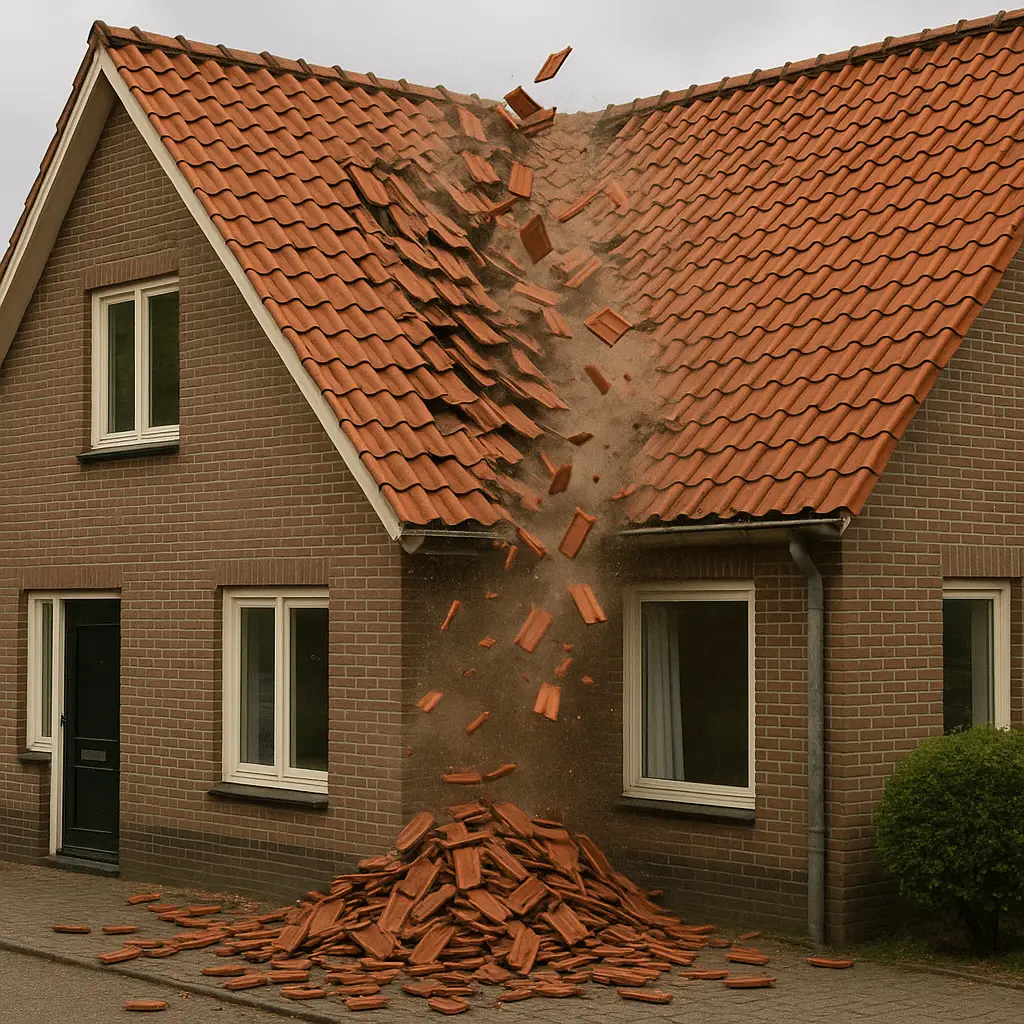
The owner of a building is, as a starting point, liable for damage caused by a leaking roof or a falling roof tile. Under Article 6:174 of the Dutch Civil Code (BW) the possessor of a structure is liable without proof of fault if the roof does not meet the standards that may be expected and that defect causes damage; if the building is used for a business, liability shifts to the person running that business (Article 6:181 BW).
Whether the owner ultimately bears the cost depends on the state of the roof, the lease or the deed of division, any contractor’s work and the insurance policies. This article explains each layer, the evidence that decides the outcome and the deadlines that end a claim.
Table of contents
When is the owner liable for roof damage?
The owner is liable if the roof did not meet the requirements that may be set for it, that created a danger to persons or property, and that danger materialised. Fault is not required.
The standard is judged objectively, considering the age and function of the building, the likelihood of the danger, the seriousness of possible consequences and the cost of precautions. Liability rests on the possessor (bezitter), normally the registered owner. In a commercial letting, Article 6:181 BW can make the operating tenant, rather than the investor-owner, liable towards an injured passer-by.
The statutory escape is narrow. The owner is not liable if he would not have been liable in tort had he known of the danger when it arose (Article 6:174(1) BW). In practice this succeeds only when the defect was genuinely undetectable and the owner can show dated inspection reports, repair invoices and a maintenance plan.
Does the Bbl building standard matter?
Yes, as evidence. Since 1 January 2024 the technical building requirements are in the Buildings (Living Environment) Decree (Besluit bouwwerken leefomgeving, Bbl) under the Environment and Planning Act (Omgevingswet), replacing the Bouwbesluit 2012.
The Bbl contains standards for new buildings and a lower set for existing buildings, including the duty not to let a structure endanger anyone. A breach does not automatically create private-law liability, but it strongly indicates that the roof was defective. A municipal inspection report is often the strongest document in the file, so ask the municipality whether one exists.
Does a storm protect the owner from liability?
Rarely. A Dutch roof must withstand the wind that can be expected in the Netherlands, and storms are foreseeable; the defence only works if the wind load genuinely exceeded what the roof could reasonably resist and the roof was otherwise in good order.
The owner must produce the evidence: recent inspections, maintenance invoices and confirmation that the roof met the building standard. Weather data from the Royal Netherlands Meteorological Institute (KNMI) for the location and hour show what the wind actually did. Where tiles were already loose or flashing was brittle, courts hold that ordinary maintenance would have prevented the damage.
What about deferred maintenance, snow and blocked drains?
Slipped tiles, plants in the gutters, perished flashing, rotten battens and an inspection record that stopped years ago mark a defective roof. The triggering weather then becomes largely irrelevant.
Water backing up from a flat-roof outlet blocked with leaves is almost always a maintenance failure. Damage from the weight of snow can be an external cause, but only if the roof was designed and maintained to carry the load that could reasonably be expected. Frost damage to a covering at the end of its life is treated as wear.
Who pays for the roof of an apartment building?
In an apartment building the roof, gutters and load-bearing structure are almost always common parts managed by the owners’ association (Vereniging van Eigenaars, VvE). Claims about a defective roof are therefore addressed to the VvE and paid through the service charges.
The deed of division (akte van splitsing) and its regulations decide which parts are common. An individual owner is only responsible if the deed allocates a part of the roof to him, such as a roof terrace belonging to a penthouse. See our article on apartment rights and the VvE in the Netherlands.
For a residential building, the VvE must reserve each year at least 0.5% of the reinstatement value, unless it sets its contribution based on a maintenance plan no more than five years old (Article 5:126 BW). If the general meeting blocks urgent repairs, an apartment owner can ask the subdistrict court (kantonrechter) for substitute authorisation (Article 5:121 BW); with an ongoing leak, summary proceedings (kort geding) for emergency measures can run alongside. See what to do when a homeowners association fails its duties.
Who repairs and who pays between landlord and tenant?
A leaking roof is a defect (gebrek) the landlord must repair at the tenant’s request (Articles 7:204 and 7:206 BW). Towards third parties, the owner remains liable under Article 6:174 BW.
If the landlord is in default after notice, the tenant may carry out the repair and recover the reasonable costs, if desired by deducting them from the rent (Article 7:206(3) BW). The tenant can also claim a proportionate rent reduction from the day the landlord was properly notified (Article 7:207 BW). The landlord owes compensation for consequential damage if the defect arose after the lease began and is attributable to him, or existed at the start and he knew or should have known of it (Article 7:208 BW). See the obligations of the landlord.
The tenant must carry out minor repairs at his own expense (Article 7:217 BW). For housing, the Minor Repairs Decree (Besluit kleine herstellingen) includes regularly cleaning gutters and rainwater drains accessible to the tenant. Replacing roof tiles and everything structural remain the landlord’s responsibility.
When is the tenant liable for roof damage?
The tenant is liable for damage to the leased property caused by his own breach of the lease (Article 7:218 BW). The law presumes the tenant caused such damage, except for fire damage and damage to the exterior of a building.
For a roof, therefore, a landlord who blames the tenant must prove it. Drilling for a satellite dish, storing heavy material on a flat roof or removing tiles for an installation are typical cases where that proof is available. If the owner’s insurer pays, it takes over the owner’s claim against a tenant at fault (subrogation, Article 7:962 BW); the tenant is not among the persons protected from that recourse.
Who is liable for a leak in a new or recently renewed roof?
The contractor, if the defect lies in the work. A roofing contract is a contract for work (aanneming van werk, Article 7:750 BW), and for construction work the contractor remains liable after delivery for defects not discovered at delivery, unless they cannot be attributed to him (Article 7:758(4) BW).
That rule was introduced with the Quality Assurance for Building Act (Wet kwaliteitsborging voor het bouwen) on 1 January 2024. Before signing the delivery report, inspect the roof and list reservations in writing. The contractor must also warn the client about errors in the assignment and defects in materials or plans he knew or should have known about (Article 7:754 BW).
A claim for a defect in delivered work becomes time-barred two years after the client complained, and in any event twenty years after delivery of a building (Article 7:761 BW). You must also complain within a reasonable time after discovering the defect. Many new-build homes come with a warranty scheme whose conditions set how long watertightness is covered; read the certificate first. See construction defects and liability and defects in newly built homes.
A neighbour or passer-by can claim from the owner under Article 6:174 BW without dealing with the building contract, or from a clearly negligent contractor in tort (Article 6:162 BW). Article 6:171 BW can also make a business liable for a non-subordinate contractor working for it. The owner then seeks recourse against the contractor. For a defect in a purchased house, see seller liability for hidden defects.
Which insurance pays first?
Insurance is usually the fastest source of money. The buildings insurance (opstalverzekering) covers the roof against sudden events such as storm, hail and falling objects; contents insurance (inboedelverzekering) covers the occupant’s belongings.
Policies define storm by wind speed in the policy conditions, not by KNMI weather warnings. Gradual wear, overdue maintenance and known construction defects are excluded almost everywhere. Even when the loss itself is excluded, the insurer normally reimburses the reasonable costs of preventing further damage (bereddingskosten). Third-party claims go to a liability insurance (aansprakelijkheidsverzekering).
If more than one policy covers the same loss, you may claim from any of the insurers, which then settle among themselves (Article 7:961 BW). Report the loss as soon as reasonably possible (Article 7:941 BW); an insurer prejudiced by a late report can reduce or refuse payment.
How do you prove the claim and calculate the loss?
The claimant must prove the defect, and the evidence disappears within days. Record the cause before any permanent repair.
Photograph the roof, the entry point, interior staining and damaged items with the date visible. Retrieve KNMI weather data for the location and hour. Ask a roofer for a written diagnosis of the cause, not only a quote, and keep removed materials where possible. Keep receipts for emergency measures.
Direct damage is the cost of restoring the property itself. Consequential loss covers ruined belongings, alternative accommodation, lost turnover and reasonable costs of establishing the loss (Article 6:96 BW). Goods are valued at the moment of loss, so depreciation applies. Compensation for non-material damage is only possible in limited cases. If only the amount is disputed, a separate damages assessment procedure can follow.
Which deadlines apply?
A damages claim becomes time-barred five years after the day following the day you knew both the damage and the liable party, and in any event twenty years after the event (Article 3:310 BW). A written reservation of rights interrupts that period (Article 3:317 BW).
A policy may set its own deadline, so check the conditions. Claims up to €25,000, and all rental cases, are heard by the subdistrict court (Article 93 of the Code of Civil Procedure, Rv), where you do not need a lawyer; larger claims go to the district court (rechtbank), where a lawyer is mandatory. See how to claim damages in the Netherlands.
What should you check as an owner or landlord?
- Check that you have dated inspection reports and maintenance invoices for the roof.
- Check your buildings and liability insurance, including the storm definition and maintenance exclusions.
- Check whether a tenant or contractor caused the damage, and whether you can prove it.
- Check the date the tenant notified you: rent reduction runs from that day (Article 7:207 BW).
- Check, as an apartment owner, whether the roof is a common part under the deed of division.
What should you check as a tenant?
- Notify the landlord of the leak in writing with photographs and ask for confirmation of receipt.
- Set a reasonable repair deadline before you repair yourself and deduct the costs (Article 7:206(3) BW).
- Claim a rent reduction for the period of reduced enjoyment from the notification date.
- Report damage to your belongings to your contents insurer as soon as possible.
- Keep gutters and drains you can reach clean; that minor repair is yours (Article 7:217 BW).
What can we do for you with roof damage?
Our liability lawyers and real estate lawyers act for owners, landlords, tenants, apartment owners and VvEs on claims for damages.
- We assess liability on the documents: lease, deed of division, contract and policies.
- We draft the notice of default or liability and interrupt limitation under Article 3:317 BW.
- We deal with the buildings, contents and liability insurers and invoke Article 7:961 BW where they point at each other.
- We start summary proceedings for urgent repairs or a substitute authorisation under Article 5:121 BW.
- We bring or defend proceedings against contractors under Articles 7:758 and 7:761 BW.
Summary
- The owner is strictly liable for a defective roof under Article 6:174 BW; for business premises, the business user is (Article 6:181 BW).
- A storm defence only works if the roof was well maintained and the wind exceeded what could reasonably be expected.
- In apartment buildings the VvE is responsible for the roof as a common part.
- The landlord repairs roof defects; the tenant only cleans accessible gutters and drains.
- Secure evidence immediately and observe the five-year limitation period (Article 3:310 BW).
Frequently asked questions
Is the owner always liable when a roof tile falls?
In principle yes, if the roof did not meet the standards that may be expected (Article 6:174 BW). The owner escapes liability only if the defect was undetectable despite proper maintenance, or the storm exceeded what a well-maintained roof could reasonably resist.
Can my landlord make me pay for a leaking roof?
Only if the landlord proves you caused the damage, for example by drilling or storing heavy material on the roof. The legal presumption of tenant fault does not apply to damage to the exterior of a building (Article 7:218(2) BW).
From when can I claim a rent reduction for a leak?
From the day you properly notified the landlord of the defect (Article 7:207 BW). Notify in writing and keep proof of the date.
Who pays for the roof in an apartment building?
Usually the owners’ association (VvE), because the roof is a common part under the deed of division. The cost is paid from the reserve fund or through a special levy on the apartment owners.
How long do I have to claim against a roofing contractor?
Complain within a reasonable time after discovering the defect. The claim becomes time-barred two years after your complaint, and in any event twenty years after delivery of a building (Article 7:761 BW).