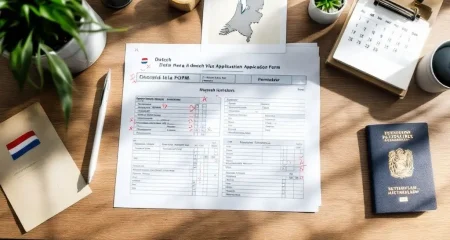
In short: if you are a non-EU national, you start with a temporary Dutch residence permit tied to a purpose of stay, such as work, study or family. After five continuous years of lawful residence you can apply to the IND for a permanent permit or for EU long-term resident status, provided you also meet the income and civic integration conditions.
The two indefinite permits look alike but work differently. The national permanent permit (verblijfsvergunning voor onbepaalde tijd) gives you secure status in the Netherlands only, while EU long-term resident status (EU-langdurig ingezetene) also makes it easier to move to another EU country. Nationals of the EU, the EEA and Switzerland do not need a residence permit to live and work in the Netherlands.

Which types of Dutch residence permit are there?
There are three main types: a temporary permit tied to a purpose of stay, a national permanent permit and an EU long-term resident permit. The Immigration and Naturalisation Service (Immigratie- en Naturalisatiedienst, IND) decides on all three under the Aliens Act 2000 (Vreemdelingenwet 2000).
A temporary permit is granted for a specific purpose, such as work, study or family reunification. It remains valid only as long as that purpose continues and you keep meeting its conditions. If you change employer, finish your studies or end your relationship, the permit may have to be changed or may be withdrawn. Most temporary permits are issued for a limited period and then extended.
The permanent permit and the EU long-term permit are both indefinite. They are no longer tied to one purpose, so your right to stay no longer depends on a particular job or relationship. The permanent permit is based on national rules. The EU long-term permit is based on Directive 2003/109/EC and adds a facilitated route to live in another EU country, subject to that country’s own conditions.
Both indefinite permits come with a residence card that must be renewed, usually every five years. Renewing the card is an administrative step. The IND does not reassess whether you still meet the conditions for the status itself.
What are the main temporary residence permits?
The purpose of your stay, not your nationality, determines which permit you need and which conditions apply. Most people come for work, study, business or family.
- Work: most international professionals come as a highly skilled migrant. This requires a salary above the criterion for your age group and an employer recognised by the IND as a sponsor. The EU Blue Card and the intra-corporate transferee permit are alternatives for specific cases. For other jobs, a combined residence and work permit (GVVA) is usually needed.
- Study or research: the university or research institution acts as sponsor. After graduating, you can apply for the orientation year (zoekjaar), which lets you work in the Netherlands for a year without the usual salary criterion.
- Business: the self-employed route tests whether your business serves an essential Dutch interest. The start-up visa runs for one year through an approved facilitator. US nationals can use the Dutch-American Friendship Treaty, which has a much lighter test.
- Family: a partner, spouse or child can join a family member who lives in the Netherlands. The family member acts as sponsor and must usually have a sufficient and lasting income.
- Other purposes: exchange and working holiday programmes, au pair placements, medical treatment and several other specific purposes.
For most applications you need a valid passport, a passport photo, the IND application form and the fee. After arrival you register with your municipality in the Personal Records Database (Basisregistratie Personen, BRP) and collect your residence card from the IND.
Who files the application?
In the sponsored route, an organisation or person in the Netherlands files the application for you. In the independent route, you file it yourself and carry full responsibility for a complete file.
Sponsored applications include those for highly skilled migrants, students, au pairs and family members. The sponsor handles the correspondence with the IND and has its own duties, such as reporting when you leave the job or programme. A mistake by your sponsor can still affect your own residence. The self-employed, start-up visa applicants and applicants under the Dutch-American Friendship Treaty file themselves. There is no sponsor to spot a missing document or a deadline, so check the file carefully before you submit it.
Formally, the IND has 90 days to decide on a combined application for an entry visa (machtiging tot voorlopig verblijf, MVV) and a residence permit. With a recognised sponsor and a complete file, the decision often comes much sooner. After a positive decision, you make an appointment at an IND desk to give your photograph and fingerprints, and you collect the card some time later.
What happens if your situation changes during a temporary permit?
A temporary permit only protects you while its purpose continues. If your job, studies or relationship ends, you must usually report the change and, where possible, switch to another purpose of stay in time.
The back of your residence card states whether you may work. The words arbeid vrij toegestaan mean you may work for any employer without a work permit. Other wording means that work is restricted or that your employer needs a work permit (tewerkstellingsvergunning, TWV) from the Employee Insurance Agency (UWV). Working without the right permission can lead to a fine for your employer and can harm your own residence.
A highly skilled migrant who loses their job has a search period of three months to find a new job with a recognised sponsor. If you find one, the new employer reports the change to the IND. If you do not, the IND may withdraw the permit, unless you qualify for another purpose, such as self-employment or residence with a partner. A student who stops studying, or whose partner relationship ends, faces a similar question: which purpose of stay fits the new situation, and does that purpose have its own conditions that you can meet?
Apply for the change of purpose while your current permit is still valid. This keeps your residence lawful while the IND decides and avoids a gap in the five-year period that you need later for permanent residence. An employee who leaves a job voluntarily in year four and waits two months before applying for a new purpose may find that the clock has started again. Planning the switch with the permanent permit in mind is often worth more than the switch itself.
For employers, the same rules have practical consequences. A recognised sponsor must report within four weeks when a sponsored employee leaves, and must keep records of the employee’s residence status. Our immigration lawyers advise both employees and employers on these obligations.
When do you qualify for permanent residence?
You qualify once you have held a valid Dutch residence permit for at least five consecutive years, with your main residence in the Netherlands throughout. You must also have a sufficient and lasting independent income, have passed the civic integration exam or be exempt, and not pose a risk to public order.
The conditions for the national permit and the EU long-term permit overlap to a large extent. The differences lie mainly in which years count, how much time you may spend abroad and what the status allows you to do afterwards. It is possible to hold both. Because the file is largely the same, applying for both at the same time is often the safest course.
Which permits count towards the five years?
For the national permanent permit, only years on a permit for a non-temporary purpose count. For the EU long-term permit, years on a study permit count for half.
Permits for work as a highly skilled migrant, for paid employment and for family reunification with a partner or parent generally count in full. Permits for a purpose that is temporary by nature do not count for the national permit. The usual examples are the orientation year, seasonal work, au pair placements, exchange, medical treatment and study. For the EU long-term permit, residence on a study permit counts for half its duration. Four years of study therefore contribute two years. A former student who has moved on to a work permit may reach the EU route a year or two sooner.
According to the IND, only years of residence from the age of eight count towards the five-year period, and a child must be at least thirteen to apply in their own right. Holders of an EU Blue Card can, under certain conditions, combine periods of residence in different EU countries towards EU long-term status.
Who does not need to wait five years?
The IND makes exceptions for a few specific groups. Most of them concern people who already have strong ties with the Netherlands.
Belgian and Luxembourg nationals are exempt from the five-year requirement, as are former privileged persons, such as diplomatic staff, and their family members. There are also routes for people with a Dutch past. These cover an adult who lived in the Netherlands for at least ten years before turning eighteen and applies to return before the age of twenty-eight, and an adult who lived here for at least five years before turning eighteen where the Netherlands is the most appropriate country of residence. A former Dutch national who lost Dutch nationality after at least five years of lawful residence here is also covered.
How does the IND test your income?
Your income must be independent, sustainable and sufficient. Applications most often fail on the second element.
Independent means the income comes from your own work, business or entitlement, not from social assistance. Sustainable means that, as a rule, the income will still be available for at least twelve months from the date of the application. For an employee, that normally means a permanent contract or a fixed-term contract with at least a year left to run. If your work history is less tidy, you can sometimes rely on income received over a longer preceding period that is still available when the IND decides. Sufficient means the income reaches the IND standard amount (normbedrag). This amount is adjusted on 1 January and 1 July, so check the figure in the week you apply.
Employees prove their income with the employment contract, recent payslips and, if requested, an employer’s statement. The self-employed provide their Chamber of Commerce registration, annual figures and income tax assessments. The IND looks at average income over a period rather than one good year. An unemployment benefit does not count. Applying shortly after a new contract starts, or during a probationary period, often leads to a refusal that a few months of patience would have avoided.
Which civic integration level do you need?
For the permanent permit, the IND requires that you have passed the civic integration exam (inburgeringsexamen) at level A2 at least, or that you are exempt. Check your own position before you apply, because the rules depend on when and under which regime you started integrating.
People who fall under the Civic Integration Act 2021 (Wet inburgering 2021) follow a route supervised by their municipality, which is usually aimed at level B1. Whether you have met the requirement for the permit, or are exempt, depends on your diploma, your earlier education and your personal situation. More on the exam itself can be found in our article on the Dutch civic integration exam. If you later want to naturalise, other and stricter language requirements may apply.
How does a criminal record affect your application?
A parking ticket or minor traffic fine is not a problem, but a criminal conviction may be. The IND uses a sliding scale: the longer your lawful residence, the more serious the offence must be before it leads to a refusal.
A settlement with the Public Prosecution Service (Openbaar Ministerie, OM) or a penalty order (strafbeschikking) also counts as a criminal matter for these purposes, and a conviction abroad can be relevant as well. One narrow protection applies to people born in the Netherlands who have reached eighteen, and to people who came to live here before the age of three. The IND may refuse them only on grounds of public order or national security; the income and integration conditions do not apply to them.
Should you choose the national permit or EU long-term residence?
If your life is firmly rooted in the Netherlands, the national permanent permit may be all you need. If you want to keep the option of living in another EU country, EU long-term residence adds that possibility.
| Point | National permanent permit | EU long-term residence permit |
|---|---|---|
| Residence required | Five consecutive years on permits for a non-temporary purpose | Five consecutive years, with study counting for half |
| Absences during the five years | Main residence in the Netherlands; not more than six consecutive months abroad, or four consecutive months a year in three successive years | No absence over six consecutive months and no more than ten months in total |
| Rights in the Netherlands | Indefinite residence, free access to the labour market | Indefinite residence, free access to the labour market |
| Moving to another EU state | No facilitated route | Facilitated procedure in the second member state |
| Loss through absence after grant | Over six consecutive months abroad, or four consecutive months a year for three years | Over twelve consecutive months outside the EU, EEA and Switzerland, or over six years outside the Netherlands |
Someone who travels a lot for work may find the national main-residence test easier to meet than the EU ceiling of ten months abroad in total. Someone who expects to move to Germany or Belgium for a job in a few years will benefit from the EU status. If you are unsure, discuss your plans with an immigration lawyer before you choose.

How do you apply to the IND?
You apply online with DigiD or on the IND paper form, and you pay the fee. The IND does not start assessing your file until the fee has been paid.
The core file is short and strict: a copy of the identity page of a valid passport, a copy of both sides of your current residence card, proof of income that fits your situation, and your civic integration diploma or exemption decision. You must be registered in the BRP. Documents in a language other than Dutch, English, French or German must be translated by a translator sworn in the Netherlands. Foreign civil status documents usually need legalisation or an apostille. Both steps can take weeks, so start them before you fill in the form.
The fee depends on the permit and is revised every year on 1 January, so check the current amount on the IND website. The fee is not refunded if your application is refused. That is a practical reason to establish whether you qualify before you apply, not afterwards.
For both the permanent and the EU long-term permit, the IND has a decision period of six months. It can extend that period, and the period is suspended while the IND waits for information it has asked you for. A complete file submitted in one go is the part of the timetable you control. Our article on building a strong case in IND procedures gives practical tips.
Why are permanent residence applications refused?
Most refusals come down to a gap in residence, income that was not sufficient throughout, a criminal record or earlier incorrect information. Each of these can often be spotted before you apply.
A gap in your residence (verblijfsgat)
The five years must be continuous, and the IND applies that strictly. If your previous permit expired on 31 May and the new one only took effect on 2 June, those days break the chain and the five-year period starts again. It makes no difference that the gap was short, administrative or not your fault.
File every extension well before your permit expires. An application for extension or change of purpose filed while your current permit is still valid keeps your residence lawful while the IND decides, so keep the confirmation of receipt for every application. If you discover a gap in your history, take advice before applying. In some circumstances a short gap can be argued around, and it is better to raise that argument yourself than to wait for the IND to find it.
Income that fluctuates
The IND looks not only at what you earn now, but also at whether your income was independent and sufficient throughout, and whether it is durable. A period of unemployment, a switch to self-employment or a year of irregular invoicing can each lead to a refusal, even if your current salary is well above the standard amount. Where income has been uneven, the evidence must show the whole pattern, not just the present.
A criminal record
Convictions are weighed against the length of your stay and the seriousness of the offence. A minor matter from years ago is not automatically fatal. Never leave it out of the application, though: giving incomplete information is a ground for refusal in its own right, and often a heavier one than the offence itself.
An earlier refusal or incorrect information
A previous refusal stays in your file, especially where it involved incorrect or incomplete information. Giving false information is a ground for refusal and for later withdrawal of a permit. If something in an earlier application was wrong, address it openly in the new one rather than leaving it to be discovered.
What can you do if the IND does not decide in time?
Once the decision period has expired, you can send the IND a notice of default (ingebrekestelling). If it still does not decide within two weeks, you can appeal to the administrative court against the failure to decide.
The decision period can be paused lawfully. If the IND asks you for more information, the clock stops until your complete answer arrives. Answer such requests quickly and in full, because every day of delay on your side is added to the IND’s period.
Older guidance on this point is out of date. The administrative penalty payment (dwangsom) that used to accrue after a notice of default was abolished in immigration cases on 15 April 2025. If the IND still does not decide after your notice, the administrative court can order it to decide within a set period and can attach a penalty payment to that order. A notice of default only works once the period has really expired, so work out the exact date first, allowing for any pauses.
How do you challenge a refusal?
You can lodge an objection (bezwaar) with the IND within four weeks of the decision. In immigration cases this period is shorter than the usual six weeks, under Article 69 of the Aliens Act 2000.
If the objection is rejected, you can appeal to the district court, again within four weeks. A further appeal lies with the Administrative Jurisdiction Division of the Council of State (Afdeling bestuursrechtspraak van de Raad van State). Whether you may await the outcome of your objection in the Netherlands depends on the type of application. Where you may not, a separate request for an interim measure (voorlopige voorziening) to the court may be needed.
Read the reasons for the refusal closely. They tell you which condition the IND considers unmet. An objection that answers that point with new evidence succeeds far more often than a general protest.

What changes once you hold an indefinite permit?
Your income no longer matters for your right to stay. You can change jobs, start a business, study, take a career break or become unemployed without risking your residence.
You can travel to other Schengen countries for up to 90 days in any period of 180 days. That is a right to visit, not to settle. Living or working in another EU country still requires that country’s own permit, or the facilitated route that EU long-term status offers.
Time abroad can cost you the permit. The IND may withdraw the national permit if you move your main residence abroad, which it assumes if you live outside the Netherlands for more than six consecutive months, or for more than four consecutive months in each of three consecutive years. Plan a long secondment, an extended stay with family abroad or a sabbatical against these limits. For the EU long-term permit, the limits are more than twelve consecutive months outside the EU, the EEA and Switzerland, or more than six years outside the Netherlands. Either permit can also be withdrawn if it was obtained with incorrect information, or on serious public order grounds, where the threshold rises with the length of your residence.
Permanent residence is not citizenship. You keep your own nationality and passport, you cannot vote in national elections and you remain subject to immigration law. For many people it is the step before applying for Dutch citizenship.
How does it work for families?
Permanent residence is granted to individuals, not to households. Your partner and each child make their own application, pay their own fee and are assessed on their own position.
- Civic integration: a partner who came for family reunification and has not worked still needs the diploma or a documented exemption. Starting that process at the same time as the main applicant avoids a delay of years.
- The five years: each person’s own permits and absences count. A partner who arrived two years later qualifies two years later, and a child who spent a school year abroad may have a gap the parents do not have.
- Income: whether an applicant may rely on the income of the person they live with depends on their current permit and their own position. Establish this before you submit, because it decides which documents the file must contain.
Holders of an asylum residence permit follow a separate route with its own conditions. Law & More does not handle asylum cases. Holders of an EU Blue Card should check the special rules that apply to them. An overview of all our guides is available in our index of Dutch immigration law guides, and the official conditions are on the IND website.
In summary
- A temporary permit is tied to a purpose of stay; after five continuous years you can apply for a permanent permit or EU long-term status.
- You also need a sufficient and lasting independent income, the civic integration exam at level A2 at least (or an exemption) and no serious public order objections.
- Study does not count for the national permit and counts for half for the EU long-term permit.
- The IND has six months to decide; against a refusal you lodge an objection within four weeks.
- After the grant, long periods abroad can still cost you the permit, so plan them against the limits.
Frequently asked questions
How long does it take to get permanent residence in the Netherlands?
You need at least five consecutive years of lawful residence on a qualifying permit before you can apply. After you apply, the IND has a decision period of six months, which it can extend.
Does my time as a student count towards permanent residence?
Not for the national permanent permit, because study is a temporary purpose. For EU long-term resident status, years on a study permit count for half.
What integration level do I need?
For the permanent permit, the IND requires that you passed the civic integration exam at level A2 at least, or that you are exempt. Check your own position, because the rules depend on the regime you fall under.
What is the difference between a permanent permit and EU long-term residence?
Both are indefinite. EU long-term status also gives a facilitated route to live and work in another EU country, while the national permanent permit is valid in the Netherlands only.
How much does the application cost?
The IND fee depends on the type of permit and is revised every year on 1 January. Check the current amount on ind.nl before you apply; the fee is not refunded after a refusal.
Law & More assists non-EU nationals and their employers with residence applications, objections and appeals against the IND. Unsure where you stand? Tell us about your situation. We will let you know your options within one working day.