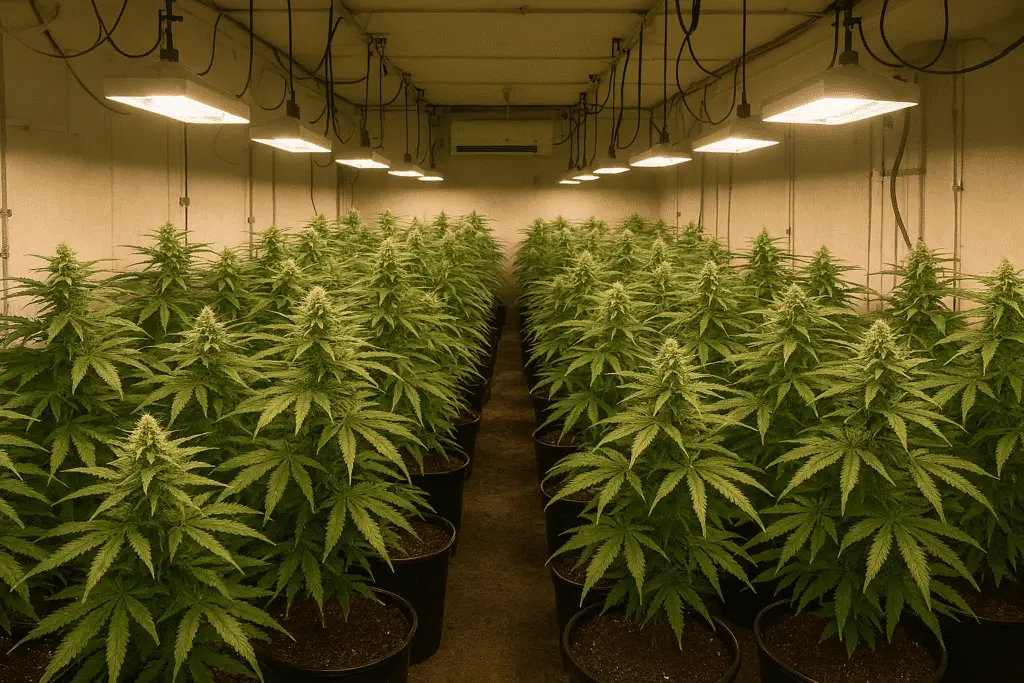
Growing cannabis in the Netherlands is a criminal offence at any scale. Article 3 of the Opium Act (Opiumwet) prohibits cultivating List II substances, including cannabis; the only exceptions are licensed medical or scientific cultivation, fibre hemp and the designated growers in the closed coffeeshop chain experiment.
The often-quoted limit of five plants is a prosecution guideline, not a permission. The same facts can also lead to closure of the premises by the mayor, confiscation of proceeds, termination of the lease and claims by the grid operator. This article explains each of these risks.
What does the Opium Act prohibit?
The Opium Act has two lists. List I contains hard drugs; List II contains the rest, including cannabis and hashish. Under Article 3 it is prohibited to import or export List II substances, to cultivate, prepare, process, sell, supply, provide or transport them, to possess them and to manufacture them.
Penalties are in Article 11. Intentional cultivation or possession carries up to two years’ imprisonment (Article 11(2)). Cultivation in the exercise of a profession or business carries up to six years (Article 11(3)), as does an offence involving a large quantity (Article 11(5)). Possession of no more than 30 grams of cannabis is only a minor offence, punishable by detention of up to one month or a fine.
Article 11a separately punishes preparing or facilitating professional cultivation, for example by supplying equipment or premises, with up to three years’ imprisonment. Article 3b prohibits any publication clearly aimed at promoting the sale of these substances.
The key question in practice is whether the conduct is treated as personal use or as professional cultivation, because that moves the case into the higher penalty range and brings confiscation into view. Courts use the sentencing guidelines of the national consultative body of criminal judges (LOVS) as a starting point.
Where does the tolerance policy stop?
The tolerance policy (gedoogbeleid) is prosecution policy, not law. It is laid down in the Opium Act Directive of the Board of Procurators General and covers only possession of a small amount for personal use and sales by coffeeshops that meet the conditions and are tolerated by the municipality.
A tolerated coffeeshop may not advertise, sell hard drugs, cause nuisance, admit or sell to minors, sell more than five grams per transaction or hold more than the permitted stock. Municipalities decide whether coffeeshops are allowed at all and may add local conditions.
Two limits are often misunderstood. First, the supply of coffeeshops (“the back door”) has never been tolerated; growing for a coffeeshop is prosecuted as production. Second, for home cultivation the directive provides that if no more than five plants are found and there is no sign of professional production, the plants are seized and prosecution is in principle waived. That confers no right and does not stop the other consequences below. See also our article on drug possession in the Netherlands.
Can the mayor close your home or premises?
Yes. Under Article 13b of the Opium Act the mayor can close a home or premises where drugs are sold, supplied or present for that purpose, or where objects or substances intended for professional cultivation (Article 11a) are present. This is an administrative measure that does not require a conviction; an acquittal does not undo it.
Closures commonly last three or six months under the municipal enforcement policy (often called the Damocles policy). The Administrative Jurisdiction Division of the Council of State (Raad van State) requires the mayor to assess necessity and proportionality in each case, including blame, links to organised crime and the effect on residents and children. A closure is a decision under the General Administrative Law Act (Awb), so you can lodge an objection and ask the preliminary relief judge to suspend it; given the short periods, that is usually the only effective route.
For tenants the consequences go further. Under Article 7:231(2) of the Dutch Civil Code (BW) the landlord may dissolve the lease without going to court if the property was closed because of conduct contrary to, among others, Articles 2, 3 or 11a of the Opium Act. Housing corporations apply this as policy and may refuse a new social tenancy for a period. Homeowners face exclusions in mortgage conditions and insurance policies.
What happens with confiscation and civil claims?
A conviction is often followed by a separate confiscation claim. Under Article 36e of the Criminal Code (Wetboek van Strafrecht, Sr) the court can order the convicted person to pay the State an amount equal to the unlawfully obtained advantage, in separate proceedings after the criminal case.
In cultivation cases the amount is usually calculated with a standard national model based on the number of plants and harvests, minus costs actually incurred. Because earlier harvests are inferred from the state of the installation, the claim often exceeds what was actually earned. The number of harvests and the deductible costs are where the defence has most to do. Non-payment can lead to coercive detention (gijzeling), which does not cancel the debt.
Three civil consequences recur, each on its own timetable and independent of the criminal case:
- The grid operator claims the value of electricity tapped outside the meter plus investigation and repair costs, and may report theft under Article 310 Sr.
- The insurer refuses cover for fire or water damage linked to the installation, which in a terraced house can include the neighbours’ damage.
- The Dutch Tax Administration (Belastingdienst) can impose an assessment on undeclared income.
When is cannabis cultivation lawful?
Only in three narrow cases, each requiring a prior decision by the authorities.
- Medical cannabis. The Office of Medicinal Cannabis (Bureau voor Medicinale Cannabis) of the Ministry of Health, Welfare and Sport is the only body that may supply cannabis for medical and scientific use. Cultivation is done by a contracted grower with an Opium Act exemption. A prescription gives no right to grow.
- Scientific research. This also requires an exemption for the specific project.
- Fibre hemp. Outdoor cultivation for fibre or seed, using varieties admitted under EU agricultural rules with a THC content below the EU limit, is excluded from the prohibition under conditions. It does not cover cultivation for cannabinoids.
What is the closed coffeeshop chain experiment?
The only regulated cultivation for the recreational market takes place in the experiment under the Act on the experiment with a closed coffeeshop chain (Wet experiment gesloten coffeeshopketen). Ten designated municipalities take part; their coffeeshops buy only from growers designated by the government, subject to quality and track-and-trace requirements.
The experimental phase began in April 2025, after a transition phase in which regulated and tolerated products were sold side by side. The experiment does not allow anyone else to obtain a permit, and outside the participating municipalities nothing has changed.
What should you do as a suspect?
The ordinary rules of criminal procedure apply. Under Article 29 of the Code of Criminal Procedure (Wetboek van Strafvordering, Sv) you are not obliged to answer and must be told so before the interview.
- Consult a lawyer before the first interview and have the lawyer present; if you are held, a lawyer can be arranged through the duty scheme.
- Ask for a copy of the list of seized items, because confiscation and civil claims are built on it.
- Be careful with statements at the scene and with consent to a search; both are hard to undo.
- Do not remove or destroy evidence.
- Pass letters from the municipality, landlord, grid operator or tax authorities to your lawyer immediately; objection deadlines are short, often six weeks under the Awb.
See also our articles on appeal in criminal law, the Dutch criminal record and our overview of Dutch drugs legislation.
What should you check as a tenant or occupant?
- Has the mayor announced or imposed a closure under Article 13b of the Opium Act, and when does the objection period end?
- Is there reason to ask the preliminary relief judge to suspend the closure?
- Has the landlord dissolved the lease under Article 7:231(2) BW, and were the conditions met?
- Is the grid operator’s claim for electricity correctly calculated?
- Does the confiscation claim rely on an assumed number of harvests you can challenge?
What should you check as a landlord or property owner?
- Does the lease prohibit use contrary to the Opium Act and allow inspection?
- After a closure, have you assessed whether extra-judicial dissolution under Article 7:231(2) BW is available?
- Have you notified your insurer and documented damage to the property?
- Can you show you were not to blame, to limit the risk of closure affecting you?
- Have you reported damage caused by the tenant and secured your claim?
What can we do for you with cannabis cultivation and criminal law?
Our criminal lawyers handle Opium Act cases together with the related administrative and civil matters.
- We assist you at the police interview and review the file and the list of seized items.
- We defend you at trial, including on the distinction between personal use and professional cultivation.
- We challenge the calculation in confiscation proceedings.
- We file an objection and request suspension of a closure order under Article 13b of the Opium Act.
- We advise tenants and landlords on dissolution of the lease and claims for damages.
Summary
- Growing cannabis is prohibited at any scale under Article 3 of the Opium Act; the five-plant rule is only a prosecution guideline.
- Professional cultivation carries up to six years’ imprisonment (Article 11(3) Opium Act).
- The mayor can close premises under Article 13b without a conviction, and the landlord can then dissolve the lease out of court.
- Confiscation, electricity claims and tax assessments often weigh more financially than the sentence.
- Lawful cultivation is limited to licensed medical, scientific and fibre hemp cultivation and the coffeeshop experiment.
Frequently asked questions
Is growing a few cannabis plants at home legal in the Netherlands?
No. Cultivation is prohibited at any scale under Article 3 of the Opium Act. The five-plant guideline only means that prosecution is in principle waived if there are no signs of professional cultivation; the plants are still seized.
What happens if the police find five or fewer plants?
Usually the plants are seized and prosecution is in principle waived if the circumstances point to personal use. That is policy, not a right, and closure of the premises or other consequences can still follow.
Does the coffeeshop tolerance policy cover cultivation?
No. It covers only small personal possession and sales by tolerated coffeeshops. Supplying coffeeshops is prosecuted as production, except for the designated growers in the closed coffeeshop chain experiment.
Can I lose my rented home because of cannabis cultivation?
Yes. If the mayor closes the home under Article 13b of the Opium Act, the landlord can dissolve the lease without going to court under Article 7:231(2) of the Dutch Civil Code.