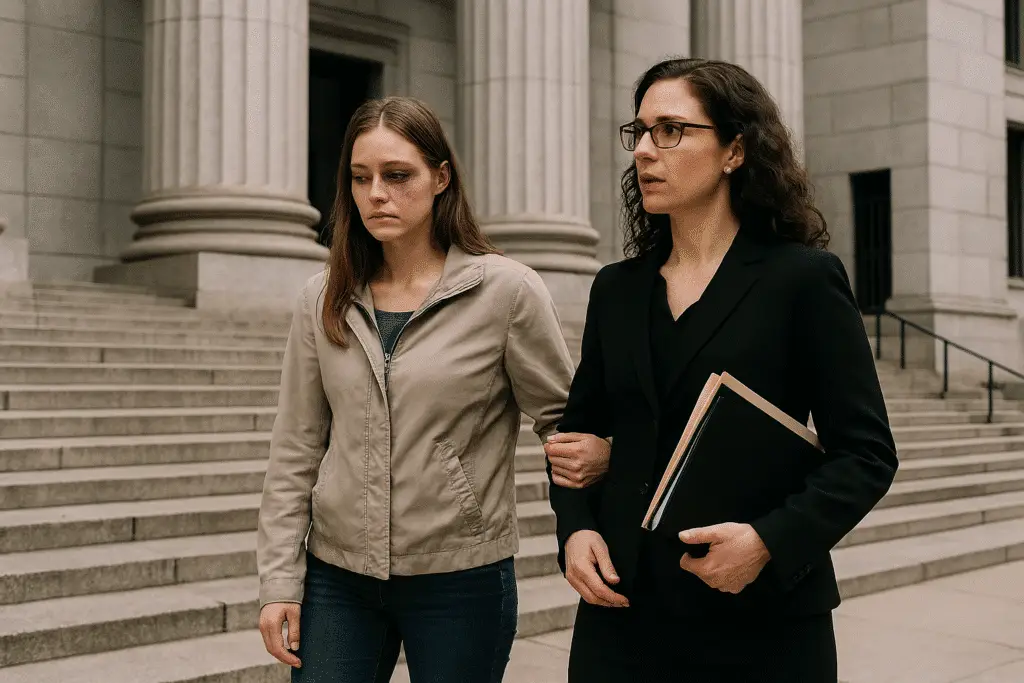
A victim advocate (slachtofferadvocaat) is a lawyer who acts only for the victim in a Dutch criminal case, not for the suspect and not for the Public Prosecution Service (Openbaar Ministerie). Under Article 51c of the Code of Criminal Procedure (Sv) you may be assisted by a lawyer during the investigation and at the hearing; for victims of a violent or sexual offence that assistance is free if the conditions of Article 44(4) of the Legal Aid Act (Wet op de rechtsbijstand) are met.

Table of contents
What does a victim advocate do?
A victim advocate exercises the rights that Title IIIA of Book 1 Sv (Articles 51a and following) gives you as a victim. It is legal representation, separate from the practical and emotional support that Slachtofferhulp Nederland offers free of cost to victims.
The work has four parts. First, information: following the decisions of the public prosecutor (officier van justitie) and requesting access to the case file under Article 51b Sv. Second, the claim: quantifying your loss and submitting it as an injured party (benadeelde partij) under Article 51f Sv. Third, participation: preparing your statement for the hearing under Article 51e Sv. Fourth, protection: asking for a contact or area ban where your safety is at risk.
You do not have to report the offence before you instruct a lawyer. Advice before reporting is often the most useful moment, because that is when you decide what evidence to secure and how to give your statement. Our guide on filing a police report in the Netherlands explains how the report itself works.
When is legal assistance free for victims?
Under Article 44(4) of the Legal Aid Act, legal assistance is free, regardless of your income, for a victim of a sexual offence or a violent offence, and for surviving relatives if the victim died. Two conditions apply: prosecution has been started in the case, and you qualify for a payment from the Violent Offences Compensation Fund under Article 3 of the Wet schadefonds geweldsmisdrijven.
Article 3 of that Act requires serious physical or psychological injury caused by an intentional violent offence committed in the Netherlands. The free assistance is granted through a legal aid certificate (toevoeging) issued by the Legal Aid Board (Raad voor Rechtsbijstand) to a lawyer registered with it. If you do not meet the conditions, the ordinary options apply: subsidised legal aid with an income-related contribution, legal expenses insurance, or private fees. Clarify which route applies at the first contact.
Which rights do you have as a victim?
The Code of Criminal Procedure gives you rights to correct treatment, information, assistance and protection. Article 51aa Sv obliges the public prosecutor to ensure you are treated correctly and that the police refer you to victim support.
- Information: you are told whether the case is prosecuted, when the hearing takes place and what the outcome is.
- Assistance: under Article 51c Sv you may be assisted by a lawyer and by a person of your choice, and by an interpreter if you do not speak Dutch well enough.
- Case file: under Article 51b Sv the public prosecutor (or, during the hearing, the court) gives permission to inspect documents that matter to you; you may also ask to add documents to the file.
- Individual assessment: under Article 51aa(3) Sv you are assessed in good time to identify specific protection needs, for example avoiding contact with the suspect in the court building.
Since the Wet uitbreiding slachtofferrechten, a suspect held in pre-trial detention must attend the substantive hearing in person for the offences listed in Article 51e(1) Sv and certain other serious offences (Article 258a Sv). The aim is that you do not address an empty chair when you speak.
How do you claim compensation in the criminal case?
You join the criminal proceedings as an injured party under Article 51f Sv and claim damages from the suspect there, without separate civil proceedings. You submit the claim before the hearing on the official joinder form (voegingsformulier) that the public prosecutor sends you with the notice that prosecution has started (Article 51g Sv).
The claim can cover material loss, such as medical costs, damaged property and lost income, and non-material damage. It must be quantified and supported by documents: invoices, medical records and correspondence with insurers. Under Article 361(3) Sv the court may declare a claim inadmissible, in whole or in part, if dealing with it would place a disproportionate burden on the criminal proceedings. You can then still bring that part before the civil court.
If the court awards the claim, it usually also imposes a compensation measure (schadevergoedingsmaatregel) under Article 36f of the Criminal Code (Sr). The State then collects the amount from the convicted person through the CJIB. If the convicted person has not paid in full within eight months after the judgment became final, the State advances the remaining amount to you as a private person and recovers it from the offender itself (Article 6:4:2(7) Sv).
What if the criminal route does not lead to compensation?
An acquittal does not close off compensation. The civil court applies its own standard of proof, and you can base a claim on unlawful act (onrechtmatige daad) under Article 6:162 of the Dutch Civil Code (BW). We explain that route in our guide to victims rights in Dutch civil law after a criminal case.
The Violent Offences Compensation Fund (Schadefonds Geweldsmisdrijven) pays victims with serious injury from an intentional violent offence, and surviving relatives, without a conviction and even if the offender is never found. Under Article 7 of the Act you must apply within ten years after the offence; for relatives the period runs from the death. A later application is still considered if you applied as soon as could reasonably be expected. The payment is fixed by the fund and capped by ministerial regulation (Article 4); amounts already received from the offender or an insurer must be repaid to the fund. Details are on schadefonds.nl.
When can you speak at the hearing?
Under Article 51e(1) Sv you have the right to speak (spreekrecht) if the charge concerns an offence carrying a prison sentence of eight years or more, or one of the offences listed there, such as several sexual offences, threats, stalking and assault causing serious injury. You must notify the public prosecutor in writing before the hearing starts, so that you are summoned in time.
Under Article 51e(2) Sv you may make a statement at the hearing; parents of a minor victim and, if the victim died, relatives and close family members may also speak (Article 51e(3)-(4)). You can speak yourself, have your lawyer or another person read the statement, or submit it in writing. Speaking is a choice, not a duty. We advise on what helps the court and what may invite questions from the defence, and arrange practical protection such as a separate waiting room. Our article on the criminal court hearing in the Netherlands describes how the day is structured.
What can you do if the prosecutor does not prosecute?
You can file a written complaint (beklag) with the court of appeal (gerechtshof) under Article 12 Sv. That applies if the case is dropped, if prosecution is not continued, or if the prosecutor settles it with a penalty order (strafbeschikking).
The court of appeal examines whether prosecution should still take place and can order the Public Prosecution Service to prosecute. You do not need a lawyer for this procedure, but the complaint must explain why prosecution is required. Do not wait: a complaint can fail if it is filed too late or if the offence has become time-barred.
How can you be protected against the suspect?
Several instruments run in parallel, and not all of them are criminal. The public prosecutor can give a suspect a behavioural direction (gedragsaanwijzing) under Article 509hh Sv, such as a contact or area ban, when there is fear of seriously harassing behaviour towards a person.
A criminal court can attach a contact ban as a special condition to a suspended sentence or impose it as a separate measure. Independently of the criminal case, a civil court can grant an injunction with a penalty payment in summary proceedings (kort geding), often the fastest route if there is no criminal file yet. In a domestic setting, the mayor (burgemeester) can impose a temporary domestic exclusion order (huisverbod) of ten days, which can be extended to a maximum of four weeks (Articles 2 and 9 of the Wet tijdelijk huisverbod). For persistent following and intimidation, see our article on stalking and the legal steps available.
What changed for sexual offences on 1 July 2024?
The Sexual Offences Act (Wet seksuele misdrijven) entered into force on 1 July 2024 and rewrote this part of the Criminal Code. The new offences are built around the absence of consent instead of proof of force, and include cases where the perpetrator should have known that consent was missing.
The Act also introduced offences for sexual harassment in public and online. Which version of the law applies depends on when the conduct took place. Our article on a sexual offence case in the Netherlands deals with the procedure in more detail.
Can an older offence still be prosecuted?
Often, yes. Under Article 70(2) Sr there is no limitation period for offences carrying twelve years’ imprisonment or more, nor for rape and several other serious sexual offences committed against a person under eighteen.
For other offences the limitation periods of Article 70(1) Sr apply: six, twelve or twenty years depending on the maximum sentence. Under Article 71 Sr, for a number of sexual offences and assaults against minors the period only starts on the day after the victim turns eighteen. With an older offence, the first question is therefore whether it can still be prosecuted at all.
What should you check as a victim?
- Whether the offence is a violent or sexual offence with serious injury, so that free legal assistance under Article 44(4) of the Legal Aid Act may apply.
- Whether you have received the joinder form and the date of the hearing from the public prosecutor.
- Whether all invoices, medical records and proof of lost income for your claim are collected.
- Whether the offence falls under Article 51e Sv, so that you can use the right to speak, and whether you notified the prosecutor in writing.
- Whether you need a contact ban or other protection now, before the case reaches court.
- Whether the ten-year deadline for an application to the Violent Offences Compensation Fund is still open.
What can we do for you as a victim of a criminal offence?
Our criminal lawyers act for victims and surviving relatives in criminal proceedings.
- We advise you before you report the offence to the police.
- We check at the first contact whether the conditions for free legal assistance are met and explain which arrangement applies to you.
- We request access to the case file under Article 51b Sv and review it with you.
- We calculate your loss, collect the evidence and submit the claim as an injured party before the hearing.
- We prepare your statement, notify the public prosecutor and attend the hearing with you.
- We request protective measures and file a complaint under Article 12 Sv if the case is not prosecuted.
Summary
- A victim advocate acts only for you; the public prosecutor acts in the public interest.
- Legal assistance is free, regardless of income, for victims of violent and sexual offences if prosecution has started and the Schadefonds criteria are met (Article 44(4) Legal Aid Act).
- You claim damages in the criminal case as an injured party; after eight months of non-payment the State advances the amount.
- You can speak at the hearing for serious offences and complain to the court of appeal if the case is not prosecuted.
- The Violent Offences Compensation Fund pays without a conviction; apply within ten years.
Frequently asked questions
Do victims of violent or sexual offences have to pay for a lawyer?
Not if the conditions of Article 44(4) of the Legal Aid Act are met: prosecution has been started and the victim qualifies for a payment from the Violent Offences Compensation Fund. The assistance is then free regardless of income. Otherwise the ordinary legal aid rules, insurance or private fees apply.
Can a victim challenge a decision not to prosecute?
Yes. Under Article 12 Sv a directly interested party can file a written complaint with the court of appeal, which can order the Public Prosecution Service to prosecute.
Can a victim claim compensation in the criminal case itself?
Yes. Under Article 51f Sv the victim joins the criminal proceedings as an injured party and submits the claim on the joinder form before the hearing. A complex claim may be referred to the civil court under Article 361(3) Sv.