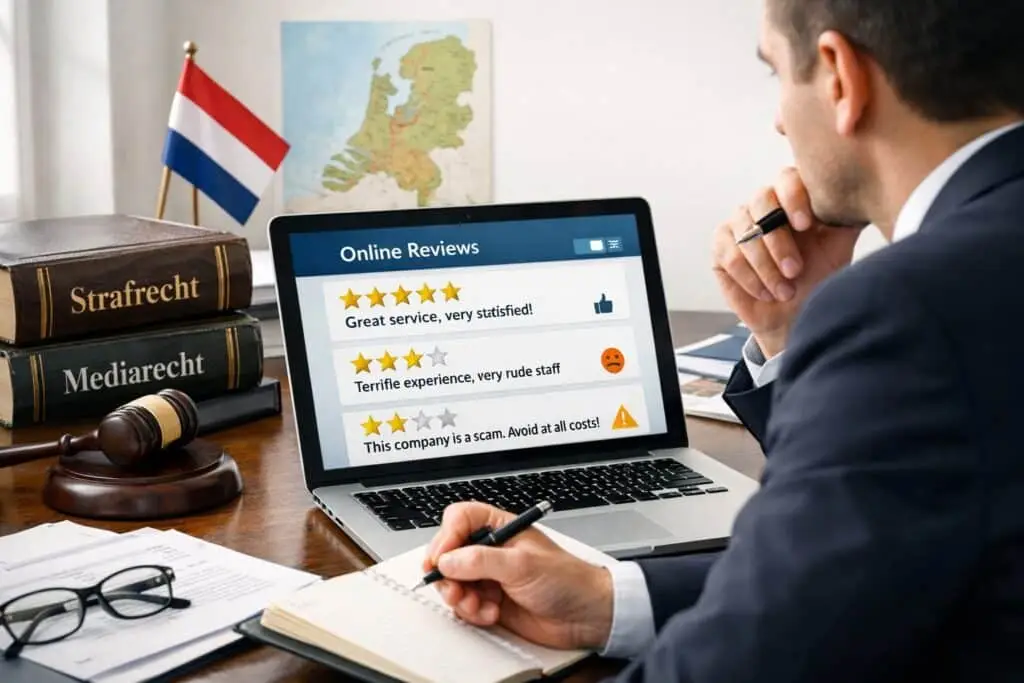
An online review in the Netherlands is lawful as long as it reports a genuine experience and contains no factual allegations that are untrue or unnecessarily damaging. The main exception: a review becomes unlawful when it states as fact something the evidence does not support, and the harm to the business outweighs the reviewer’s freedom of expression. A negative review is not unlawful simply because it is negative. That balancing exercise, not the star rating, decides every Dutch review case.
Two separate bodies of law meet on a review page. The first governs what a reviewer may write. That is freedom of expression under Article 10 of the European Convention on Human Rights. It is limited by the criminal provisions on insult and defamation in the Dutch Criminal Code, and by liability in tort (onrechtmatige daad) under Article 6:162 of the Dutch Civil Code.
The second governs what a business may do with reviews: the rules on unfair commercial practices apply, enforced by the Netherlands Authority for Consumers and Markets (Autoriteit Consument en Markt, ACM). They prohibit fake reviews and require transparency about how reviews are collected and shown.
Is a review an opinion or a factual allegation?

Dutch courts first ask what the review actually says. A value judgement, however harsh, is protected far more strongly than a statement of fact, because it cannot be true or false.
Writing that the service was rude, the room was disappointing or the price was not worth it is opinion. Writing that the owner falsified an invoice, that the food caused food poisoning or that the company keeps customers’ deposits is a factual allegation. For an allegation, the reviewer must be able to point to something that supports it.
The protection of opinion is not unlimited. An opinion with no factual basis at all can still be unlawful. The same applies to an opinion expressed in terms that go further than the point requires. Dutch case law speaks of a sufficient factual foundation: the more serious the accusation, the more support it needs. A reviewer who was actually there, describes what they saw and keeps the language proportionate is in a strong position, even when the business is furious.
When is a review a criminal offence?
A review can be a criminal offence if it attacks someone’s honour or reputation with a specific allegation, or is pure abuse. Dutch criminal law does not use the English distinction between libel and slander; it uses three offences in Title XVI of the Dutch Criminal Code (Sr).
- Defamation (smaad), Article 261 of the Dutch Criminal Code: intentionally attacking someone’s honour or reputation by alleging a specific fact, with the aim of giving that allegation publicity. Where the allegation is made in writing or in images, it is written defamation (smaadschrift). That is the form an online review takes.
- Calumny (laster), Article 262: defamation committed while knowing that the alleged fact is untrue. It is the more serious offence and carries a higher maximum sentence.
- Simple insult (eenvoudige belediging), Article 266: insult that does not involve alleging a specific fact, for example pure abuse directed at a person.
The defence to defamation is narrower than most people assume. Truth alone is not enough. Article 261 provides that there is no defamation where the person acted in necessary defence. The same applies where the person could reasonably assume in good faith that the allegation was true and that the public interest required it to be made. A reviewer who publishes a true but purely private grievance to damage someone is therefore not automatically safe. A reviewer who was mistaken, but had good reason to believe what they wrote, may be.
Two procedural features shape the criminal route in practice. These offences are prosecuted only on a formal complaint (klacht) by the person concerned. That complaint must be filed within three months of the moment the person entitled to complain became aware of the offence. The Public Prosecution Service (Openbaar Ministerie) then decides whether to prosecute, and for a commercial dispute over a review it often does not. The criminal provisions also protect honour and reputation in a personal sense. That is why a company that wants a review dealt with almost always uses the civil route instead.
How does a civil court decide whether a review is unlawful?

The court weighs the reviewer’s freedom of expression against your right to protection of honour and reputation. Neither right ranks above the other in the abstract.
A business that wants a review removed, or wants compensation, brings a claim in tort under Article 6:162 of the Dutch Civil Code. On one side is freedom of expression under Article 10 of the European Convention on Human Rights. On the other is the right to protection of honour, reputation and private life under Article 8. The outcome depends on the circumstances, and Dutch courts assess them along a settled set of factors.
- The nature of the allegations and the seriousness of the consequences they can be expected to have for the person or business concerned.
- The seriousness of the grievance the reviewer wanted to raise, seen from the general interest.
- The extent to which the allegations found support in the factual material available at the time of publication.
- The way the review is worded, and whether the wording goes further than the point required.
- The likelihood that the same aim could have been achieved in another way, for example by complaining to the business first.
- The reach and permanence of the publication, and the position of the person making it.
As the claimant, you carry the burden of proving that the publication is unlawful and that you have suffered damage. In practice the argument concentrates on the third factor. A reviewer who kept the correspondence, the invoice, the photographs or the complaint that preceded the review will usually keep the review online. A reviewer who cannot substantiate a concrete accusation will usually be ordered to remove it. Our overview of online defamation and reputation management under Dutch law deals with the broader reputational picture. The differences between the offences are set out in our article on defamation and its variants.
A civil claim in tort is subject to the ordinary limitation period of Article 3:310 of the Dutch Civil Code. That is five years from the day after the injured party became aware of both the damage and the person responsible, and twenty years in any event. A business that waits two years before objecting, however, weakens the urgency argument it needs in summary proceedings.
What may a business do with reviews?
A business may show, filter and invite reviews, but only honestly and transparently. This second set of rules applies to the trader rather than the reviewer, and a regulator enforces it rather than a court.
Reviews are commercial information. Using them misleadingly is an unfair commercial practice under Articles 6:193a and following of the Dutch Civil Code. The changes brought in by the European Omnibus Directive, which took effect in the Netherlands on 28 May 2022, added specific obligations for reviews.
Some practices are always unfair, without any assessment of their effect on the consumer. Submitting or commissioning false reviews falls into that category, whether they are written by staff, by the owner or by a purchased service. So does misrepresenting reviews or endorsements as coming from consumers who actually used the product. Stating that reviews come from genuine purchasers, without taking reasonable and proportionate steps to check this, is prohibited on the same basis.
Alongside the prohibitions there are information duties. If you give access to consumer reviews, you must tell consumers whether and how you check that they come from people who actually bought or used the product. That information has to be clear and available where the reviews are shown, not buried in the general terms.
May you delete or filter reviews?
You may not remove a review simply because it is negative, and you may not publish only the favourable ones. Selective publication makes the overall picture misleading, which is precisely what the rules address. Removal is legitimate where a review is unlawful, contains abuse or personal data that do not belong there, is manifestly fake, or breaches the platform’s own rules. You should be able to explain the criterion you applied.
Filtering and ranking are permitted if they are transparent. If reviews are ordered other than chronologically, or if some are excluded, the criteria have to be disclosed. The same applies to aggregate scores: if a rating is shown, the consumer should be able to understand what it is based on.
May you reward customers for a review?
Yes, but only openly and never on condition that the review is positive. Offering a discount, a free product or entry to a prize draw in exchange for a review is not prohibited in itself. The incentive must be disclosed, so the reader knows the review was rewarded. Inviting only satisfied customers, or rewarding only five-star ratings, turns a legitimate marketing tool into a misleading commercial practice. The same disclosure duty applies to influencers and affiliates with a commercial relationship to the trader.
The ACM supervises these rules. It has published guidance on the protection of the online consumer, which sets out in detail what it expects from webshops and platforms. It can impose orders subject to a penalty payment and administrative fines. The statutory maxima are laid down in the Instellingswet Autoriteit Consument en Markt, and the ACM publishes its penalty policy on its own website. Our article on unfair commercial practices explains the wider framework, and the consumer protection rules in contracts sit alongside it.
How do you get an unlawful review removed?
The fastest route is almost never the courtroom; it runs through the platform. Since the Digital Services Act became applicable in February 2024, that route has a legal shape rather than depending on a web form and good luck.
How do you notify the platform?
Hosting providers, including review platforms and social networks, must operate a mechanism that lets anyone report content they consider illegal. A notice has to be sufficiently precise and adequately substantiated. It should explain why the content is unlawful, give the exact location by URL, and include the contact details of the person reporting it. A properly substantiated notice gives the platform actual knowledge of the content. That is what makes the platform potentially liable if it then does nothing.
The platform must confirm receipt, decide without undue delay, and give both sides a statement of reasons for its decision. If it refuses, its internal complaint-handling system is open for at least six months after the decision. The dispute can also be referred to a certified out-of-court dispute settlement body. None of this obliges a platform to remove a review that is merely negative. A notice that simply asserts the review is false rarely succeeds; one that shows why, with the underlying documents, sometimes does.
When are summary proceedings the right step?
Where the harm is serious and continuing, the practical instrument is summary proceedings (kort geding) before the preliminary relief judge. The claim is for an order to remove the review, usually backed by a penalty payment (dwangsom) for each day of non-compliance. It can be directed at the reviewer, at the platform, or at both. A decision normally follows within a few weeks. You must show both that the publication is unlawful and that the matter is urgent. The judgment is provisional: the merits can be reopened in ordinary proceedings.
Where the reviewer is anonymous, the platform can be asked to disclose the identifying data it holds. The Supreme Court (Hoge Raad) set the test in Lycos/Pessers (ECLI:NL:HR:2005:AU4019). Disclosure is possible where it is sufficiently plausible that the publication is unlawful and damaging, and where the requesting party has a real interest in the data. There must also be no less far-reaching route, and the balance of interests must favour disclosure. It is a demanding test and courts apply it restrictively, because anonymity is itself part of freedom of expression.
What can you claim?
Removal is the primary remedy, and in most cases it is the only one worth pursuing. Beyond that, Dutch law offers rectification. The court can order a correction to be published, and it decides the wording and placement so that the correction reaches the audience that read the original.
Damages are available but are usually modest. Material damage, such as lost turnover, has to be proven and causally linked to the review. Compensation for non-material damage can be awarded where reputation or honour has been harmed, and Dutch courts award restrained amounts. For most businesses the value of a claim lies in removal and in the deterrent effect, not in the money. Our article on compensation for non-material damage explains how those amounts are assessed, and civil litigation in the Netherlands sets out the ordinary procedure.
What about personal data in reviews?
A review that names an employee, describes their behaviour or includes a photograph processes personal data. The General Data Protection Regulation then applies to the platform and, depending on the circumstances, to a business that republishes the review. A purely personal or household activity is exempt, but publishing on an open review platform is generally not covered by that exemption.
The practical consequences are limited but real. A named individual can ask the platform to erase data about them. A refusal can be taken to the Dutch Data Protection Authority (Autoriteit Persoonsgegevens) or to court. If you copy reviews onto your own website, consider whether the names of staff or of other customers need to be there. If you collect reviews, you must inform reviewers about what happens to their data. Our overview of Dutch data privacy law covers those duties, and the Dutch Data Protection Authority supervises them.
What if the reviewer is not a customer?
A review by someone who was never a customer lacks the factual foundation that protects a real experience, and is easier to attack. Think of reviews posted by a competitor, a former employee, a disgruntled ex-partner or an account created for the purpose. They are treated differently from a genuine but harsh customer review.
Where a competitor posts the review, it is also a commercial act. Misleading or denigrating statements about a competitor’s products or business fall under the rules on comparative advertising and unlawful competition. Where a review is part of a pattern aimed at a single business, the campaign matters more than the individual message. Courts respond to campaigns far more readily than to a single sharp opinion.
Former employees raise a separate question. Their review may reveal information covered by a confidentiality clause, or it may be their account of a genuine grievance. Accusations that a business acted criminally require serious substantiation. If you face them, read our articles on false accusations and your rights and on fighting for your reputation. Where the statement is an insult rather than an allegation of fact, the position is set out in our article on insult, defamation and the available legal solutions. The wider publication rules are covered in our guide to media law in the Netherlands.
How is a removal order enforced?
Mainly through a penalty payment attached to the order. Dutch practice sets it per day or per violation, capped at a maximum, and it becomes due automatically once the deadline passes. That is what makes removal orders effective against reviewers who would otherwise ignore them.
Two complications recur. First, the reviewer may remove the review and post it again, sometimes reworded, sometimes from a new account. A well-drafted order therefore covers repetition of substantially the same statements, not merely the specific URL. Second, there is the international platform. An order against a provider established abroad has to be enforced abroad, which is slower and sometimes out of proportion to the harm. In that situation the notice-and-action route under the Digital Services Act, backed by the judgment, is usually more productive than enforcement proceedings. If a dispute arises about the penalty payments, our article on legal remedies against enforcement of a judgment explains the options. Our article on claims for damages covers the substantive claim that follows.
What should you check as a business?
Secure the evidence first, reply once in public, and only then consider legal steps. A failed removal action can draw far more attention to a review than it ever attracted on its own.
- Take a full screenshot showing the URL, the date and the reviewer’s display name, and keep the order, correspondence and complaint behind it.
- Reply in public once, factually and calmly, and never disclose the customer’s personal details in that reply.
- Check whether the review contains a concrete factual allegation that is untrue, or is merely an unwelcome opinion.
- Ask the reviewer for a correction with your evidence; if that fails, file a substantiated notice with the platform under the Digital Services Act.
- Check your own review page against the ACM rules: no fake or selectively published reviews, disclosed rewards and a clear statement of how you verify reviewers.
- Remember the three-month deadline for a criminal complaint (Article 66 Sr) if you want to report defamation to the police.
What should you check as a reviewer?
Write about what you experienced yourself and keep the proof: whether your allegations had support in the facts available to you is the factor courts weigh most heavily.
- Separate what you observed from what you concluded: describe the dirty table rather than alleging a breach of hygiene rules.
- Avoid accusations of crime unless you can substantiate them with documents.
- Do not name individual staff members or post photos of them.
- Disclose any discount, free product or payment you received for the review.
- Take the complaint to the business first; whether you could have reached your aim another way is one of the court’s factors.
What can we do for you with an online review?
Our IT lawyers act for businesses and for reviewers in disputes about online reviews.
- We assess whether a review is an unlawful factual allegation or a protected opinion.
- We draft the substantiated notice to the platform under the Digital Services Act.
- We send the reviewer a demand letter asking for removal or correction within a short deadline.
- We start summary proceedings (kort geding) for removal with a penalty payment, or defend you against such a claim.
- We review your review policy and incentives against the ACM rules on unfair commercial practices.
Summary
- A negative review is lawful if it reflects a genuine experience; factual allegations need a sufficient factual basis.
- Courts weigh freedom of expression (Article 10 ECHR) against protection of reputation (Article 8 ECHR), with a strong focus on evidence and wording.
- Defamation and calumny are criminal offences, but businesses almost always use the civil route under Article 6:162 of the Dutch Civil Code.
- Businesses may not post fake reviews, delete reviews just because they are negative, or hide rewards; the ACM enforces these rules.
- For removal, start with evidence and a substantiated notice to the platform under the Digital Services Act; summary proceedings are the next step.
Frequently asked questions
What makes an online review lawful under Dutch rules?
A review should reflect a real experience of someone who bought or used the product or service, and factual allegations need a sufficient factual basis. As a business you may not write reviews about yourself while posing as a customer, and rewards for reviews must be disclosed.
How does Dutch law treat defamation in online content?
Dutch law distinguishes defamation (smaad, Article 261 Sr), calumny (laster, Article 262 Sr) and simple insult (Article 266 Sr). These are prosecuted only on a complaint filed within three months; in civil law, an unlawful review is a wrongful act under Article 6:162 BW.
What are the consequences of posting an unlawful review?
The court can order you to remove the review, usually backed by a penalty payment, and to publish a rectification. You may also have to pay damages and part of the legal costs.
What can a business do if it believes a review is unlawful?
Secure the evidence, reply once in public, and ask the reviewer for a correction. If that fails, file a substantiated notice with the platform under the Digital Services Act; summary proceedings (kort geding) are the next step if the harm is serious and continuing.
What role does freedom of expression play for online reviews?
A large one. Freedom of expression under Article 10 ECHR protects harsh opinions, and the court weighs it against the protection of reputation under Article 8 ECHR. A negative review is not unlawful simply because it is negative.