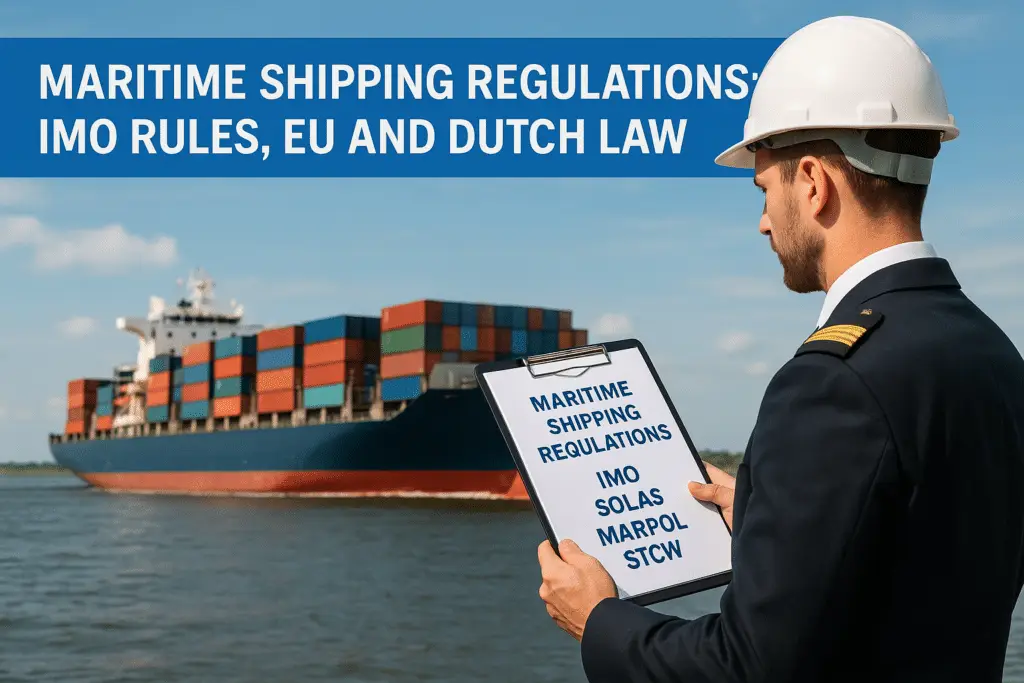
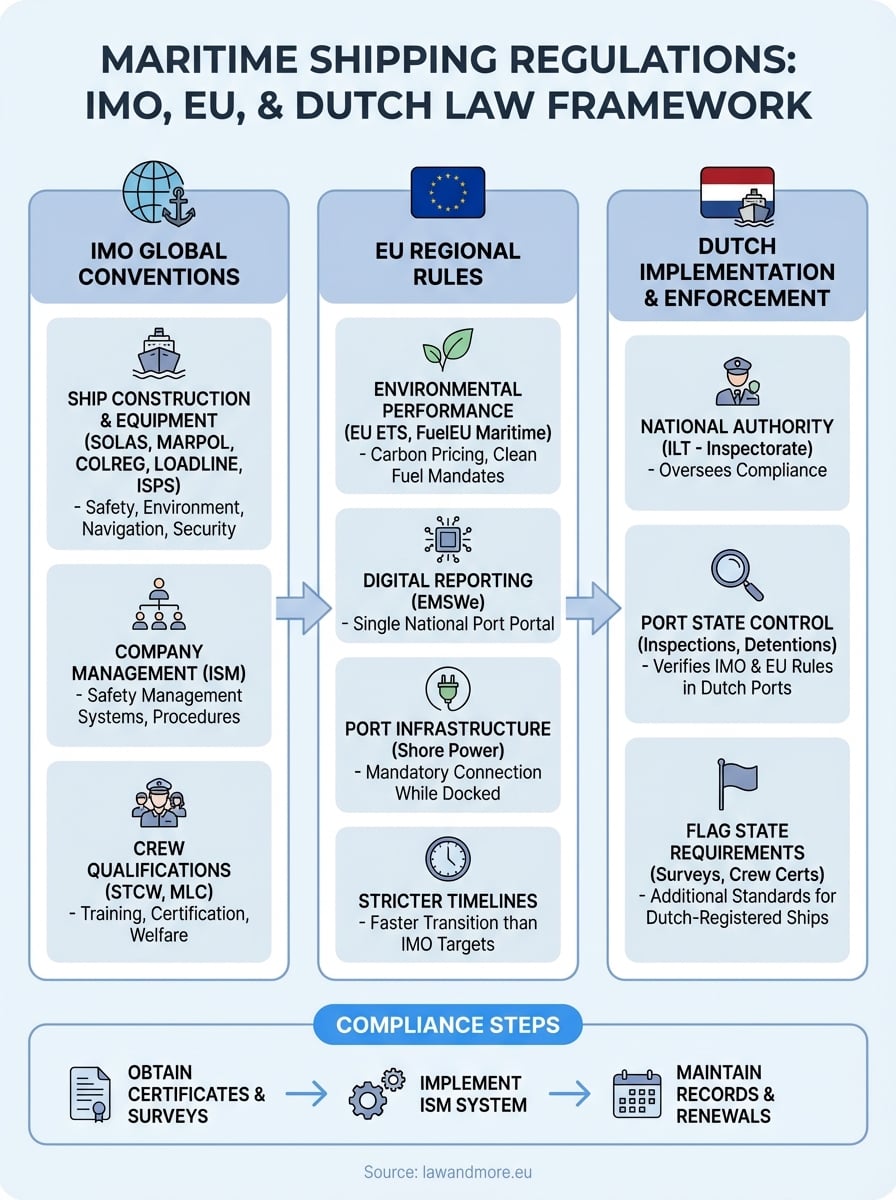
Maritime shipping in the Netherlands is governed by three layers at once: international conventions of the International Maritime Organization (IMO), EU rules that add stricter environmental and reporting duties, and Dutch law, which implements both and provides enforcement through the Human Environment and Transport Inspectorate (Inspectie Leefomgeving en Transport, ILT). A ship calling at Rotterdam is subject to all three, whatever flag it flies.
This article explains which conventions apply, what EU law adds, how the Netherlands enforces the rules against Dutch and foreign ships, and where liability lies when something goes wrong.
Table of contents
Which IMO conventions set the baseline?
The IMO does not enforce anything itself. Its conventions bind states that ratify them and implement them in national law, so the practical question is always what the flag state and the port state require.

- SOLAS governs construction, fire protection, navigation equipment and life-saving appliances, through surveys and certificates.
- MARPOL prevents pollution in six annexes, covering oil, noxious liquids, harmful packaged substances, sewage, garbage and air emissions, including the sulphur limit for marine fuel.
- COLREG sets the collision regulations; the Load Line Convention limits how deep a ship may be loaded; the ISPS Code requires ship and port security plans.
- The ISM Code requires a certified safety management system, evidenced by a Document of Compliance for the company and a Safety Management Certificate for each ship.
- STCW sets training, certification and watchkeeping standards; the Maritime Labour Convention sets minimum working and living conditions for seafarers.
Certificates prove compliance on the day of the survey. Inspectors use the ISM system to test whether compliance is maintained between surveys, and a pattern of minor defects is often treated as a failing safety management system.
What does EU law add for ships in European waters?
EU rules apply on top of the conventions and are often stricter. Three of them now affect the cost and administration of trading to Europe.

- EU Emissions Trading System: since 2024, shipping companies with ships of 5,000 gross tonnage and above must surrender emission allowances for emissions on voyages within the EEA, at berth in EEA ports and for half of the emissions on voyages into and out of the EEA. The obligation was phased in, with full coverage of in-scope emissions from the 2026 reporting year.
- FuelEU Maritime: since 2025, the greenhouse gas intensity of the energy used on board is capped, with tightening limits and penalties for exceedance; compliance can be pooled between ships and banked between years.
- European Maritime Single Window environment: arrival and departure formalities are submitted once through the national single window and shared with customs, the harbour master and other authorities.
Because the allowance price is set by the market, the cost of a voyage now moves with the carbon price. Allocate these costs expressly in charterparties and management agreements.
How does the Netherlands implement and enforce the rules?
Private maritime law is in Book 8 of the Dutch Civil Code (BW), covering ships as property and carriage by sea. Public law statutes carry the conventions into Dutch law, including the Prevention of Pollution from Ships Act (Wet voorkoming verontreiniging door schepen) for MARPOL and the Seagoing Ships Manning Act (Wet bemanning zeeschepen), which replaced the manning rules of the Seafarers Act (Wet zeevarenden).

The ILT acts as flag state authority, port state control authority and main enforcement body. It can board and inspect, demand documents, impose an order subject to a penalty or an administrative fine, and detain a ship until serious deficiencies are remedied. Detentions are published under the Paris Memorandum of Understanding (Paris MoU) and follow the ship and company from port to port. Serious pollution offences are prosecuted by the Public Prosecution Service (Openbaar Ministerie).
An ILT decision is an administrative decision. Under Article 6:7 of the General Administrative Law Act (Awb), you must file an objection within six weeks. If the ship needs to sail before the objection is decided, ask the court separately for a provisional measure. See our note on regulatory enforcement and inspections.
How does a ship obtain the Dutch flag?
Since 1 July 2025, the Kingdom Act on the Nationality of Seagoing Ships (Rijkswet nationaliteit zeeschepen) applies in the Netherlands. Under Article 3 of that Act, a seagoing ship acquires the nationality of the Kingdom by registration in the public flag register (vlagregister), and under Article 17 the Minister issues a certificate of nationality (zeebrief) as proof of the right to fly the flag.

Registration also has a private-law side. A registered ship is registered property: ownership and ship mortgages are transferred and created by notarial deed and registration in the public registers of the Land Registry (Kadaster). For a financed vessel, the ship mortgage is the lender’s main security, and its rank follows from the register.
How does port state control work for foreign ships?
Foreign-flagged ships are inspected under the Paris MoU, to which the Netherlands is a party. Inspection frequency follows a risk profile based on ship age and type, flag performance, the recognised organisation and previous deficiencies.
Inspectors check certificates, but a certificate that does not match the situation on board opens up the inspection. The usual route to detention is a set of individually minor deficiencies that together show the safety management system is not working. Deficiencies are recorded with a code and a rectification deadline, and the report is published. A disputed finding must be challenged through the ILT and, if necessary, through administrative proceedings.
Who is liable when something goes wrong?
Liability is a matter of private law. Carriage of goods by sea under a bill of lading is governed by Book 8 BW, which gives effect to the Hague-Visby Rules, with their exceptions, package limitation and short time bar for claims against the carrier. The interaction between charterparty and bill of lading decides whom a cargo claimant can actually sue.
Shipowners can limit their liability for most maritime claims under the international limitation regime by constituting a limitation fund with the court; the District Court of Rotterdam handles these proceedings and maritime disputes generally. Oil pollution from cargo and from bunkers falls under separate conventions that channel liability to the registered owner and require compulsory insurance, which is why port state inspectors ask for the insurance certificate.
How does ship arrest work in the Netherlands?
A claimant can ask the preliminary relief judge (voorzieningenrechter) for leave to arrest a ship by written request, and leave is often granted the same day. An arrest in a Dutch port secures the claim and can, in some cases, also give the Dutch court jurisdiction over the merits.
A wrongful arrest makes the arresting party liable for the resulting loss. Decide quickly, and on advice, both on the arrest itself and on the security you accept in exchange for release of the ship.
What should you check as a shipowner or operator?
- Plan statutory surveys a year ahead; a lapsed certificate is an immediate detention risk.
- Check that the ISM and security documentation matches actual practice on board, through internal audits.
- Check the ship’s Paris MoU risk profile and inspection history before a Dutch port call.
- Prepare monitoring plans, emissions reports and allowance accounts for the EU ETS, and decide on pooling and banking under FuelEU Maritime.
- Calendar the six-week objection period for every ILT decision.
- Keep the insurance certificates required by the pollution conventions on board.
What should you check as a charterer or cargo interest?
- Check who the carrier is under the bill of lading and how the charterparty allocates liability.
- Note the short time bar for cargo claims under Book 8 BW and act well within it.
- Agree in the charterparty who bears EU ETS and FuelEU Maritime costs.
- Consider ship arrest in a Dutch port to secure a claim, but weigh the risk of liability for a wrongful arrest.
- Check the ship’s detention history before fixing it.
What can we do for you with maritime regulation?
Our corporate lawyers advise shipowners, operators, charterers and cargo interests; see also our overview of types of legal compliance.
- We file an objection and request a provisional measure against an ILT detention or enforcement decision.
- We review charterparties and management agreements, including the allocation of EU ETS and FuelEU costs.
- We advise on registration under the Dutch flag and on ship mortgages.
- We prepare a request for leave to arrest a ship, or the defence against an arrest.
- We assess cargo claims and limitation of liability.
Summary
- Shipping in the Netherlands is governed by IMO conventions, EU rules and Dutch law at the same time, enforced mainly by the ILT.
- The EU ETS and FuelEU Maritime now add emissions costs and reporting duties for ships trading to Europe.
- An ILT decision can be challenged by objection within six weeks under Article 6:7 Awb.
- Since 1 July 2025, Dutch nationality is acquired by registration in the flag register under the Rijkswet nationaliteit zeeschepen.
- Ship arrest in a Dutch port is fast, but a wrongful arrest creates liability.
Frequently asked questions
Which authority enforces maritime rules in the Netherlands?
The Human Environment and Transport Inspectorate (ILT) acts as flag state authority, port state control authority and main enforcement body. Serious pollution offences are prosecuted by the Public Prosecution Service.
Do Dutch rules apply to foreign-flagged ships?
Yes. Foreign ships calling at Dutch ports are inspected under the Paris MoU against the international conventions and EU rules, and can be detained if serious deficiencies are found.
How can I challenge a detention by the ILT?
File an objection with the ILT within six weeks under Article 6:7 Awb. If the ship must sail sooner, ask the court for a provisional measure at the same time.
How fast can a ship be arrested in the Netherlands?
Leave to arrest is requested from the preliminary relief judge by written request and is often granted the same day. The claimant is liable for the loss caused if the arrest proves wrongful.