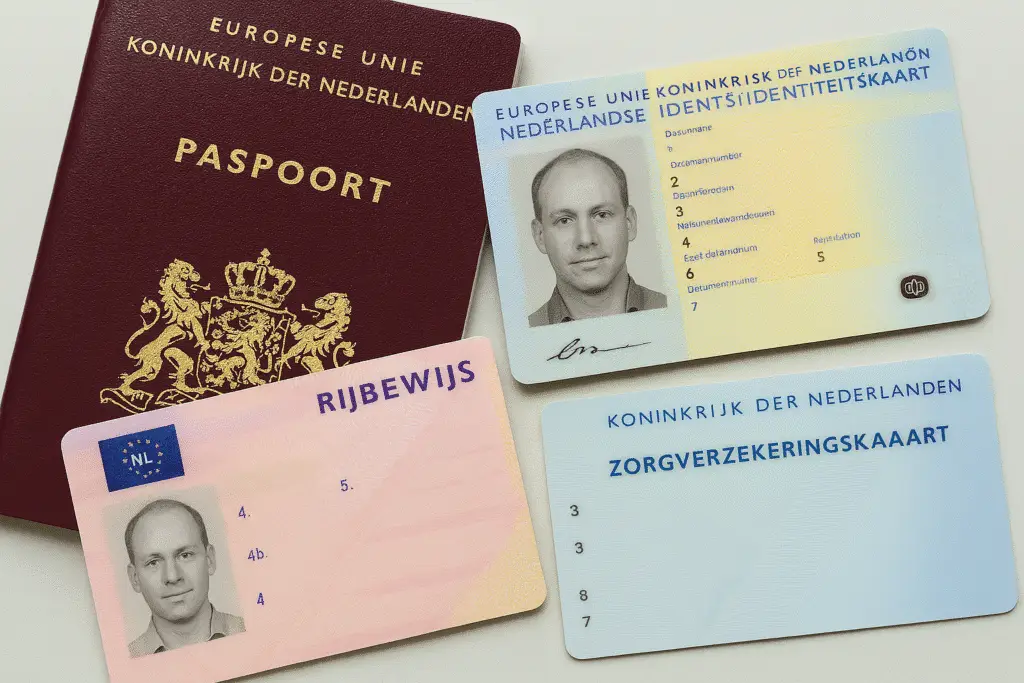
Identity fraud in the Netherlands carries a maximum of five years’ imprisonment or a fine of the fifth category under Article 231b of the Dutch Criminal Code (Wetboek van Strafrecht, Sr). The main exception is biometric data, such as fingerprints or facial images: misuse of those falls under Article 231a Sr, with a maximum of six years.
Those are ceilings, not fixed tariffs. A first offender with limited damage is far more likely to receive community service (taakstraf) or a suspended sentence than prison. Below we explain what is punishable, how courts set the sentence and what you can do as a suspect or as a victim.
Table of contents
What exactly is punishable under Article 231b Sr?
Article 231b Sr punishes the intentional and unlawful use of another person’s identifying data, with the aim of hiding your own identity or hiding or misusing theirs, where harm may result. If one of these elements is missing, the Public Prosecution Service (Openbaar Ministerie, OM) cannot obtain a conviction for this offence.
- Identifying data: a name, date of birth, citizen service number (BSN), a copy of a passport or ID card, or a bank account number combined with other details.
- Intentional and unlawful: an administrative mistake, or use with the consent of the person concerned, falls outside Article 231b Sr.
- Aim of concealment or misuse: the data must be used to hide or misuse an identity.
- Possible harm: actual damage is not required, but a purely theoretical risk is not enough.
Using an invented name is not an offence under Article 231b Sr. It only becomes identity fraud when the data of a real other person is used in this way. The fine amounts for each category are set in Article 23 Sr and indexed periodically, so always check the current amount on wetten.overheid.nl.
When does the higher maximum for biometric data apply?
Article 231a Sr applies when someone falsifies biometric features or data, uses falsified biometric data as genuine, or uses another person’s real biometric data. The maximum is six years’ imprisonment or a fine of the fifth category.
The legislator chose a higher maximum because a fingerprint or a face cannot be replaced like a password. A wrongly attributed biometric trace is also very hard to remove from police and government records.
Which other offences are usually charged alongside identity fraud?
Identity fraud rarely stands alone in a summons. The Public Prosecution Service usually adds forgery, fraud or money laundering, which can raise the total sentence well above five years.
- Forgery of documents: Article 225 Sr, maximum six years.
- Fraud (oplichting) by using a false name or a web of lies: Article 326 Sr, maximum four years.
- False travel documents, or using a travel document issued to someone else: Article 231 Sr.
- Unauthorised access to a computer system (computervredebreuk): Article 138ab Sr.
- Money laundering of the proceeds: Articles 420bis to 420quater Sr.
When several offences are tried together, Article 57 Sr allows the court to impose up to the highest applicable maximum plus one third. Our overview of fraud and financial crime in the Netherlands explains how these offences interlock.

How does a Dutch court decide on the sentence?
There is no statutory tariff for identity fraud. The court sentences within the statutory maximum, guided by the orientation points of the national consultation of criminal judges (LOVS) and by sentences in comparable cases.
The factors that weigh most are the financial damage, the number of victims, the period over which the conduct continued, the degree of organisation, your role and any previous convictions. Early compensation of victims, a long time since the offence and personal circumstances can lower the sentence.
The court has more options than prison:
- Community service of up to 240 hours (Article 22c Sr), often for first offenders.
- A (partly) suspended sentence with a probation period and conditions, such as a reporting obligation (Article 14a Sr).
- A conviction without any penalty in exceptional cases (Article 9a Sr).
- A compensation order (schadevergoedingsmaatregel) in favour of the victim.
- Separate confiscation proceedings (ontnemingsprocedure) to recover any criminal gain.
Can staying silent lead to a heavier sentence?
No. Under Article 29 of the Code of Criminal Procedure (Wetboek van Strafvordering, Sv) you are not obliged to answer questions, and the police must tell you so before each interview.
The court may not punish you more heavily for denying the charge or remaining silent. It may treat a confession, remorse and compensation as mitigating factors. You also have the right to consult a lawyer before the first police interview and to have a lawyer present during it. Our article on the summons and the hearing in a Dutch criminal case explains what happens after the investigation.
What applies to minors and lent identity documents?
Lending your identity document to someone else is an offence under Article 231 Sr, even with the consent of the holder or a parent. Both the lender and the user can be prosecuted.
A document reported as misused can be entered in the travel document alert register (Register Paspoortsignaleringen), which can block a new passport. Suspects under 18 are tried under juvenile criminal law: youth detention is capped at 12 months for those under 16 at the time of the offence and 24 months for 16- and 17-year-olds. For young adults up to 23, the court may still apply juvenile criminal law (adolescentenstrafrecht).
What should you check if you are suspected of identity fraud?
Do not make a statement before you have spoken to a lawyer. Identity fraud is usually investigated together with forgery, fraud and money laundering, so the charge that decides the sentence is often not the first one the police mention.
- Ask which offence you are suspected of and over which dates.
- Check whether there is proof of each element of Article 231b Sr, including intent and possible harm.
- Keep documents that show consent or a legitimate reason for holding the data.
- Gather proof that an account or transaction was not yours.
- If the evidence is strong, start compensating victims before the hearing, not at it.
What should you check if you are a victim of identity fraud?
Report the fraud to the police first: without a report there is no criminal investigation. Then contact the Central Reporting Point for Identity Fraud and Errors (Centraal Meldpunt Identiteitsfraude en -fouten, CMI), which helps you trace and correct wrong entries in registers.
- Bring evidence to the police: letters, invoices, bank statements and screenshots of accounts opened in your name.
- Notify your bank at once and report a lost or stolen document so it can be registered.
- Do not pay for loans or subscriptions you did not take out: an agreement made in your name without authority does not bind you.
- Ask organisations to correct or erase the false data under the GDPR (AVG); if they refuse, you can complain to the Dutch Data Protection Authority (Autoriteit Persoonsgegevens).
- Join the criminal case as an injured party (benadeelde partij) to claim your damage from the suspect.
If the convicted person does not pay a compensation order on time, the state advances the amount to a private victim through the Central Fine Collection Agency (CJIB), subject to statutory limits. Without a prosecution you can still bring a civil claim for an unlawful act under Article 6:162 of the Dutch Civil Code (BW). Our guide on fraud in the Netherlands covers the recovery steps in more detail.
How long can identity fraud be prosecuted?
Under Article 70 Sr, the right to prosecute offences with a maximum of more than three years’ imprisonment expires after twelve years. That covers both Article 231b and Article 231a Sr; any act of prosecution the suspect knows about starts the period again.
A civil claim for damages against the fraudster becomes time-barred five years after the day after you became aware of the damage and the person liable, with an outer limit of twenty years (Article 3:310 BW). A written demand that clearly reserves your right to compensation interrupts that period.
How can you reduce the risk of identity fraud?
Most identity fraud starts with a copy of an identity document. Only hand over a copy where the law requires identification, such as when you start a job or open a bank account; a landlord or webshop usually has no right to your BSN.
Where a copy is needed, use the government’s KopieID app, black out your BSN and photo, and write the date, recipient and purpose on it. Use a unique password and two-factor authentication for each account, and check your bank statements regularly. Our article on online fraud and phishing explains how evidence in these cases is built.
What can we do for you with an identity fraud case?
Our criminal lawyers act for both suspects and victims in identity fraud cases.
- We assist you before and during the police interview and advise on whether to make a statement.
- We review the case file against each element of Article 231b or 231a Sr.
- We prepare your defence and the sentencing arguments for the hearing at the district court.
- We draft and substantiate your claim as an injured party in the criminal case.
- We send written demands and bring civil claims against the fraudster or organisations that refuse to correct your data.
Summary
- Identity fraud under Article 231b Sr carries up to five years’ imprisonment or a fine of the fifth category; biometric fraud under Article 231a Sr up to six years.
- Courts have no fixed tariff; damage, number of victims, organisation and record decide the sentence, and first offenders often receive community service.
- Forgery, fraud and money laundering are often charged as well, which can raise the maximum by one third.
- Silence may not lead to a heavier sentence; ask for a lawyer before the first interview.
- Victims should report to the police, contact the CMI and can claim damages in the criminal case.
Frequently asked questions
Do you always get a prison sentence for identity fraud?
No. Article 231b Sr allows up to five years, but first offenders with limited damage often receive community service of up to 240 hours or a suspended sentence. The court looks at the damage, the number of victims and your record.
Is pretending to be someone else always a criminal offence?
No. Using an invented name is not identity fraud under Article 231b Sr. It becomes an offence when you intentionally and unlawfully use the identifying data of a real person, with the aim of concealing or misusing an identity, in a way that may cause harm.
What happens if the suspect is a minor?
Suspects under 18 are tried under juvenile criminal law. Youth detention is capped at 12 months for children under 16 and 24 months for 16- and 17-year-olds, and the focus is on preventing reoffending.
Can I get a new passport after a conviction for identity fraud?
A conviction alone does not bar a new Dutch passport. Issue can be refused if you are entered in the travel document alert register (Register Paspoortsignaleringen), for example after a reported misuse of a document.
Am I liable for loans taken out in my name by a fraudster?
No. An agreement concluded in your name without your authority does not bind you. The party claiming payment must show that you consented; report the fraud to the police and send them a copy of the report.