
A divorce in the Netherlands always goes through the court: there is no administrative route for ending a marriage. The marriage only ends when the court’s decision has been entered in the civil registry, which must happen within six months after the decision has become final; if that deadline is missed, the decision lapses and the whole procedure has to be repeated (Article 1:163 of the Dutch Civil Code, Burgerlijk Wetboek, BW).
The procedure takes one of two forms. Where both spouses agree, they file a joint petition through one lawyer (advocaat) acting for both of them, together with a divorce settlement (echtscheidingsconvenant) and, where there are children under eighteen, a parenting plan. A mediator can help reach those agreements, but only a lawyer can file the petition. This is the faster and cheaper route, and in most cases no hearing is needed. Where there is no agreement, one spouse files a petition through their own lawyer, the other files a defence through theirs, and the court decides the disputed points after a hearing. Interim measures, such as who lives in the home, where the children stay and temporary maintenance, can be requested separately and are usually dealt with within weeks rather than months.
In either case, four subjects need to be settled: the division of the marital property or the settlement under the prenuptial agreement, maintenance for the children and, where relevant, for the former spouse, the arrangements for the children, and the equalisation of pension rights built up during the marriage. For the pension, under the current rules the pension provider must be notified within two years of the divorce if the ex-spouse is to receive payments directly.
What are the key steps in a Dutch divorce?
The key steps are preparation, filing the petition, the court proceedings, the divorce decision, and registration. Each step has its own requirements and documents.

How do you prepare for a divorce?
Start by gathering documents and making an overview of your assets, debts, income and pensions. Then decide whether you and your spouse can reach agreement on the main points, because that determines the route.
The documents typically include an extract of the marriage certificate, extracts from the Personal Records Database (Basisregistratie Personen, BRP), financial statements, property records and information on the children. You need an overview of all joint and individual assets and debts to know what has to be divided. Which assets are shared depends on your property regime: for marriages from 1 January 2018 the limited community of property applies by default, for older marriages usually the general community, unless you made a prenuptial agreement (huwelijkse voorwaarden).
The key decisions concern the division of property, partner maintenance, child maintenance and the arrangements for the children. Couples can choose between two routes: a joint petition or a unilateral petition. A joint petition usually goes faster and with less emotional strain, because both parties have already agreed on the terms.
How is the petition filed and how do the court proceedings work?
The formal procedure starts with a petition (verzoekschrift) filed with the district court (rechtbank) by a lawyer. With a joint petition one lawyer can act for both spouses; with a unilateral petition each spouse needs their own lawyer.
A Dutch court has jurisdiction if one of the grounds in the Brussels II-ter Regulation (EU) 2019/1111 applies. The most common grounds are that both spouses, or the respondent, live in the Netherlands; that the applicant has lived here for at least a year before filing; or that both spouses have Dutch nationality. More information on navigating divorce procedures is available on our website.
In a unilateral procedure, the other spouse has six weeks to file a defence and can make counter-requests. The court then holds an oral hearing, where both spouses and their lawyers explain their positions. The court reviews the documents, assesses the financial arrangements and decides on the arrangements for the children if the parents cannot agree.
How is the divorce finalised?
Once the procedure is complete, the court issues its decision. The decision dissolves the marriage in principle, and deals with the disputed points or includes the agreed divorce settlement.
After the decision has become final, the lawyer sends it to the civil registry for registration. For marriages concluded in the Netherlands this is the municipality where the marriage took place; for marriages concluded abroad it is usually the municipality of The Hague. Only then is the marriage dissolved. The registration must take place within six months after the decision became final.
Overview of the steps
The table below shows the typical stages of the Dutch divorce procedure, with the main actions and results at each stage.
| Step | Main actions | Result |
|---|---|---|
| Preparation | Gather documents, list assets and debts, draft the settlement and parenting plan | Complete documents and proposed terms |
| Filing | Lawyer files the joint or unilateral petition with the district court | Start of the proceedings |
| Proceedings | Defence (in a unilateral procedure), oral hearing if needed, further negotiation | Agreements or court decisions on property, children and maintenance |
| Divorce decision | Court issues its decision | Divorce pronounced |
| Registration | Lawyer sends the final decision to the civil registry within six months | Marriage legally dissolved |
| After the divorce | Update the municipal registration, bank accounts, insurance, property and pension arrangements | Administrative transition completed |
Which documents and time frames apply?
You need documents on your marriage, your children and your finances. A divorce on a joint petition often takes a few months; a contested divorce usually takes much longer.
Which documents do you need?
The petition must be accompanied by a number of official documents, and the financial arrangements require insight into all assets and income.
- an extract of the marriage certificate, or of the registration of a marriage concluded abroad;
- extracts from the BRP for the spouses and any minor children;
- birth certificates or extracts for the children;
- the parenting plan, if there are minor children (Article 815 of the Dutch Code of Civil Procedure, Wetboek van Burgerlijke Rechtsvordering, Rv);
- the divorce settlement, if the spouses have reached agreement;
- for foreign documents: a certified translation and, depending on the country, an apostille or legalisation.
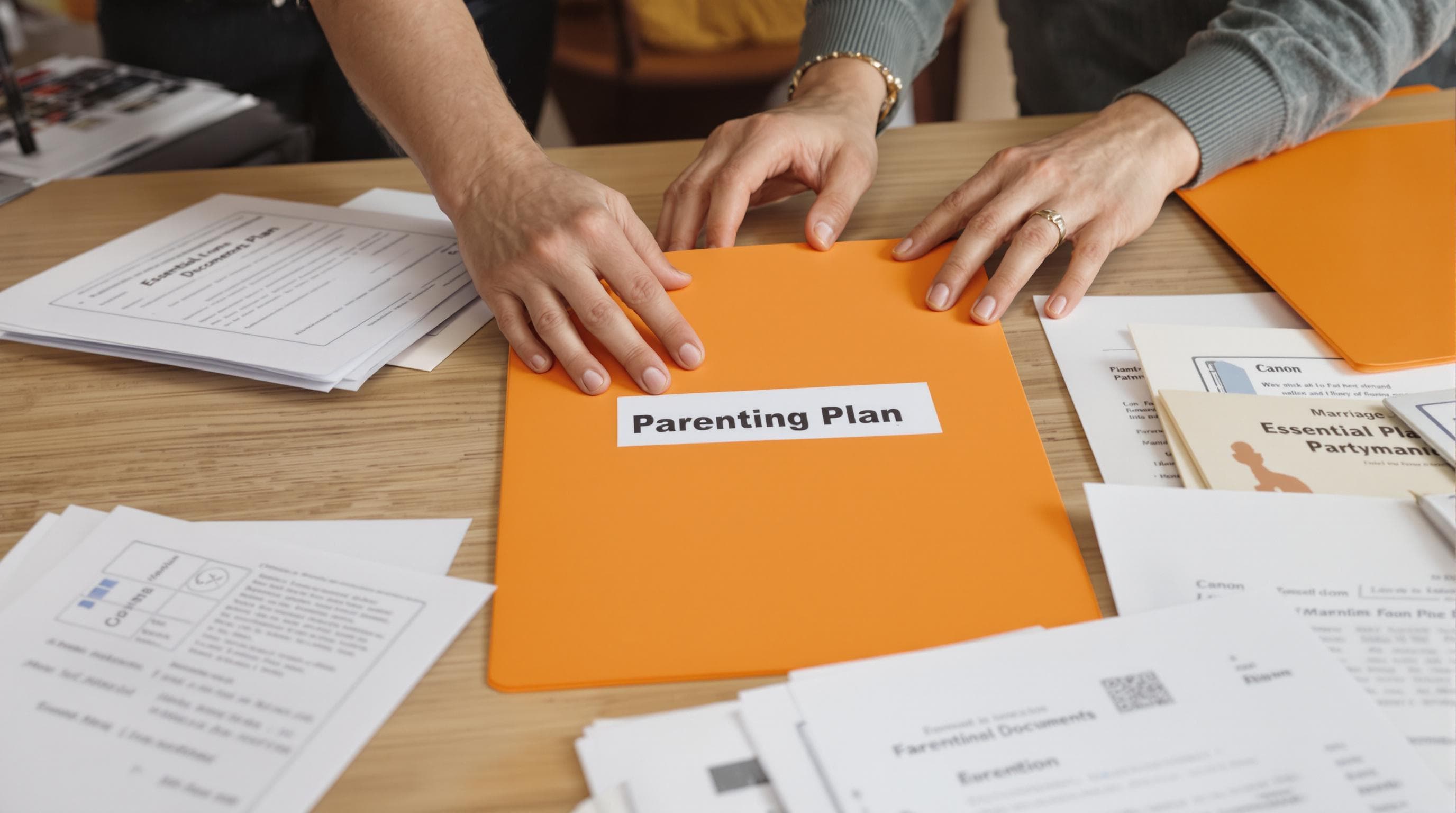
Financial documents are needed for the division of property and the calculation of maintenance. Collect recent tax returns, pay slips, bank statements, investment records, mortgage documents, pension overviews and information on shared and individual assets and debts. These documents allow the spouses, and if necessary the court, to divide the property correctly and to calculate maintenance on the basis of actual income.
The parenting plan must at least describe how the parents divide care and upbringing or arrange contact, how they inform and consult each other about important matters, and how they share the costs of the children. It must also state how the children were involved in drawing it up.
How long does a divorce take?
There are no fixed statutory time frames for the whole procedure. As an indication, a divorce on a joint petition can often be completed within a few months after filing, provided the documents are complete. A contested divorce often takes a year or more, especially if the division of property or the arrangements for the children are disputed.
In a contested procedure, the court gives the other spouse six weeks to respond, after which it schedules an oral hearing. Sometimes the court decides the divorce itself first and deals with other points, such as the division of property, later. Missing a deadline or submitting incomplete documents delays the procedure.
If arrangements are needed during the procedure, a spouse can ask for interim measures (voorlopige voorzieningen) under Article 821 Rv. The court can then decide quickly, usually within weeks, on matters such as the use of the marital home, the children’s temporary residence and temporary maintenance.
What must you arrange after the divorce?
After registration, several practical steps follow. Update your registration in the BRP if you move, and inform banks, insurers and other institutions. Close or divide joint accounts, and arrange the transfer of the home and the mortgage if one spouse keeps the house.
Check your pension arrangements as well. Under the Pension Rights Equalisation (Divorce) Act (Wet verevening pensioenrechten bij scheiding) each ex-spouse is in principle entitled to half of the retirement pension built up during the marriage, unless they agreed otherwise. For direct payment by the pension provider, the provider must be notified within two years after the divorce with the prescribed form. A bill to replace these rules (the Wet pensioenverdeling bij scheiding 2022) is still pending in parliament and is not in force, so equalisation under the current Act remains the default.
Also review your will and any beneficiary designations, such as those in life insurance policies. The parenting plan does not need to be registered anywhere, but the parents must follow it and update it if circumstances change.
What does a divorce mean for families and business owners?
A divorce affects much more than the legal relationship between the spouses. For children, it changes their daily life; for business owners, it can affect the ownership and financing of the company.
How are the children protected?
The interests of the children come first. Parents who had joint authority keep it after the divorce, and the parenting plan sets out how they will continue to raise the children together (Article 1:251 BW).
The plan must cover care and contact, information and consultation, and the costs of the children. It should ensure as little disruption as possible to the children’s daily life. Children aged twelve and older are invited by the court to give their views, and younger children can also be heard.
If parents keep fighting about the children, the court can involve the Child Care and Protection Board (Raad voor de Kinderbescherming).
What happens to a business in a divorce?
Whether a business falls under the division depends on the property regime. Under the old general community of property, a business usually falls into the community in full. Under the limited community of property since 2018, a business owned before the marriage remains private, but the community may be entitled to a reasonable remuneration for the effort of the entrepreneur spouse during the marriage (Article 1:95a BW). With a prenuptial agreement, the agreement decides.
If the business, or part of its value, must be divided or settled, a valuation is needed. Business valuators, often working with accountants and lawyers, assess the value of the company on the basis of factors such as expected future earnings, existing contracts and market conditions. Entrepreneurs then often look for solutions such as a buy-out of the other spouse, payment in instalments, or a combination with other assets, so that the business can continue.
How do you choose the right legal support?
The right support depends on how much you and your spouse agree and how complex your situation is. A lawyer is always needed to file the petition; a mediator can help you reach agreement.
What does a divorce cost, and can you get legal aid?
The costs consist of lawyers’ fees, the court fee (griffierecht) and any costs of mediators, notaries and valuators. They vary with the complexity of the case, the route chosen and the rates of the professionals involved.
If your income and assets are below certain limits, you may qualify for subsidised legal aid through the Legal Aid Board (Raad voor Rechtsbijstand), with a personal contribution. Mediation is often cheaper, because the spouses share one mediator and usually one lawyer for the joint petition.
What should you check as the spouse who files?
If you start the procedure, a complete file prevents delays at the district court. Check these points:
- Whether a Dutch court has jurisdiction under the Brussels II-ter Regulation, for example because you have lived here for at least a year.
- Your property regime: limited community of property for marriages from 1 January 2018, general community for most older marriages, or a prenuptial agreement.
- Whether you have a parenting plan for minor children (Article 815 Rv), or can explain why there is none.
- Whether you need interim measures under Article 821 Rv for the home, the children or maintenance.
- Whether your marriage certificate, BRP extracts and any foreign documents with translation and apostille are ready.
What should you check as the spouse who receives the petition?
If your spouse files a unilateral petition, the court sets a deadline of six weeks for your defence. Check these points:
- Note the deadline for the defence and instruct your own lawyer straight away; you cannot file it yourself.
- Check which requests the petition contains and decide which counter-requests you want to make.
- Collect your own financial documents: tax returns, pay slips, pension overviews and business figures.
- If you run a business, check whether the community may claim a reasonable remuneration under Article 1:95a BW.
- After the divorce, notify the pension provider within two years if you want direct payment of your share.
What can we do for you with a divorce?
Our divorce lawyers in Eindhoven and Amsterdam handle Dutch and international divorces, in English or Dutch. More on the wider area is on our family law page.
- We check whether a Dutch court has jurisdiction and which law applies to your property and maintenance.
- We draft the divorce settlement and the parenting plan and file the joint petition for both of you.
- We file a unilateral petition or a defence within the six-week deadline, with any counter-requests.
- We request interim measures under Article 821 Rv for the home, the children and temporary maintenance.
- We work with valuators and notaries on the division of the home, a business or shares.
- We send the final decision to the civil registry within the six-month deadline of Article 1:163 BW.
Summary
- A divorce in the Netherlands always requires a court decision, and the marriage only ends once that decision is registered, within six months after it becomes final.
- With a joint petition one lawyer can act for both spouses; with a unilateral petition each spouse needs their own lawyer.
- With minor children, a parenting plan must in principle be filed with the petition.
- Four subjects must be settled: property, maintenance, the children and the pension.
- Interim measures during the procedure can be requested separately and are usually decided within weeks.
Frequently asked questions
How long does a divorce take in the Netherlands?
There are no fixed statutory time frames. A divorce on a joint petition can often be completed within a few months after filing, while a contested divorce often takes a year or more. After the decision becomes final, it must be registered within six months.
What documents are required to start a divorce in the Netherlands?
Usually an extract of the marriage certificate, extracts from the Personal Records Database (BRP), details of the children and, where there are minor children, a parenting plan. Foreign documents may need a certified translation and an apostille or legalisation.
How does a divorce affect the children?
Parents with joint authority keep it after the divorce (Article 1:251 BW) and must set out in a parenting plan how they divide care, consult each other and share the costs. Children aged twelve and older are invited to give their views to the court.
Do I need a lawyer for a divorce in the Netherlands?
Yes. Only a lawyer (advocaat) can file the petition with the district court. With a joint petition one lawyer can act for both spouses; a mediator can help you reach agreement but cannot file the petition.