Under Article 3:15a of the Dutch Civil Code (BW), an electronic signature has the same legal effect as a handwritten one. For a qualified electronic signature this follows directly from the law; an advanced or simple electronic signature only has that effect if the signing method was sufficiently reliable, given the purpose of the signature and all other circumstances.
Dutch and European law therefore do not prescribe a technology. They set a reliability standard that must match what is at stake. Some transactions, such as the transfer of a house or of shares in a private limited company (BV), cannot be signed electronically at all because they need a notarial deed.
Table of contents
Why does the reliability standard matter?
A weak signature rarely makes a contract void, but it weakens your evidence. Under Article 6:217 BW a contract is formed by offer and acceptance, and in most cases no signature is needed at all.
What a weak signature costs you is your position in court. If the other party denies signing and your only record is an e-mail address and a click, you must prove that this person signed and intended to be bound. Under Article 159(2) of the Dutch Code of Civil Procedure (Rv), a signed private deed proves nothing as long as the denied signature has not been traced to the signatory.

The effort you put into authentication should therefore follow the exposure of the document. An internal approval, a routine order confirmation and a fifteen-year lease do not need the same level. Our note on legal compliance obligations places this in the wider picture.
Which European and Dutch rules apply?
The basis is Regulation (EU) No 910/2014, the eIDAS Regulation, whose rules on electronic signatures have applied since 1 July 2016. Article 3:15a BW refers to this regulation and links it to Dutch evidence law.
The eIDAS Regulation provides that a signature may not be denied legal effect or admissibility as evidence only because it is electronic or because it is not qualified. A qualified electronic signature has the same legal effect as a handwritten signature in every EU member state.
Regulation (EU) 2024/1183, in force since 20 May 2024, amended the eIDAS Regulation and introduced the European Digital Identity Wallet. Member states must offer the wallet from around the end of 2026, and it is expected to become a common way to prove your identity when signing.

What does Article 3:15a BW say?
Article 3:15a BW gives a qualified signature the same effect as a handwritten one. An advanced or a simple electronic signature has that same effect only if the method used was sufficiently reliable, given the purpose of the signature and all other circumstances of the case.
A simple signature is therefore not invalid. It is unproven until you prove it, and the court decides whether the method was reliable enough for this document. In business contracts you may agree in advance which signing method both parties accept, which makes a later dispute about reliability less likely.
When is the electronic route closed?
Some transactions require a notarial deed and cannot be completed with any electronic signature. The transfer of real estate requires a notarial deed under Article 3:89 BW, and the transfer of shares in a BV requires a deed executed before a Dutch civil-law notary under Article 2:196 BW.
A prenuptial agreement and a will follow the same notarial route; a notary is not optional there. Where the law only requires a contract in writing, Article 6:227a BW accepts an electronic contract if it can be consulted by the parties, its authenticity is sufficiently guaranteed, the moment of conclusion and the identity of the parties can be established with sufficient certainty.
Article 6:227a(2) BW excludes contracts for which the law requires the involvement of a court, a public body or a professional with a public task. So the first step is always to check whether your document needs a notary, needs writing, or needs neither.
What are the three signature levels worth?
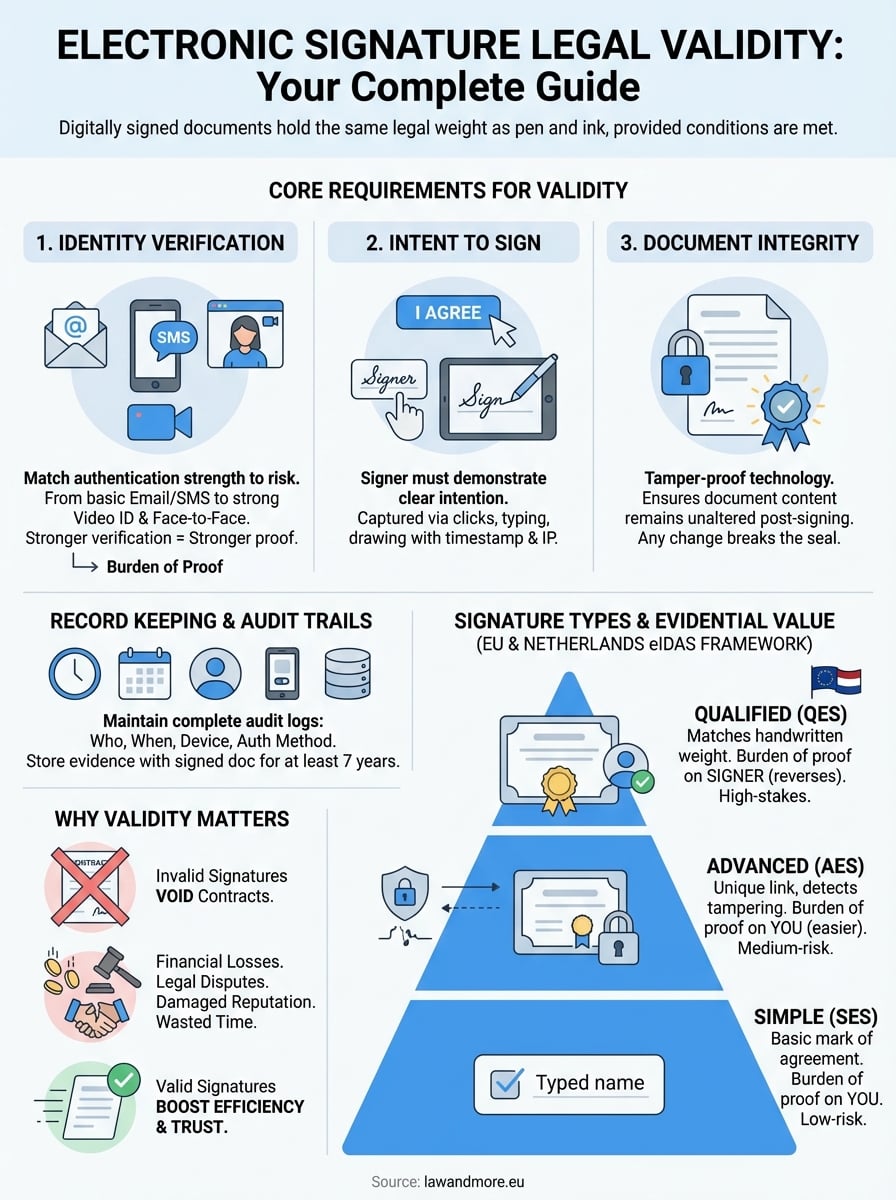
The eIDAS Regulation distinguishes three levels, and the difference is about evidence. A simple electronic signature is any electronic data used to sign: a typed name, a click on an “accept” button or a scanned image of a signature.
An advanced electronic signature is uniquely linked to the signatory, identifies him, is created with data under his sole control, and is linked to the document so that any later change can be detected. A qualified electronic signature is an advanced signature made with a qualified signature creation device and based on a qualified certificate from a trust service provider on the EU trusted list.
Only the qualified signature is equal to a handwritten one by law. For the other two levels, the court applies the reliability test of Article 3:15a BW. Use simple signatures where the exposure is small and the relationship is settled; use at least an advanced signature for high-value or long-term contracts and for unfamiliar counterparties.
What does a signature prove in Dutch proceedings?
A signed private deed (onderhandse akte) gives compelling evidence (dwingend bewijs) between the parties of the statements it contains, under Article 157(2) Rv. If the other party firmly denies the signature, Article 159(2) Rv takes that evidential force away until you prove where the signature came from.
With a qualified signature, that proof is simple because the certificate and the audit data identify the signatory. With a simple signature, everything depends on what your signing platform recorded at the time. That record cannot be rebuilt later.
How do you prove identity, intent and integrity?
You prove identity with what the process records before the signature is applied. An e-mailed link only proves control of a mailbox; a second factor by phone, a verified bank transaction, an ID check by video or a qualified certificate each raise the level and leave a record.
Where several people share one departmental login, the process proves nothing about which person signed. This is a recurring weakness in employment and procurement files, and it is exactly the point a court will test under Article 159(2) Rv.

Intent is shown by the act: opening the document, scrolling through it and choosing to sign the version presented. A platform that records the document hash, the time, the authentication used and the sequence of steps gives you that evidence. Integrity is the technical side: a sealed document shows any later change, so a correction after signing needs a new signing round.
How long should you keep the audit trail?
Keep the audit trail with the signed document for at least the retention period of the underlying records. Under Article 52(4) of the General State Taxes Act (AWR), businesses must keep their tax-relevant records for seven years.
The audit trail should show who was invited, who opened the document, how they authenticated, when they signed and the validation result of any certificate at the time of signing. Certificates expire, so a signature remains verifiable afterwards only if the validation was recorded when it was made.
Where do electronic signatures go wrong?
Most failures follow four patterns. The first is a mismatch between the authentication used and the value of the document, such as a click-through signature on a contract worth a year of turnover.
The second is a shared mailbox or login, which makes it impossible to link the signature to a person. The third is a signatory without authority to bind the company: check who may represent the company in the Chamber of Commerce (KVK) trade register before signing, not afterwards. The fourth is an incomplete record, where the platform subscription ends and the audit data disappears with it.
Before you sign a contract, agree which signature level the document needs and who on each side may use it. Where someone signs on behalf of another person, document the power of attorney as carefully as the signature itself.
Which documents need particular care?
Some clauses are only valid if agreed in writing. Under Article 7:652(2) BW a probationary period must be agreed in writing, and under Article 7:653 BW a non-competition clause is only valid if agreed in writing with an adult employee.
An employment contract concluded through an HR portal meets that written-form requirement only if it satisfies Article 6:227a BW: the employee can consult the text and the moment of signing can be established. For counterparties outside the EU, check whether the signature will be recognised there, because the equivalence rule of the eIDAS Regulation only covers the EU.
How do you set up a signing process that holds?
A workable signing policy fits on one page. Sort your documents into three tiers, link each tier to a signature level, name who may sign in each tier, archive the audit trail with the document, and list the transactions that must go to a notary under Articles 3:89 and 2:196 BW.
Test the policy against your own standard contracts and against the contracts your largest counterparties ask you to sign. The second group usually carries the most risk, because you do not control their signing platform or its records.
What should you check before you rely on an electronic signature?
Whether you sign or ask someone else to sign, the same checks apply. Do them before the signing round starts.
- Check whether the document needs a notarial deed (real estate, BV shares) or only written form under Article 6:227a BW.
- Choose the signature level (simple, advanced or qualified) that matches the value and duration of the contract.
- Check in the KVK trade register that each signatory may represent the company.
- Make sure the platform records identity checks, timestamps and the document hash.
- Sign only the final version, and make sure every party receives a copy of the signed document.
- Archive the audit trail with the contract for at least seven years.
- For a counterparty outside the EU, confirm that the signature will be recognised in that country.
What can we do for you with electronic signatures?
Our IT lawyers and contract lawyers work on electronic signing for businesses.
- We review your signing policy and link each type of contract to the right signature level.
- We check whether a specific contract may be signed electronically or needs a notary.
- We review the clauses that require written form, such as probationary periods and non-competition clauses.
- We assess the audit trail and evidence when the other party denies having signed.
- We conduct proceedings in which the validity of an electronic signature is disputed.
Summary
- Under Article 3:15a BW a qualified electronic signature equals a handwritten one; other electronic signatures do so if the method was sufficiently reliable.
- If the other party denies a signature, Article 159(2) Rv requires you to prove where it came from.
- Real estate transfers and BV share transfers need a notarial deed and cannot be signed electronically.
- Written-form requirements can be met electronically under the conditions of Article 6:227a BW.
- Keep the audit trail with the contract; tax-relevant records must be kept for seven years.
Frequently asked questions
Is a scanned signature an electronic signature under Dutch law?
Yes. A scanned image of a handwritten signature is a simple electronic signature. Under Article 3:15a BW it has the same effect as a handwritten signature only if the method was sufficiently reliable in the circumstances, which you must prove if the signature is denied.
Can I sign an employment contract electronically?
Yes. Clauses that require written form, such as a probationary period (Article 7:652 BW) or a non-competition clause (Article 7:653 BW), can be agreed electronically if the conditions of Article 6:227a BW are met: the employee can consult the text and the moment and parties can be established.
Can shares in a Dutch BV be transferred with an electronic signature?
No. Article 2:196 BW requires a deed executed before a civil-law notary based in the Netherlands. The same applies to the transfer of real estate under Article 3:89 BW.
What happens if the other party denies signing?
Under Article 159(2) Rv a signed private deed then proves nothing until you show from whom the signature comes. A qualified signature or a complete audit trail makes that proof much easier.
Is an email confirmation a signature?
It can be a simple electronic signature if it is intended to sign. Under Article 3:15a BW it counts only if the method is reliable enough for the document and the circumstances, which for anything significant is a thin foundation.
Is a qualified signature necessary for contracts?
Rarely by law, but it removes the argument. A qualified signature has the effect of a handwritten signature under Article 25(2) eIDAS, so its reliability is not open to debate.