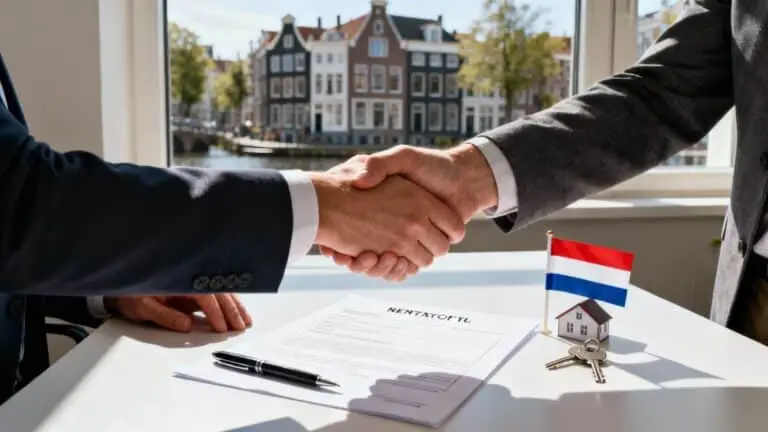
If you are buying a house in the Netherlands, the transfer must be executed by a Dutch civil-law notary (notaris) and registered in the public registers of the Kadaster (Article 3:89 of the Dutch Civil Code, BW). You become the owner only on registration, not when you sign the purchase contract, and the notary acts for both parties rather than for you alone.
For buyers used to a system where each side instructs its own lawyer, this is the least familiar part of the process. Below we explain what the notary does and does not do, how the money and the deeds move, and when you also need your own lawyer.
Table of contents
What is a Dutch civil-law notary?
A Dutch notary is a public officer appointed by royal decree (Article 3 of the Notaries Act, Wet op het notarisambt, Wna). The notary executes authentic deeds where the law requires it or a party asks (Article 2 Wna), and such a deed has special evidential status and can often be enforced without a court judgment.
Two consequences matter:
- The notary has a duty to act. A notary must carry out the work the law assigns or a party requests, subject to limited exceptions (Article 21 Wna).
- The notary is not on anyone’s side. The notary serves the interests of all parties, impartially and with the greatest possible care (Article 17 Wna).
How does a notary differ from a lawyer in your own country?
In England, Ireland and the United States, each side of a conveyance instructs its own lawyer; a Dutch notary is a single, neutral officer serving the transaction. The notary investigates title, prepares and explains the deeds, holds the money and registers the transfer, but will not negotiate the price, advise on whether the deal is sound or act for you in a dispute.
What does the notary’s duty to inform cover?
Under Article 17 Wna the notary must make sure each party understands what the deed does and what the risks are. That duty is heavier where a party is less experienced or does not speak Dutch.
Informing both sides is not advocacy. Where buyer and seller disagree over defects found before completion, a moved date or the meaning of a condition, the notary stays in the middle. That is when you need a lawyer whose only duty is to you, for example where:
- the contract is non-standard, or the seller is a developer using its own terms;
- you buy at auction, from an estate or company, or from a seller in financial difficulty;
- the property involves a ground lease (erfpacht), a monument listing or an unusual easement;
- there is a dispute, or a prospect of one, over defects, deposits, penalties or dates;
- the purchase touches a divorce, a matrimonial property regime or a cross-border inheritance.
Why does signing the purchase contract not make you the owner?
Dutch property law separates the obligation to transfer from the transfer itself. A valid transfer requires a valid title, a person entitled to dispose of the property and a valid delivery (Article 3:84 BW); for real estate, that delivery is a notarial deed followed by registration (Article 3:89 BW).
The purchase contract (koopovereenkomst), often called “provisional”, creates a binding obligation to buy and sell. Once the cooling-off period has run, it binds you completely, but ownership passes only when the deed of transfer is registered.
What are the stages from offer to registration?
| Stage | What happens | Effect on ownership |
|---|---|---|
| Offer and acceptance | Terms agreed through agents | None; must be in writing |
| Purchase contract | Signed in writing (art. 7:2 BW) | Binding obligation only |
| Cooling-off period | Three days for a consumer buyer | Buyer may withdraw |
| Conditions and security | Finance and survey conditions; deposit or guarantee | None |
| Notary’s investigation | Title, Kadaster searches, identity checks | None |
| Statement of account | Buyer transfers funds to the notary | None |
| Completion | Deed of transfer and mortgage deed signed | Still none |
| Registration | Deed presented to the Kadaster | Ownership passes |
| Final search | Registers re-checked; seller paid | Transfer secured |
When is the contract binding, and can you withdraw?
Where the buyer is a consumer and the property is a dwelling, the purchase must be in writing (Article 7:2(1) BW). A handshake, an e-mail or a WhatsApp exchange does not bind a consumer buyer.
The same article gives a consumer buyer a cooling-off period of three days, starting the day after receipt of the signed contract (Article 7:2(2) BW). No reason or compensation is needed. If the period does not include at least two working days, it is extended; keep proof of when the contract reached you.
What security does the buyer have to give?
The standard model purchase contract of the NVM, VBO, VastgoedPRO and Vereniging Eigen Huis requires a deposit (waarborgsom) paid to the notary’s third-party account or a bank guarantee (bankgarantie), customarily 10% of the price. A buyer who fails to complete typically owes a penalty of the same 10%, so match any finance condition to your mortgage timetable.
What does the notary check in the Kadaster?
The Kadaster keeps public registers of facts relevant to the legal status of registered property (Article 3:16 BW). A registrable fact that was not registered when your acquisition was registered generally cannot be held against you unless you knew of it (Article 3:24 BW).
The notary will typically check:
- the seller’s title and the chain of earlier deeds;
- existing mortgages, which must be redeemed and released at completion;
- attachments (beslagen) against the seller or the property;
- easements, other real rights and qualitative or chain obligations;
- ground lease terms, public law restrictions such as monument status, and the deed of division for a flat;
- the identity, capacity and matrimonial status of both parties.
The notary does not check the building’s condition, floor area, foundations or value, or whether an extension was permitted unless it appears in the registers. Settle those points before signing or cover them with a condition in the contract.
How does the money move through the notary?
A notary must keep a special third-party account (derdengeldenrekening) in the notary’s name, used only for money held for others (Article 25 Wna). That money is beyond the reach of the notary’s creditors, which is why a Dutch completion needs no escrow agent.
- The notary issues a statement of account (nota van afrekening) covering the price, transfer tax, fees, registration costs, apportionments and the deposit.
- You transfer the balance from an account in your own name, usually by the working day before completion; your lender pays the loan to the same account.
- After signing, registration and a final search, the notary redeems the seller’s mortgage, pays the seller and remits the transfer tax.
What happens at the signing, and in which language?
At completion you sign the deed of transfer (akte van levering) and, if you borrow, the mortgage deed (hypotheekakte), which creates your lender’s security (Article 3:260 BW). The notary first explains both deeds; bring original identity documents, as copies are not accepted.
A Dutch notarial deed is drawn up in Dutch (Article 42 Wna). Where a party has insufficient command of Dutch, Article 43 Wna requires a translation and, in practice, a sworn interpreter; the deed records that this was done. Ask for an English translation of the drafts several days ahead, but remember that the Dutch text governs.
Can you sign by power of attorney?
Yes. You can grant a power of attorney (volmacht) to an employee of the notarial office to sign for you. Abroad, the power of attorney usually has to be signed before a local notary with legalisation or an apostille, so arrange it several weeks ahead.
When does ownership actually pass?
Ownership passes on registration, not on signature (Article 3:89 BW). The notary normally offers the deed to the Kadaster electronically the same day, and registration takes effect from the moment the deed is offered (Article 3:19 BW).
Processing into the register takes a few working days. The seller is paid only after the notary’s final search confirms that no attachment or new mortgage has intervened.
Who chooses the notary, and what does it cost?
Existing homes are almost always sold kosten koper: the buyer pays the transfer tax and the cost of the deed of transfer, and therefore normally chooses the notary. Notarial fees are not fixed by law, so ask for written quotations that separate the fees for both deeds, Kadaster charges and any translation or interpreter costs.
Transfer tax (overdrachtsbelasting) is due under the Dutch Legal Transactions Tax Act (Wet op belastingen van rechtsverkeer). In 2026 the rate is 2% for a home you will live in yourself, 8% for other dwellings and 10.4% for non-residential property; a buyer aged 18 to 34 can use a one-off starter exemption up to a value limit set each year by the Belastingdienst. See our article on transfer tax and the buyer’s costs.
What if the seller is in financial difficulty?
If the seller is heading for bankruptcy, a creditor may attach the property or the seller may be declared bankrupt before your deed is registered. You would then have a claim against an insolvent seller rather than a house.
Article 7:3 BW lets the notary register the purchase contract itself (often called Vormerkung). For six months after that registration, later attachments, a bankruptcy and new mortgages cannot be invoked against you, provided the transfer follows within that period. Registration is not automatic and costs extra, so ask the notary for it where the searches show any sign of trouble.
Why does the notary ask about the source of your money?
Notaries fall under the Dutch Anti-Money Laundering and Anti-Terrorist Financing Act (Wwft) and must carry out client due diligence under Article 3 Wwft. That means verifying your identity, identifying the ultimate beneficial owner of a purchasing company and checking where the funds come from.
Expect to provide bank statements, proof of another property sale, a gift deed or employment records. Funds from a third party or from outside the EU attract extra scrutiny. The notary must report unusual transactions to FIU-Nederland (Article 16 Wwft) and may not tell you a report was made (Article 23 Wwft).
What should you check as the buyer?
As buyer you choose the notary and carry the risk of everything the notary does not investigate. Check these points:
- The contract contains a finance and a survey condition with dates that match your mortgage timetable.
- You know the date you received the signed contract, so you know when the three-day cooling-off period ends.
- The deposit or bank guarantee (usually 10%) is arranged before the contractual deadline.
- You have itemised quotations from at least two notaries.
- Your source-of-funds documents are ready before the notary asks for them.
- A power of attorney is arranged in time if you cannot attend the signing.
What should you check as the seller?
As seller you must deliver the property free of mortgages and attachments, unless the contract says otherwise. Check these points:
- The redemption amount of your mortgage is known, and the price covers it.
- Any attachment against you or the property is resolved before completion.
- Your matrimonial or registered-partner status is clear, as your spouse may need to consent under Article 1:88 BW.
- You have disclosed known defects; the seller’s duty to disclose limits the buyer’s duty to investigate.
- Ground lease, owners’ association and monument details are available for the notary.
What can we do for you with your property transfer?
Our real estate lawyers act for you alone, alongside the neutral notary. Concretely:
- We review the purchase contract before you sign or before the cooling-off period ends.
- We check the finance and survey conditions, the deposit and the 10% penalty clause.
- We advise on ground lease, owners’ association and monument issues found in the searches.
- We ask the notary to register the purchase under Article 7:3 BW where the seller shows signs of financial trouble.
- We act for you when defects, delay or a failed completion turn into a dispute.
Summary
- Only a Dutch civil-law notary can transfer Dutch property: by notarial deed, followed by registration in the Kadaster.
- The notary is neutral and explains the deeds to both sides, but does not act for you; where interests conflict, instruct your own lawyer.
- Signing the purchase contract creates only an obligation; a consumer buyer has a three-day cooling-off period and becomes owner on registration.
- Because you pay the transfer tax and the deed, you normally choose the notary; get itemised quotations first.
- Expect detailed questions about the source of your funds under the Wwft.
Frequently asked questions
Do I need a Dutch notary to buy a house in the Netherlands?
Yes. Ownership of Dutch real estate can only be transferred by a deed executed before a Dutch civil-law notary and registered in the public registers (Article 3:89 BW). A foreign notary cannot execute the transfer, though one can often certify a power of attorney so that someone in the Netherlands signs for you.
Does the notary act for me as the buyer?
No. The notary serves the interests of all parties impartially (Article 17 Wna). The notary explains the deeds and their consequences but will not negotiate for you or take your side. Where your interests and the seller’s conflict, instruct your own lawyer.
When do I actually become the owner?
On registration of the deed of transfer in the Kadaster, not on signing the purchase contract or the deed (Article 3:89 BW). Registration takes effect from the moment the deed is offered to the Kadaster (Article 3:19 BW), usually the day of signing.
Can I change my mind after signing the purchase contract?
As a consumer buying a dwelling, yes, within the three-day cooling-off period of Article 7:2 BW, without giving reasons. After that the contract binds you, and withdrawing usually costs the contractual penalty of 10% of the price unless a condition applies.
The deed is in Dutch and I do not speak Dutch. What happens?
The deed is executed in Dutch (Article 42 Wna). If you do not sufficiently understand Dutch, the notary must arrange a translation and, in practice, a sworn interpreter at the signing (Article 43 Wna). Ask for an English translation of the drafts several days in advance.