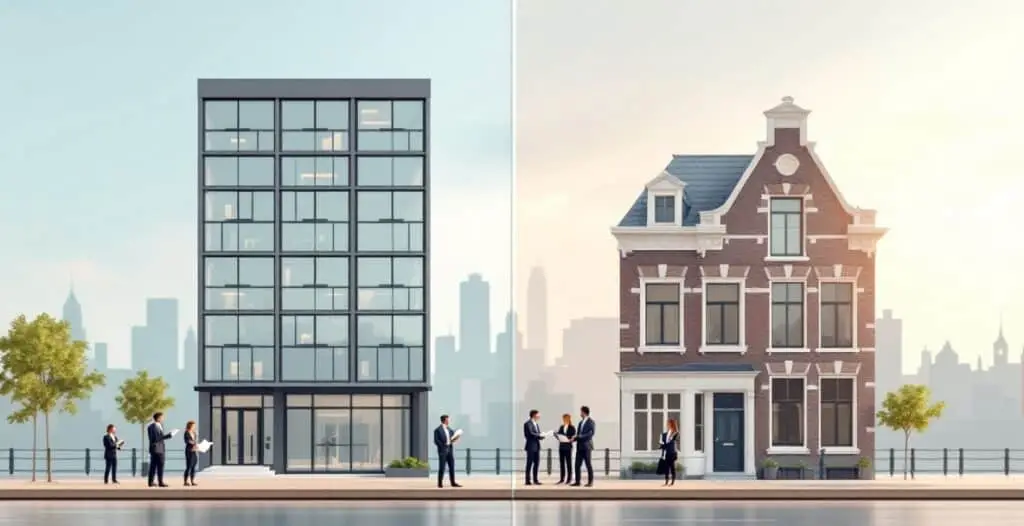
Dutch property law governs rights in the building itself, such as ownership, long leasehold and mortgage; tenancy law governs the contract for its use. The key link between them: sale does not break a lease, so a buyer takes over existing leases by law (Article 7:226 of the Dutch Civil Code, BW).
Property rights are acquired by notarial deed and registration in the public registers of the Land Registry (Kadaster). A lease needs no notary and is largely mandatory law in favour of the tenant, especially for retail space. That is why the leases, and whether they concern residential, retail or other business space, belong in the due diligence before any purchase.
Table of contents
How do you acquire ownership of Dutch real estate?
Ownership of real estate passes only by a notarial deed of transfer registered in the public registers (Article 3:89 BW). Signing the purchase agreement (koopovereenkomst) creates obligations but does not yet transfer ownership.
The process therefore has two steps: the purchase agreement and, usually weeks later, the transfer at the civil-law notary. The buyer of a home who is a consumer has a three-day cooling-off period after receiving the signed agreement (Article 7:2 BW); a business buyer does not. Our page on buying a house in the Netherlands sets out the steps for residential property.
The buyer pays transfer tax (overdrachtsbelasting). In 2026 the rate is 2% for a home you live in yourself, 8% for other homes such as rental properties, and 10.4% for non-residential property such as offices and shops, according to the Belastingdienst. First-time buyers under 35 may qualify for a 0% rate under conditions.
Which property rights exist under Dutch law?
Dutch law has a closed system of property rights: you can only create the rights the law provides. The most important ones are listed below.
| Right | What it gives you |
|---|---|
| Ownership (eigendom) | The fullest right; as a rule it includes the buildings on the land (accession, natrekking). |
| Long leasehold (erfpacht) | The right to use someone else’s land, usually against an annual ground rent (canon); common in Amsterdam. |
| Right of superficies (opstalrecht) | The right to own buildings or works on someone else’s land, which breaks accession. |
| Apartment right (appartementsrecht) | A share in a divided building with the exclusive use of one unit, within an owners’ association (VvE). |
| Easement (erfdienstbaarheid) | A burden on one plot for the benefit of another, such as a right of way. |
All these rights are created by notarial deed and registered with the Kadaster. Before buying, check the Kadaster extract for mortgages, attachments, easements and leasehold conditions, including when the ground rent will next be revised.
What rules apply to commercial leases?
Dutch law distinguishes two types of business premises. Retail space (also called 290-bedrijfsruimte, after Article 7:290 BW) has strong tenant protection; other business space (230a-bedrijfsruimte), such as offices and warehouses, has very limited protection.
Retail space covers premises open to the public where goods are sold or services provided, such as shops, restaurants and hairdressers. A lease of retail space runs for at least five years, automatically extended by another five years (Article 7:292 BW). Shorter terms of up to two years are possible without protection. After that, the landlord can terminate only on statutory grounds, and the lease ends only if the tenant agrees or the subdistrict court (kantonrechter) allows it (Article 7:295 and 7:296 BW).
Either party can ask the court to set the rent at the level of comparable premises in the area, at the end of the agreed term and then every five years (Article 7:303 BW). A tenant selling his business can ask the court for permission to transfer the lease to the buyer (indeplaatsstelling, Article 7:307 BW).
For other business space, the parties are largely free to agree on term, notice and rent review. The lease ends as agreed. The tenant’s only statutory protection is the right to ask the court to postpone eviction for a limited period after the lease has ended (Article 7:230a BW), and the request must be filed within two months of the eviction date. Many leases are based on the ROZ model lease, including its general provisions on maintenance, service charges and a bank guarantee or deposit, usually three months’ rent.
What happens to a lease when the property is sold?
The lease continues. Under Article 7:226 BW, the rights and obligations of the landlord pass to the buyer on transfer, so the tenant keeps the premises on the same terms.
This applies to residential, retail and other business space alike. A buyer who wants vacant possession must therefore end the lease on the grounds the law allows, which for retail space and housing is often difficult.
A buyer of let property should review each lease before signing the purchase agreement: the term, the rent and indexation, the classification of the space, guarantees, side letters and any running rent reviews. The seller usually gives warranties on the rent roll, but these only give a claim against the seller, not against the tenant.
Should a business buy or lease its premises?
Buying gives control but ties up capital and costs transfer tax of 10.4% on business premises. Leasing keeps capital free but leaves you dependent on the lease terms and, for offices and warehouses, on the landlord’s willingness to renew.
As an owner, you decide on alterations within the omgevingsplan (the municipal environment plan) and the permits under the Environment and Planning Act (Omgevingswet). As a tenant, structural changes need the landlord’s consent, and you may have to restore the premises when you leave. Check the permitted use in the omgevingsplan before you buy or sign, because neither ownership nor a lease allows a use the plan forbids.
What should you check as a buyer of let property?
You step into the seller’s position as landlord. Check these points before signing the purchase agreement.
- Which leases exist, and is each one retail space, other business space or housing?
- When does each lease end, and on which grounds could it be terminated?
- Are rent reviews under Article 7:303 BW pending or possible?
- Which bank guarantees or deposits exist, and will they transfer to you?
- What does the Kadaster extract show about leasehold, easements and mortgages?
What should you check as a commercial tenant?
Your protection depends on the classification of the space. Check these points before you sign.
- Is the space retail (Article 7:290 BW) or other business space (Article 7:230a BW)?
- Do the term and notice period match your business plan, and is there a renewal option?
- Does the permitted use in the lease match the omgevingsplan?
- Which maintenance and service charges are for your account under the general provisions?
- Can you sublet or transfer the lease if you sell or restructure the business?
What can we do for you with property and lease questions?
Our tenancy lawyers and real estate lawyers act for buyers, landlords and tenants.
- We review the leases and Kadaster data in a legal due diligence before you buy.
- We draft or review a commercial lease based on the ROZ model.
- We determine whether premises are retail or other business space.
- We handle rent review proceedings under Article 7:303 BW.
- We conduct termination and eviction proceedings before the kantonrechter.
Summary
- Ownership of real estate passes only by notarial deed and registration with the Kadaster (Article 3:89 BW).
- Sale does not break a lease: the buyer becomes the landlord by law (Article 7:226 BW).
- Retail space has a 5+5-year minimum term and strong protection; other business space has very little.
- Transfer tax in 2026 is 2%, 8% or 10.4%, depending on the type of property and its use.
Frequently asked questions
Does a sale end an existing lease in the Netherlands?
No. Under Article 7:226 BW, the buyer takes over the landlord’s rights and obligations. The tenant keeps the premises on the existing terms.
What is the difference between retail space and other business space?
Retail space (Article 7:290 BW) is open to the public for selling goods or services and has a minimum 5+5-year term with strong protection against termination. Other business space, such as offices and warehouses, falls under Article 7:230a BW and has very limited protection.
Do I need a notary to buy commercial property?
Yes. Ownership passes only by a notarial deed of transfer registered in the public registers of the Kadaster (Article 3:89 BW). A lease, by contrast, does not require a notary.
How much transfer tax do I pay on business premises?
In 2026 the rate for non-residential property, such as offices and shops, is 10.4%. Homes not used as your main residence are taxed at 8%, and a home you live in yourself at 2%.