
An acquittal (vrijspraak) means the criminal court has found that the offence you were charged with has not been lawfully and convincingly proved. Once the acquittal is final, you cannot in principle be prosecuted again for the same facts, although Dutch law allows a retrial to your detriment in a few narrowly defined and very serious cases.
An acquittal is not the only way a case can end without a conviction. If the facts are proved but are not a criminal offence, or you cannot be held criminally liable, for example because you acted in self-defence, the court discharges you from all further prosecution (ontslag van alle rechtsvervolging). The prosecution can also drop the case before it reaches court. Each outcome has its own consequences for a retrial, for your costs and for compensation.
What does an acquittal mean under Dutch law?
An acquittal is the court’s finding that the charge has not been proved. It is a decision on the evidence in your file, not a moral verdict on who you are.
The Dutch criminal court follows a fixed order of questions, set out in Articles 348 and 350 of the Dutch Code of Criminal Procedure (Wetboek van Strafvordering, Sv). First it deals with formal points. Is the writ of summons (dagvaarding) valid? Does the court have jurisdiction? May the Public Prosecution Service (Openbaar Ministerie, OM) prosecute? Is there a reason to suspend the case? Only then does the court ask whether the charged facts are proved, whether they amount to a criminal offence, whether you are criminally liable and which penalty fits.
Under Article 352(1) Sv, the court acquits you when it finds that the charged offence has not been proved. The acquittal can cover the whole indictment or only part of it. A partial acquittal is common in practice. An accused who faces several charges may be convicted of one and acquitted of another. The court may also acquit on the heavier primary charge and convict on a lighter alternative charge.
When is an offence proved in a Dutch court?
A charge is proved only if the court is convinced of your guilt on the basis of lawful means of evidence. Dutch law uses this test of lawful and convincing proof, not the Anglo-American standard of proof beyond reasonable doubt.
Article 338 Sv states that the court may only find the charged facts proved if it has become convinced of this by the content of lawful means of evidence (wettige bewijsmiddelen). Article 339 Sv lists these: the court’s own observations, statements by the accused, statements by witnesses, statements by experts and written documents. Under Article 341(4) Sv, your own statement alone is not enough to prove the charge. Article 342(2) Sv sets the same rule for the statement of a single witness. There must always be further supporting evidence.
The burden of proof lies with the OM. You do not have to prove your innocence, and under Article 29 Sv you are not obliged to answer questions. There is no jury in the Netherlands: professional judges decide on the facts and must give reasons for their decision. If the file contains too little evidence, or the evidence is contradictory or unreliable, the court must acquit. The same can happen if key evidence is excluded because it was obtained unlawfully. Our article on which evidence is admissible in Dutch criminal cases explains when that happens.
In practice, many acquittals turn on a single weak link. Think of an identification by one witness that is not supported by camera images, or a statement given to the police without proper legal assistance. A defence lawyer examines the file for exactly these points and can ask the court to hear witnesses again or to order further investigation (Article 315 Sv).
How does an acquittal differ from a discharge or a dropped case?
An acquittal means the facts are not proved. A discharge means they are proved but do not lead to punishment, and a dropped case means the OM decided not to take you to court, or not to continue.
Under Article 352(2) Sv, the court discharges you from all further prosecution where the proved facts are not a criminal offence, or where you are not punishable. This happens, for example, when the court accepts that you acted in self-defence (noodweer) under Article 41 of the Dutch Criminal Code (Wetboek van Strafrecht, Sr). It also happens when you cannot be held responsible because of a mental disorder under Article 39 Sr. In that last situation the court can still impose a measure, such as a hospital order (tbs). A discharge is therefore not always the end of the matter.
Some outcomes involve no decision on the facts at all. If the writ of summons is void (nietig), the court gives no ruling on the substance, and the OM can in principle summon you again with a corrected writ. If the OM is declared inadmissible (niet-ontvankelijk), for example because the offence is time-barred, the case ends without a judgment on guilt. A case can also end before any trial through a decision not to prosecute (sepot). Our article on what happens when the police or the prosecutor decides not to proceed explains that route.
Can you be tried again after an acquittal?
In principle, no. Once an acquittal is final, Article 68 Sr prevents a new prosecution for the same facts, but since 1 October 2013 the Supreme Court can reopen an acquittal in a small number of very serious cases.
The ne bis in idem rule in Article 68 Sr, which means that nobody may be tried twice for the same facts, protects anyone whose case has been finally decided by a Dutch court. It covers acquittals, discharges and convictions alike. Under certain conditions it also applies to final judgments of foreign courts. Within the Schengen area, Article 54 of the Convention implementing the Schengen Agreement gives a similar protection across borders.
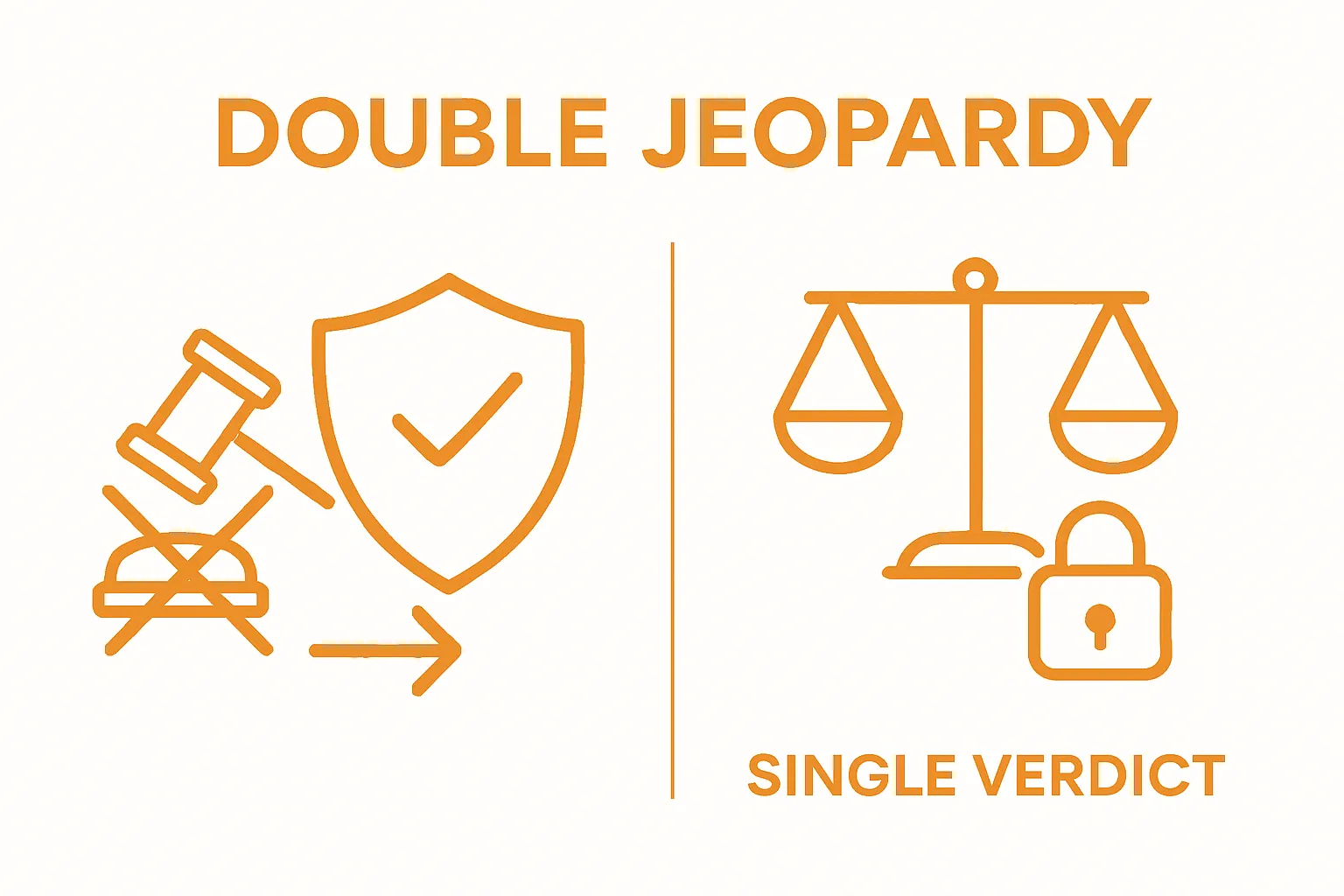
An acquittal only becomes final once no further appeal is possible. The OM can lodge an appeal (hoger beroep) against an acquittal by the district court within 14 days of the judgment, under Article 408 Sv. The court of appeal then hears the whole case again. The same 14-day period applies to an appeal in cassation to the Supreme Court (Hoge Raad) under Article 432 Sv. Until these periods have expired, the acquittal gives you no final protection.
The Revision to the Detriment Act (Wet herziening ten nadele) entered into force on 1 October 2013. Articles 482a to 482i Sv now allow the Supreme Court, at the request of the Board of Procurators General, to set aside a final acquittal or discharge. There are two routes. The first is new evidence, such as a credible confession or the results of new technical examination, in a case where someone intentionally caused another person’s death. The second is an acquittal obtained through false documents, perjury, bribery or intimidation of witnesses, or bribery of the judge. In both routes there must be a serious suspicion that the accused would otherwise have been convicted. These cases are rare, and they do not affect ordinary offences such as fraud, theft or assault.
How do you claim your costs and compensation for detention?
After an acquittal you can ask the court for a contribution towards your costs and for compensation for any time spent in custody. You must file the request within three months of the end of the case.
The rules are in Articles 529 to 539 Sv. Under Article 530 Sv, a former accused (gewezen verdachte) can claim a contribution towards the fees of a lawyer and certain other costs, such as travel to the hearings. Under Article 533 Sv, you can claim compensation for the time you spent in police custody or pre-trial detention (voorlopige hechtenis) when the case ends without a penalty or measure. The request goes to the court that dealt with your case. It must be filed within three months of the end of the case, which in most cases is the moment the acquittal becomes final.
Compensation is not automatic. The court decides on grounds of fairness (billijkheid) and looks at all the circumstances of the case. For detention it uses fixed daily amounts, which it can increase in special circumstances. For lawyers’ fees, you need invoices and a specification of the hours worked. A request can also be made after the case was dropped, not only after an acquittal. Read more about suspension of pre-trial detention and about compensation after unlawful police action, which follows a different route.
What does an acquittal mean for your record and reputation?
An acquittal is not a conviction, and nobody may treat you as having been convicted of that offence. The allegation itself may still have left traces that you need to deal with separately.
Under Article 6(2) of the European Convention on Human Rights, the presumption of innocence continues to protect you after a final acquittal. Public authorities must respect the acquittal in later decisions and statements. They may not suggest, for example when deciding on your claim for compensation, that you were guilty after all.
An acquittal does leave a trace in the Judicial Documentation System (Justitieel Documentatiesysteem). According to the Judicial Information Service (Justid), an acquittal or a discharge is also recorded there. For a Certificate of Conduct (Verklaring Omtrent het Gedrag, VOG), however, the policy rules of Justis are clear: offences that ended in a final acquittal are not taken into account. Read more in our article on what a criminal record in the Netherlands is.
A civil court or an employment court is not bound by your acquittal. Under Article 161 of the Dutch Code of Civil Procedure (Rv), only a final criminal conviction has binding evidential force in civil proceedings, not an acquittal. An employee who was dismissed on the spot because of a suspicion can therefore not rely on the acquittal alone. The subdistrict court (kantonrechter) will assess the facts again under civil law. The criminal judgment is still an important piece of evidence in those proceedings.

Online reports and social media posts often remain visible after the case has ended. You can ask a publisher to update or remove an article that no longer reflects the outcome. You can also ask a search engine to remove search results about the criminal case under the right to erasure in Article 17 of the General Data Protection Regulation (GDPR). Where someone keeps accusing you publicly, a claim for unlawful publication may be possible. See our article on online reputation damage for the options.
A company can also be prosecuted under Article 51 Sr, and its directors can be prosecuted alongside it. For a business, the acquittal matters in contacts with banks, insurers and business partners who may have asked questions during the investigation. Keeping a copy of the final judgment helps you answer those questions later.
What should you do after an acquittal?
First check whether the acquittal has become final, then file your requests for costs and compensation in time. After that, deal with the practical consequences at work and online.
Note the date of the judgment and count 14 days. If the OM lodges an appeal, the case continues at the court of appeal and you should prepare for a new hearing. If no appeal is lodged, the three-month period for your requests under Articles 530 and 533 Sv starts to run. Collect your lawyer’s invoices, travel costs and the dates of any custody in good time. Ask for a copy of the judgment, as you may need it for your employer, an insurer, a publisher or a foreign authority.
If you are still a suspect in other cases, or if the OM has only partly lost, get advice before you make public statements about the case. More on the role of a defence lawyer can be found in when you need a criminal defence lawyer. Background on the legal texts is available on wetten.overheid.nl (Dutch Code of Criminal Procedure) and on rechtspraak.nl.
What can we do for you after an acquittal?
Our criminal lawyers assist individuals and companies during the case and after the judgment.
- We check whether the OM has lodged an appeal within the 14-day period and when the acquittal becomes final.
- We prepare and file your request for costs under Article 530 Sv and for detention compensation under Article 533 Sv within the three-month deadline.
- We defend you at the court of appeal if the OM appeals, together with our appeal lawyers.
- We advise on using the criminal judgment in a dismissal dispute before the subdistrict court, together with our employment lawyers.
- We draft requests to publishers and search engines to remove or update reports under Article 17 GDPR.
Summary
- An acquittal means the court found the charge not lawfully and convincingly proved (Article 352(1) Sv); a discharge means the facts are proved but not punishable.
- The OM can appeal within 14 days; only a final acquittal protects you against a second prosecution (Article 68 Sr).
- Since 1 October 2013 a final acquittal can be reopened only in rare, very serious cases (Articles 482a to 482i Sv).
- You can claim a contribution towards lawyers’ fees and compensation for detention within three months of the end of the case (Articles 530 and 533 Sv).
- Civil and employment courts are not bound by an acquittal, so reputation and employment issues need separate attention.
Frequently asked questions
Can the prosecution appeal against an acquittal?
Yes. The Public Prosecution Service can lodge an appeal within 14 days of the judgment under Article 408 Sv. The acquittal only becomes final when no appeal is possible any more.
What is the difference between an acquittal and a discharge?
With an acquittal the facts are not proved. With a discharge (ontslag van alle rechtsvervolging) they are proved, but they are not an offence or you are not punishable, for example because of self-defence.
Can I claim my lawyer’s fees after an acquittal?
You can ask the court for a contribution under Article 530 Sv, and for compensation for detention under Article 533 Sv. The request must be filed within three months of the end of the case.
Does an acquittal appear on my criminal record?
The case is recorded in the Judicial Documentation System, together with the acquittal. Justis does not take a final acquittal into account when you apply for a Certificate of Conduct (VOG).
Is my employer bound by my acquittal?
Not automatically. A civil or employment court assesses the facts itself, because under Article 161 Rv only a criminal conviction has binding evidential force. The acquittal is still relevant evidence.