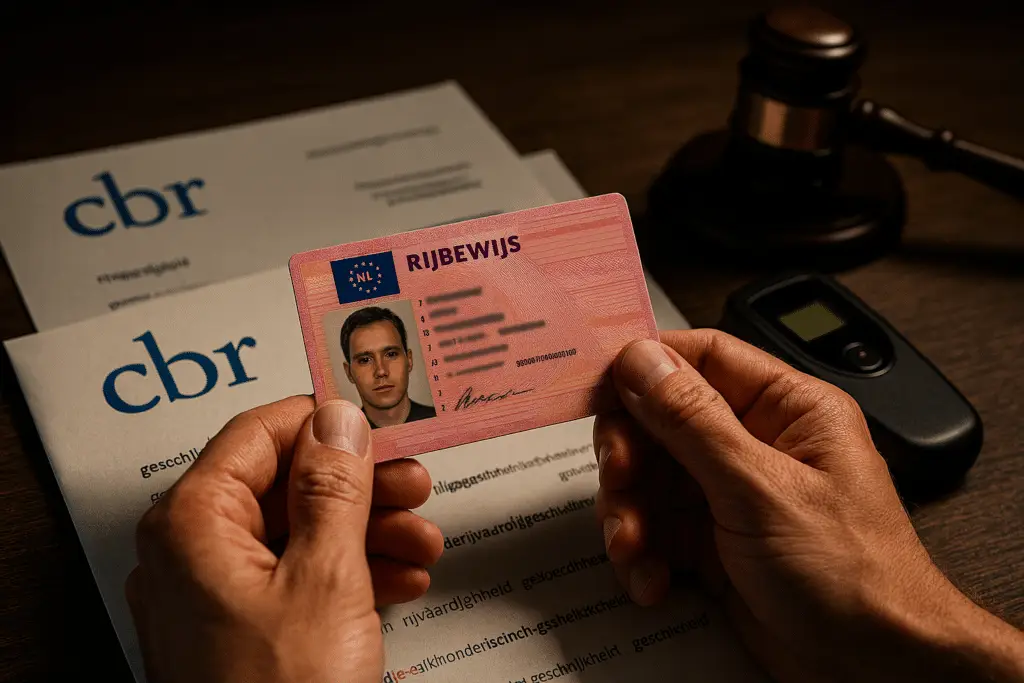
After a positive alcohol test, the Central Office for Motor Vehicle Driver Testing (Centraal Bureau Rijvaardigheidsbewijzen, CBR) starts its own administrative procedure to assess whether you are still fit to drive. That procedure runs separately from any criminal case and can lead to a course, an investigation into your fitness to drive, suspension of your licence or a declaration that your licence is invalid. You can object to each CBR decision within six weeks, and after that you can appeal to the administrative court, again within six weeks.
In this article we follow the administrative track from the police notification to the final decision, and we show where you still have room to defend yourself. We do not cover the criminal case brought by the Public Prosecution Service (Openbaar Ministerie) or the seizure of your licence at the roadside. Those topics are covered in our articles on alcohol and your driving licence and on appealing the seizure of your driving licence.
Is the CBR procedure separate from the criminal case?
Yes. One alcohol test can start two procedures at the same time, and neither waits for the other. The Public Prosecution Service decides whether to prosecute you for driving under the influence under article 8 of the Road Traffic Act 1994 (Wegenverkeerswet 1994, WVW 1994). The criminal court can then impose a fine, a community service order or a disqualification from driving. The CBR has a different task. It is an administrative body responsible for road safety, and it only asks whether you still meet the requirements of driving ability and fitness to drive. Whether you are guilty is not its question.
An acquittal in the criminal case does not undo a CBR measure, a decision not to prosecute does not give you your licence back, and a paid fine is no argument before the CBR. It is not double punishment either: an administrative measure under the WVW 1994 protects road safety and is not a criminal penalty.
On which rules does the CBR base its powers?
The CBR derives its powers from the Road Traffic Act 1994 and from the Regulation on measures for driving ability and fitness 2011 (Regeling maatregelen rijvaardigheid en geschiktheid 2011). That regulation links alcohol readings to specific measures. Four provisions of the Act form the backbone of the procedure.
- Article 130 WVW 1994 – the police notify the CBR when facts or circumstances suggest that you no longer meet the requirements of driving ability or fitness. You may be required to hand in your driving licence.
- Article 131 WVW 1994 – based on that notification, the CBR imposes an educational measure or orders an investigation into your driving ability or fitness. It can suspend the validity of your licence while the procedure runs.
- Article 132 WVW 1994 – you must cooperate with the measure imposed and pay its costs. If you do not, your licence is declared invalid.
- Article 134 WVW 1994 – after the investigation, the CBR takes a decision. It must declare your licence invalid if you do not meet the fitness requirements.
Article 164 WVW 1994 sits next to this framework. It allows the police to demand that you hand over your licence at the roadside when a disqualification from driving is a serious possibility. That seizure belongs to the criminal track, even though the same incident also leads to the notification to the CBR.
What are the steps from police notification to CBR decision?
The procedure follows five steps: notification, assessment, measure, execution and decision. Each stage has its own deadline and its own decision that you can challenge.
Step 1: when do the police notify the CBR?
The police notify the CBR after a breath or blood test above the legal limit. They draw up an official report and send a notification under article 130 WVW 1994. The legal limit is 0.5 per mille, or 220 microgrammes of alcohol per litre of exhaled air. For novice drivers the limit is 0.2 per mille, or 88 microgrammes. You are a novice driver during the first five years after obtaining your licence, or during the first seven years if you obtained it at seventeen. The notification is an administrative step. The police send it whether or not the Public Prosecution Service decides to prosecute.
Step 2: how does the CBR assess the notification?
The CBR assesses, based on the official report, whether there is a justified suspicion that you are not fit or not able to drive safely. At this stage it does not investigate the facts itself and it does not hear you first. The result is a written decision stating which measure it imposes. That decision is the moment from which your six-week objection period runs.
Step 3: what measure follows, and is your licence suspended?
Under article 131 WVW 1994 the CBR either imposes an educational measure or orders an investigation. If it orders an investigation into your fitness, it normally also suspends your licence with immediate effect. From the moment the decision reaches you, you may not drive. Driving during a suspension is a separate criminal offence with its own consequences.
Step 4: what do you have to do to carry out the measure?
You must register within the period stated in the decision, attend the appointments and pay the costs. The CBR sets those costs, and you pay them in advance. An investigation into fitness consists of an interview with a psychiatrist and a medical examination, including blood tests that can show longer-term alcohol use. If you ignore an invitation, the CBR treats that as a refusal to cooperate.
Step 5: what does the CBR decide after the investigation?
Article 134 WVW 1994 requires the CBR to decide as soon as possible after the investigation. If the report concludes that you do not meet the fitness requirements, for example because alcohol abuse or dependence is diagnosed, the CBR must declare your licence invalid. The CBR has no discretion at that point, because the obligation follows directly from the Act. If you do meet the requirements, the suspension ends and your licence remains valid.
Which measure follows from which alcohol reading?
The measure depends on your alcohol reading and on whether you are a novice driver. The Regulation on measures for driving ability and fitness 2011 sets these thresholds. They are not the same as the thresholds the criminal court uses for sentencing, which is a common source of confusion.
- Light educational measure on alcohol and traffic (LEMA) – for an experienced driver with a reading from 350 microgrammes per litre (0.8 per mille) up to 435 microgrammes. For a novice driver from 220 microgrammes (0.5 per mille) up to 350 microgrammes.
- Educational measure on alcohol and traffic (EMA) – for an experienced driver with a reading from 435 microgrammes per litre (1.0 per mille) up to 785 microgrammes. For a novice driver from 350 microgrammes (0.8 per mille) up to 570 microgrammes. Refusing the breath test also leads to an EMA.
- Investigation into fitness to drive – for an experienced driver from 785 microgrammes per litre (1.8 per mille). For a novice driver from 570 microgrammes (1.3 per mille). Repeated incidents within a certain period, or alcohol combined with other circumstances, can also lead to an investigation.
An educational measure is a course, not a punishment: once you complete it, the matter ends. An investigation is the heavier route, because under Article 134 WVW 1994 it can end in invalidation. The CBR publishes the fees for both, and you pay them yourself.
What happens if you do not cooperate?
Then the CBR declares your licence invalid, without assessing whether you are actually fit to drive. Article 132 WVW 1994 obliges you to cooperate with the measure and to pay its costs. If you do not register in time, do not show up, do not pay or frustrate the investigation, the licence is declared invalid. This outcome is easy to avoid. It typically happens when a deadline is missed, for example because a letter went to an old address or was put aside while the criminal case was running.
A declaration of invalidity is a separate decision, and you can object to it. The only question then is whether the CBR was entitled to conclude that you did not cooperate. Arguing afterwards that you were in fact fit to drive will not help. If something genuinely prevented you from attending, such as a documented illness or an invitation that never reached you, tell the CBR in writing before the deadline expires, not afterwards.
How do you challenge a CBR decision?
You first lodge an objection with the CBR, then appeal to the district court and, if necessary, to the Council of State. Every CBR decision is an administrative decision under the General Administrative Law Act (Algemene wet bestuursrecht, Awb), so the ordinary administrative remedies apply. The deadlines are strict. An objection or appeal lodged one day late is declared inadmissible, unless the delay is excusable.
How do you object to the CBR?
You send a written notice of objection to the CBR within six weeks, starting the day after the decision was sent, under article 6:7 Awb read with article 7:1 Awb. State which decision you challenge, why it is wrong and what you want instead. If you cannot yet explain your grounds, lodge a provisional objection within the deadline and ask for time to complete it. You have the right to be heard before the CBR decides on your objection. Under article 7:4 Awb you may inspect the file, including the official report, at least one week before the hearing.
Grounds that carry weight are concrete: a wrongly recorded reading, a device that was not properly calibrated, a notification about someone else, the wrong measure for the reading, or an investigation that did not follow the protocol. The CBR reconsiders the whole case but remains bound by the same mandatory rules.
When can you appeal to the district court?
If the CBR rejects your objection, you can appeal to the administrative law section of the district court within six weeks, under article 8:1 Awb. You pay a court fee, which is set by law each year. The court checks whether the facts were properly established, whether the right rules were applied, whether the decision is properly reasoned and whether the CBR followed the procedural safeguards. The court does not put its own judgement on your fitness in place of that of the medical experts. A defence that only disagrees with the diagnosis therefore rarely succeeds.
Can you appeal further to the Council of State?
Yes. Both you and the CBR can appeal against the judgment of the district court to the Administrative Jurisdiction Division of the Council of State (Afdeling bestuursrechtspraak van de Raad van State), within six weeks. This is the highest administrative court for these cases. Its case law determines how the CBR applies the Regulation in practice.
Can you keep driving while the procedure runs?
Not automatically. An objection or appeal does not suspend the CBR decision, so a suspension or invalidation stays in force. Under article 8:81 Awb you can ask the interim relief judge (voorzieningenrechter) to suspend the decision, provided an objection or appeal is pending. You must show an urgent interest, and the judge makes a provisional assessment of whether your objection or appeal is likely to succeed. In alcohol cases that second hurdle is usually the problem, because the rules leave the CBR very little discretion. An application stands a realistic chance mainly where there is a clear procedural error.
Can you rely on your personal interests?
Only to a very limited extent. Article 3:4(2) Awb forbids disproportionate consequences, but the 2011 Regulation already prescribes which measure follows from which reading, so the CBR has little room left. In settled case law, needing your licence for work, financial hardship or care responsibilities is not enough on its own.
Can you claim compensation for an unlawful decision?
Yes, if a CBR decision is annulled because it was unlawful. You first submit your claim to the CBR; if it rejects the claim, you can ask the administrative court to award damages under Article 8:88 Awb. You must show the unlawful decision, actual loss and a causal link, and document lost income carefully.
How do you challenge the official police report?
You need concrete, verifiable evidence; a denial is not enough. In the administrative procedure the CBR may in principle rely on the accuracy of an official report drawn up by an officer under oath, as far as it records the officer’s own observations. To contradict it, you must produce material that raises genuine doubt about its accuracy, and the burden of doing so rests on you. This principle of administrative law is why the file, rather than your account of events, is decisive. Useful evidence includes:
- Documentation on the breath analysis device, in particular its approval and the date of its last calibration.
- The measurement record itself, including the waiting period observed before the test and whether a second measurement was taken.
- A medical statement offering another explanation for the reading, such as a condition or medication that affects it.
- Camera images, audio recordings or witness statements that describe the events differently.
- An expert report on measurement errors or on the interpretation of the blood values used in the fitness investigation.
Request the file early: Article 7:4 Awb gives you access to the documents in the objection procedure, and Article 15 GDPR gives you the right to see the personal data the CBR holds about you.
How do you get your driving licence back?
An invalid licence is not a lifelong ban, but you have to start again. If your licence was declared invalid because you did not cooperate, you can apply for a new licence once the reasons for the invalidation no longer stand in the way. The CBR will normally still require you to complete the investigation. If your licence was declared invalid on fitness grounds after a diagnosis of alcohol abuse or dependence, the Regulation on fitness requirements 2000 (Regeling eisen geschiktheid 2000) requires you to show a period without problematic alcohol use before you can be found fit again. In practice that means at least a year, supported by medical evidence, followed by a new fitness assessment.
Two more points are easy to overlook. First, you pay the costs of the new investigation, the health declaration (Gezondheidsverklaring) and the new licence yourself. Second, quite apart from the CBR track, a licence can become invalid by operation of law under the repeat-offender scheme in article 123b WVW 1994, after a second conviction for serious traffic offences such as high-reading drink-driving within five years. Bill 36586 (Wet verbetering aanpak rijden onder invloed) replaces this scheme with a power of the criminal court to declare the licence invalid, so check which rule applies on the date of your conviction.
What should you check after receiving a CBR decision?
Start from the date the decision was sent, not the date you opened it: the six-week objection period under Article 6:7 Awb runs from the day after. Check at least:
- The deadline for objection, noted in your diary, and whether you need a provisional objection to secure it.
- The registration and payment deadline for the measure; register and pay even if you object.
- Whether the measure matches your reading and your novice or experienced status under the 2011 Regulation.
- The official report, the device approval and calibration data, and the time of the test.
- Whether your licence is suspended; do not drive while it is.
- That what you say in the criminal case is consistent, because it ends up in the CBR file.
What can we do for you with a CBR procedure?
We assist drivers at every stage of the administrative track after an alcohol test:
- We review the notification and check whether the measure fits your reading.
- We request the file under Article 7:4 Awb and Article 15 GDPR and analyse the device and measurement data.
- We lodge the objection with the CBR within six weeks and attend the hearing with you.
- We bring an appeal to the district court and, if needed, to the Council of State.
- We apply for interim relief under Article 8:81 Awb where there is a clear procedural error.
- We advise on the route back to a valid licence after invalidation.
Summary
- The CBR procedure is an administrative track that runs separately from the criminal case; the outcome of one does not decide the other.
- Your alcohol reading and whether you are a novice driver determine the measure: LEMA, EMA or an investigation into fitness to drive.
- If you do not register, attend or pay in time, the CBR declares your licence invalid without looking at your actual fitness.
- You can object within six weeks and then appeal to the district court and the Council of State, each within six weeks; an objection does not suspend the decision.
- Concrete evidence from the file, such as device data and the measurement record, carries far more weight than a denial.
Frequently asked questions
Is the CBR procedure the same as a criminal prosecution for drink-driving?
No. The CBR procedure under articles 130 to 134 WVW 1994 is an administrative procedure, completely separate from any prosecution by the Public Prosecution Service. It has its own rules and deadlines, even though both follow from the same alcohol incident.
Can the police take my driving licence immediately after a high alcohol reading?
Yes. Under article 164 WVW 1994 the police can demand that you hand over your licence at the roadside when a disqualification from driving is a serious possibility. This is separate from the later CBR assessment.
What measures can the CBR impose after an alcohol incident?
Depending on your reading, whether you are a novice driver and earlier incidents, the CBR imposes a light educational measure (LEMA), an educational measure on alcohol and traffic (EMA) or an investigation into your fitness to drive. For an experienced driver, an investigation follows from 785 microgrammes per litre (1.8 per mille); your licence is then normally suspended.
How long do I have to object to a CBR decision?
Six weeks, starting the day after the decision was sent (Articles 6:7 and 6:8 Awb). An objection does not suspend the decision, so if you need to keep driving you must ask the interim relief judge for a suspension under Article 8:81 Awb.