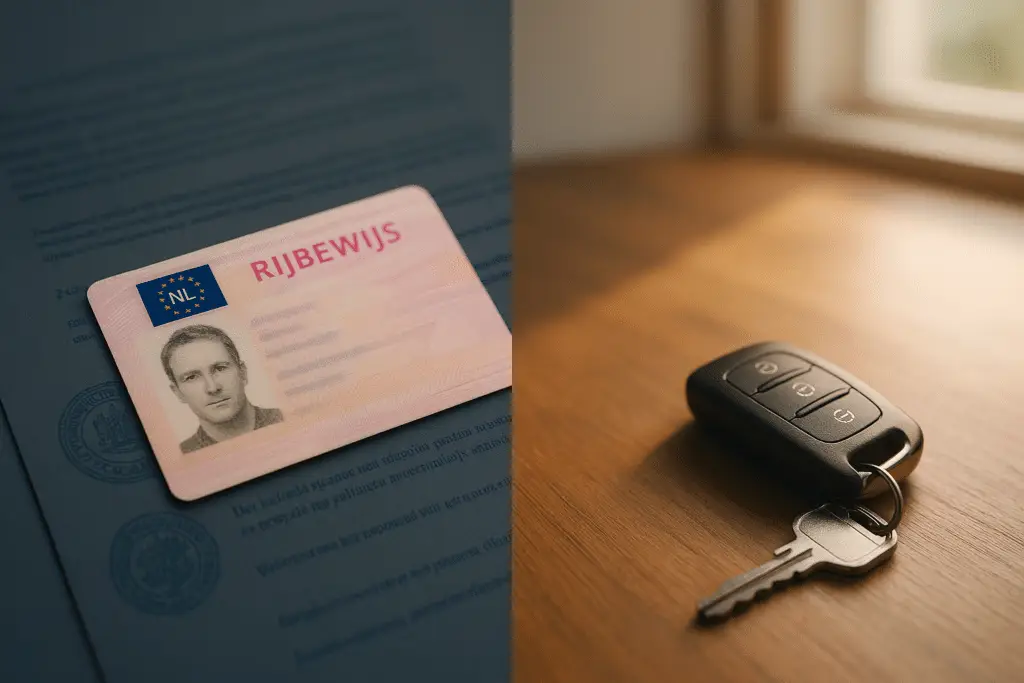
A driving licence seized by the Dutch police is not automatically lost. Under article 164 of the Road Traffic Act 1994 (Wegenverkeerswet 1994, WVW), the public prosecutor must decide within ten days of the seizure whether to retain the licence; if no decision is taken in time, the licence must be returned immediately. Where it is retained, any interested party may lodge a written complaint (klaagschrift) with the district court under article 164(8) WVW, and the court decides in chambers as soon as possible. If that complaint is dismissed, an appeal in cassation to the Hoge Raad (Supreme Court) must be lodged within fourteen days.
Those deadlines, and the difference between the three ways a Dutch driver can lose the right to drive, decide almost every case. This guide covers the first ten days, the complaint procedure and what the court tests, cassation, the separate administrative route through the CBR, and what realistically improves your position.
Which of the three situations are you in?
Your licence can be retained by the public prosecutor, taken away as a penalty by the criminal court, or suspended or invalidated by the CBR. Each has its own remedy, its own deadline and a different decision-maker, so establish which one you are in before doing anything else.
What is seizure and retention under article 164 WVW?
This is the provisional criminal measure. A police officer seizes the licence on the spot, usually after a positive breath or blood test or after a serious speeding offence, and the public prosecutor then decides whether to hold on to it while the criminal case is prepared. Nothing has been decided about guilt at this stage. The remedy is the complaint procedure under article 164(8) WVW, and it is the subject of most of this article.
What is a driving ban imposed by the criminal court?
The ontzegging van de rijbevoegdheid (disqualification from driving) is a penalty. It is imposed by the criminal court, or accepted as part of a settlement, after the case has been heard. It is challenged not by a complaint but by an ordinary appeal against the judgment, to the court of appeal and then, on points of law, to the Hoge Raad. Time already spent with the licence retained under article 164 WVW is deducted from an unconditional driving ban, which is precisely why the retention period matters so much in practice.
What does invalidation or suspension by the CBR mean?
The third route is administrative and has nothing to do with the criminal case. Where the police report a driver to the Central Office for Motor Vehicle Driver Testing (Centraal Bureau Rijvaardigheidsbewijzen, CBR), the CBR can require an educational measure or an investigation into fitness or competence to drive, and in the more serious cases it suspends the validity of the licence while that investigation runs. A driver who does not cooperate, or who is found unfit, has the licence declared invalid. That decision is an administrative decision under the General Administrative Law Act, and the remedy is objection to the CBR followed by appeal to the administrative court. A criminal court can acquit you and the CBR decision can still stand.
What happens in the first ten days?
In the first ten days the police send your licence to the public prosecutor, who must decide whether to retain it. If no decision is taken in time, you get the licence back. Article 164 WVW governs this opening phase, and it is worth understanding line by line, because it contains two hard rules that work in the driver's favour.
When may the police take your licence?
An officer may require you to hand over your driving licence where there is a serious suspicion of an offence for which a driving ban can be imposed, and the statute names the situations in which the licence must then be sent on to the public prosecutor: broadly, driving with an alcohol level well above the limit, refusing a breath or blood test, driving under the influence of drugs, substantial excess speed, and driving in a manner that endangers others. The threshold is a suspicion, not proof. Handing the licence over is compulsory, and refusing is a separate offence, so this is not the moment to argue.
Ask for the seizure record and keep it. It states the date and the ground, and the date is what starts every clock that follows.
What is the ten-day rule?
The public prosecutor must decide within ten days of the seizure whether the licence is retained. These are calendar days, not working days. If no decision is taken within that period, the licence must be returned without delay. That is not a discretion and not a courtesy: it is the statutory consequence of missing the deadline, and it is worth checking, because administrative delays are common and a return on this ground requires no argument about your circumstances at all.
The prosecutor must also return the licence during the retention period if the ground for retention falls away, for example where the file shows that the measurement cannot support the suspicion.
How long can retention last?
Retention is provisional and limited in time. Under article 164 WVW the licence must be returned if, within six months of the seizure, the case has not been brought before the court and no punishment order has been issued. Once the case has been brought in time, retention can in principle continue until the case has been dealt with. In many cases the practical question is therefore not whether you will ever drive again, but whether you will be without a licence for six weeks or for six months, and whether the time already served will be set against any driving ban the court later imposes. It will be: an unconditional driving ban is reduced by the period during which the licence was already retained.
Can you drive in the meantime?
No. Driving while the licence is retained, suspended or invalid is a separate criminal offence under article 9 WVW and is treated seriously. It removes any argument about proportionality you might otherwise have had, it is usually detected quickly because the status is registered, and it can affect insurance cover in the event of an accident. An international or foreign licence does not help: what has been withdrawn is the authority to drive in the Netherlands, not a particular document.
When must the licence be taken, and when not?
Seizure is not left to the officer's judgement in the main categories. Article 164(2) WVW requires the officer to demand the licence in defined situations. Knowing the thresholds tells you immediately whether the seizure was a matter of obligation or of discretion, and that in turn shapes the complaint.
The licence must be taken where a breath analysis shows more than 570 microgrammes of alcohol per litre of exhaled air for an ordinary driver, or more than 350 microgrammes for a novice driver; where the driver refuses to cooperate with a breath or blood investigation; and, where the driver has been stopped, where the speed limit has been exceeded by fifty kilometres per hour or more by a motor vehicle, or by thirty kilometres per hour or more by a moped. Note the gap between these figures and the limits in article 8 WVW: a driver can commit the offence at 220 microgrammes and keep the licence at the roadside, while the seizure thresholds sit considerably higher.
Beyond those cases, the statute allows the licence to be taken where the driver has seriously endangered road safety, which covers drug offences, accidents with injury and grossly dangerous driving. There is no fixed threshold, so this is the category in which the seizure itself is most open to challenge. If your licence was taken on this discretionary basis, that is the first thing to examine.
Article 164 WVW also lists the situations in which the licence must be returned, which mirror the complaint criterion: no decision to retain within ten days, no realistic prospect of an unconditional driving ban longer than the retention already served, and expiry of six months without the case being brought before the court or a punishment order being issued. Each of those is a self-contained ground that requires no balancing of interests at all.
What does the first month look like?
Almost every decision that matters is taken in the first four weeks. It helps to see the sequence laid out, day by day and week by week.
- Day one. The licence is handed over and you receive the seizure record. Keep it, note the date, and do not drive.
- Days one to three. Take advice, and decide whether to ask for a counter-analysis if the reading is disputed. The window for that is short and it cannot be reopened later.
- Within ten days. The prosecutor decides whether to retain the licence. If no decision arrives, that is a ground for immediate return and should be raised at once.
- Days ten to twenty. If the licence is retained, the complaint is prepared and lodged. This is when employer statements, care records and route information are collected, because they must be in the file before the hearing.
- Weeks three to six. The chamber hears the complaint and decides. A decision that goes against you starts a fourteen-day period for cassation, so the question whether to appeal has to be answered immediately, not considered at leisure.
- In parallel. A letter from the CBR may arrive at any point, with its own six-week objection period, and a punishment order from the prosecutor may arrive with its own fourteen-day period for objection. Neither waits for the other.
The recurring failure is not a lack of argument but a lack of sequencing. Three separate authorities are acting at once, each with its own clock, and none of them will tell you what the others are doing.
How does the complaint procedure under article 164(8) WVW work?
You lodge a written complaint (klaagschrift) with the district court, which decides in chambers after hearing you. The complaint procedure exists because the decision to retain a licence is taken by the public prosecutor without a hearing. Article 164(8) WVW gives any interested party the right to lodge a written complaint against it with the district court, which then decides in chambers (raadkamer) as soon as possible, after hearing the complainant or at least summoning them. It is the only point in the provisional phase at which an independent judge looks at your situation.
When should you lodge the complaint?
The statute does not impose a fixed time limit for lodging the complaint, but that is not a reason to wait. The six-month limit keeps running and the court decides as soon as possible; every week you delay is a week of the retention period that has already run, and a complaint filed late in the period is often met with the answer that the remaining time is too short to justify the exercise. In practice a complaint is worth lodging within days of the prosecutor's decision.
The deadlines that are fatal come later, in cassation, and after the criminal judgment. In the complaint procedure the enemy is not a deadline but the passage of time.
What does the court actually test?
This is where most complaints are lost before they are argued. The chamber is not asked whether the seizure was fair, or whether you deserve a second chance. It applies a specific and narrow criterion: whether serious account must be taken of the possibility that the criminal court will not impose an unconditional driving ban, or will impose one that is shorter than the retention that has already been served. Put differently, the court makes a provisional estimate of the eventual sentence and asks whether continued retention would overshoot it.
That criterion explains outcomes that otherwise look arbitrary. A high alcohol reading makes a long driving ban likely, so continued retention almost never overshoots it and the complaint fails, however sympathetic the personal situation. A borderline reading, a first offence, or a real prospect that the evidence will not hold makes a short ban or no ban plausible, and the complaint becomes arguable. Personal circumstances matter within that framework, mainly because they bear on what sentence is likely, not as a separate ground of hardship.
What belongs in the complaint?
A complaint is a legal document, not a letter of protest. It should identify the decision complained of and the date of seizure, set out concisely why continued retention would exceed the likely driving ban, and support every factual assertion with a document. Statements that cannot be checked carry almost no weight in a chamber hearing that may last twenty minutes.
The material that actually helps is narrow and specific:
- The seizure record and the prosecutor's decision, so that the dates are beyond argument.
- Anything that bears on the evidence: the measurement result, the record of the breath or blood analysis, and any indication that the prescribed procedure was not followed.
- A clean driving record extract, where you have one.
- Concrete proof of consequence: an employer's written statement that the position requires a licence and what happens without it, an employment contract or job description, or for the self-employed the contracts that cannot be performed.
- Where care responsibilities are relied on: a statement from the treating physician or care organisation, appointment schedules, and a realistic account of why public transport or another driver is not an alternative.
- Evidence of steps already taken, such as enrolment on a driver improvement course or a treatment programme, which shows the risk is being addressed rather than argued away.
Be precise rather than emphatic. The sentence that works is not that you need your licence for your work; it is that you cover eleven home care addresses a day across a rural area where the first bus arrives after the first appointment, that your employer has confirmed in writing that no alternative duties exist, and that the resulting loss of income is set out in the attached payslips.
What happens at the hearing in chambers?
The chamber sits with either a single judge or three judges depending on the court and the case, and the public prosecutor attends. The hearing is not a trial: there is no evidence taken, no witnesses and no verdict on guilt. The court has read the file, and the purpose of the hearing is to test the estimate it has already begun to form.
You are entitled to be heard, and that entitlement is real. The statute requires the court to hear the interested party or at least to summon them, and the right to be heard in a procedure that determines a civil right of this kind is reinforced by article 6 of the European Convention on Human Rights. A decision taken without a proper summons, or without giving you the opportunity to speak, is defective, and this is the single most reliable ground of appeal in the whole procedure. It follows that you should attend, and that if you cannot attend on the date given you should ask for an adjournment in writing, with reasons, rather than simply staying away.
At the hearing itself, brevity and candour work better than argument. Judges hear the same submissions every week and discount them accordingly. Minimising the offence, blaming the equipment or the officer, or presenting the loss of a licence as an injustice in itself all read as a lack of insight, and lack of insight tends to increase the estimated sentence rather than reduce it. Acknowledging what happened, explaining concretely what has changed since, and confining yourself to the criterion the court has to apply is the more effective posture.
What weighs, and what does not?
Factors that genuinely improve the estimate are those that make a shorter driving ban plausible: a reading only marginally over the limit, a first offence after decades of clean driving, evidence that the offence arose from prescribed medication whose effect was not disclosed to you, an evidential problem with the measurement, or a real and documented disproportion between the retention already served and the sentence the offence would ordinarily attract.
Factors that make the complaint close to hopeless are equally recognisable: a high reading, hard drugs, refusal of a test, a previous conviction for a comparable offence within a short period, or an offence accompanied by an accident or by dangerous driving. In those cases a long unconditional ban is likely, continued retention cannot overshoot it, and no amount of personal hardship changes the arithmetic.
Generic hardship arguments are the most common reason complaints fail. That the licence is needed for work, that you live outside a town, that the situation is inconvenient for your family: these are true of nearly every complainant, and a court that granted relief on that basis would be granting it to everyone. The argument only becomes effective when it is specific, documented and connected to the sentencing estimate.
What happens if the complaint succeeds, or fails?
If the court upholds the complaint it orders the licence to be returned. That is a decision about the provisional measure only; the criminal case continues, and the court that eventually hears it can still impose a driving ban. If the complaint is dismissed, the retention continues to its statutory limit or until the case is dealt with, and two routes remain: cassation to the Hoge Raad on points of law, and a fresh complaint if the circumstances genuinely change.
Can you appeal to the Supreme Court?
Yes, but only on points of law, and within fourteen days. An appeal in cassation lies against the chamber's decision. It must be lodged within fourteen days: for the interested party, fourteen days after the decision is served; for the Public Prosecution Service, fourteen days after its date. This deadline is absolute. A day late is fatal, without exception and regardless of the reason, so the appeal is lodged first and the arguments are formulated afterwards.
Which two steps does cassation involve?
Lodging the appeal is a formal act performed at the registry of the court that gave the decision. It contains no reasoning. What follows is the schriftuur, the statement of grounds, which must be filed within the period set by the Hoge Raad and must be signed by a lawyer admitted to practise before the Supreme Court. This is a genuinely separate specialisation: an ordinary lawyer, however experienced in traffic cases, cannot sign it. If no grounds are filed in time, the appeal is declared inadmissible without being looked at. Our page on cassation in the Netherlands explains how that specialisation works.
What can cassation achieve, and what not?
Cassation is a review of the law, not a rehearing. The Hoge Raad takes the facts as the chamber established them; a complaint that the chamber gave too little weight to your circumstances fails, but a decision that gives no comprehensible reason for setting documented circumstances aside can be quashed.
New facts cannot be introduced. Circumstances that arose after the chamber’s decision, such as a dismissal that has since taken effect, belong in a fresh complaint to the district court. Circumstances that existed but were not put forward are lost.
Which grounds succeed in cassation?
Three categories account for nearly all successful appeals. The first is a defect in the right to be heard: you were not summoned, were summoned at an address the court should have known was wrong, or were refused an adjournment without a decision. The second is a failure to respond to an argument that could have changed the outcome. The third, and rarest, is applying the wrong legal criterion.
Why do most appeals in cassation fail quickly?
Under Article 80a of the Judiciary Organisation Act (Wet RO), the Hoge Raad can declare an appeal inadmissible at an early stage if the grounds plainly cannot succeed or the appellant has insufficient interest; under Article 81 Wet RO it can reject an appeal with brief reasons. Cassation also takes months while the six-month retention limit keeps running, so ask what a successful appeal would still achieve on your facts before instructing a cassation lawyer.
Can the Public Prosecution Service appeal too?
Yes. The Public Prosecution Service (Openbaar Ministerie) can lodge cassation against a decision in your favour within fourteen days of its date, usually on a point of principle. The licence is normally returned in the meantime, but the decision is not final until that period has passed.
What happens if the Supreme Court quashes the decision?
The Hoge Raad quashes the decision and refers the case back for a fresh assessment. The court then looks at the position at that moment: the retention may have run its course, or the criminal case may have been dealt with, in which case the complaint has lost its purpose.
Can you drive while the procedure runs?
No. Neither the complaint nor an appeal in cassation suspends the retention, and there is no interim procedure in this part of the law that allows a judge to hand the licence back for the duration. Advice suggesting that a preliminary relief application to a civil court can be used to pause a criminal retention should be treated with caution: the civil courts are reluctant to intervene in decisions the criminal legislature has assigned to the criminal courts, and the complaint procedure is itself the remedy the statute provides.
What does exist is more useful than it sounds. Three routes can shorten the period without a licence.
- The ten-day rule. If the prosecutor did not decide in time, the licence must be returned, and this can be raised immediately.
- A fresh complaint. There is no bar on lodging a further complaint when the circumstances have genuinely changed, for example where a dismissal has now taken effect, where a medical situation has deteriorated, or where the file has developed in a way that undermines the suspicion. What will not work is repeating the same complaint in different words.
- The six-month limit and the substantive hearing. Because the licence must be returned if the case is not brought to court within six months, and retention otherwise ends when the case is dealt with, asking for the criminal case to be listed can be more effective than litigating about the provisional measure. Where a driving ban is realistically coming, accepting it and starting the clock is often the shortest route back to driving, since the retention already served is deducted from it.
What does the CBR route involve?
The CBR can impose a course or an investigation into your fitness to drive, separately from the criminal case. Running alongside all of this, and frequently overlooked until a letter arrives, is the administrative track. Where the police report a driver in connection with alcohol, drugs, or driving behaviour indicating unfitness, the CBR assesses what measure is required. The lighter outcomes are educational measures on alcohol and traffic or on driving behaviour, at the driver's own expense. The heavier outcomes are an investigation into fitness to drive, conducted by an independent psychiatrist, or an investigation into driving competence.
Two features of this system regularly take people by surprise. The first is that in the more serious cases the CBR suspends the validity of the licence while the investigation is carried out, so the licence can be unavailable on administrative grounds even after it has been returned in the criminal track. The second is that failing to cooperate, failing to attend, or failing to pay for the measure leads to the licence being declared invalid, and a licence that has been declared invalid is not returned at the end of a period: it has to be earned back through the prescribed procedure.
The remedy here is administrative, not criminal. You lodge an objection with the CBR within six weeks of the decision, and if that is rejected you appeal to the administrative division of the district court, with a further appeal to the Administrative Jurisdiction Division of the Council of State. The six-week period is strict. Because the criminal and administrative tracks are independent, an acquittal, a dismissal of the criminal case or a favourable decision on your complaint does not undo a CBR measure, and the two need to be handled together from the start.
What happens to the criminal case itself?
The case ends with a punishment order, a court judgment, or a dismissal or acquittal. The retention is provisional, and it exists only because a criminal case is coming. How that case is disposed of determines when you drive again, so it is worth understanding the three possible routes.
What if the prosecutor issues a punishment order?
In a substantial proportion of traffic cases the Public Prosecution Service does not bring the matter before a court at all but issues a punishment order (strafbeschikking) under the Code of Criminal Procedure. The prosecutor can impose a fine, a community service order and a driving ban of limited duration without any hearing. A punishment order is a determination of guilt, and accepting it by paying is a decision with consequences beyond the amount involved.
If you disagree, you must lodge an objection (verzet) within fourteen days of the order being made known to you. That brings the case before the criminal court in the ordinary way. Missing the period means the order stands and is enforced. This is the deadline most often missed, because a punishment order arrives as a letter and reads like an invoice.
What if you are summoned to the criminal court?
In more serious cases, and where objection has been lodged, the case is heard by the police judge (politierechter) sitting alone, or by a full bench where the case warrants it. The court decides on guilt and, if it convicts, on sentence. The sentencing options include a fine, a community service order, a suspended or immediate custodial sentence in the more serious cases, an unconditional driving ban, a conditional driving ban subject to a probationary period, or a combination.
A conditional driving ban is often the practical objective of a well-run defence. It leaves you able to drive while making a repeat offence extremely costly, and courts are receptive to it where the personal consequences of an unconditional ban are severe, the offence was at the lower end, and the defendant has taken concrete steps to address the cause. This is an argument to develop before the hearing, with documentation, not one to raise for the first time in court.
Any unconditional driving ban is reduced by the time the licence was already retained under article 164 WVW. Appeal against the judgment lies to the court of appeal and must be lodged within fourteen days, with cassation on points of law thereafter. An appeal does not necessarily postpone the effect of the driving ban, so ask specifically about enforcement before deciding to appeal.
What if the case is dismissed or you are acquitted?
The prosecutor can decide not to prosecute, and the court can acquit, most often where the evidence of the reading does not hold. The retention then ends and the licence is returned, but a CBR measure is not undone. Under Article 591a of the Code of Criminal Procedure (Sv), a former suspect can ask the court for compensation of certain costs, such as lawyer’s fees, within three months after the case has ended; loss caused by the retention itself is harder to recover.
What if you hold a foreign licence or come from abroad?
The Dutch measures apply to you in full, whichever country issued your licence. Law & More acts for a large number of internationally mobile clients, and the questions here are consistent enough to be worth answering directly.
A driving ban imposed in the Netherlands removes the authority to drive in the Netherlands. It attaches to the person, not to the plastic card, so producing a licence issued in another country does not restore the right to drive here, and doing so anyway is the same offence as driving on a retained Dutch licence. The Dutch authorities can seize and retain a foreign driving licence in the same way, and the decision may be communicated to the authority that issued it.
For drivers who hold a licence from another EU or EEA state and live in the Netherlands, the Dutch measures apply in full, and the effect of a Dutch decision in the country of issue is a matter for that country. Drivers who have recently moved to the Netherlands should also check separately with the RDW whether their licence is still valid for use here and whether it needs to be exchanged, because a licence that has ceased to be valid for Dutch use creates the same criminal exposure as one that has been withdrawn, without any of the warning.
Two further points matter for non-Dutch clients. Proceedings are conducted in Dutch, and you are entitled to an interpreter and to translation of essential documents; ask for it rather than working from a summary. And a conviction can have consequences for a residence permit or a naturalisation application, which are assessed under separate rules by the immigration authorities. Where residence status is in play, that assessment should be part of the strategy from the first week, not an afterthought once the traffic case is over.
What are the consequences beyond the licence itself?
A seized licence can affect your job, your record and your insurance. Clients usually arrive with one question and leave with three, because losing a licence rarely stays a transport problem.
What happens to your job?
A driving ban is not in itself a ground for dismissal. If driving is essential to the role and no alternative duties exist, the employer can ask the subdistrict court (kantonrechter) to dissolve the contract, and in serious cases summary dismissal may follow where the conduct breached clear rules. The outcome turns on the contract, the role, the length of the ban and the employer’s search for alternatives.
Tell your employer early, with a proposal: temporary reassignment, a colleague driving or unpaid leave. Do not sign a termination agreement in the first week; you can dissolve a settlement agreement within fourteen days of signing (Article 7:670b BW), but after that it is difficult to unwind.
Does it affect your record and certificate of conduct?
Retention is not a conviction. A conviction or an accepted punishment order is recorded in the judicial documentation system, which Justis consults when you apply for a certificate of conduct (Verklaring Omtrent het Gedrag, VOG). Whether it stands in the way depends on the screening profile: a drink-driving conviction matters far more for a driving job than for an office role, and a refusal can be challenged by objection and appeal.
What about insurance and costs?
Insurers ask about driving bans and convictions when a policy is taken out or renewed, and an incorrect answer can cost you cover. The costs of CBR measures are paid by the driver and are not refunded after an acquittal. Legal expenses insurance often excludes offences involving alcohol or drugs, so check the exclusions.
How strong is the evidence behind the seizure?
The reading decides most cases, so check how it was obtained. Because the complaint procedure turns on the sentence the criminal court is likely to impose, and because that sentence follows closely from the reading, the evidence deserves attention at the earliest stage rather than at trial. Article 8 WVW sets the limits and article 163 WVW governs how they are established.
What are the statutory alcohol limits?
For an ordinary driver the offence is committed where the breath analysis shows more than 220 microgrammes of alcohol per litre of exhaled air, or the blood analysis more than 0.5 milligrammes of alcohol per millilitre of blood. For a novice driver the limits are 88 microgrammes and 0.2 milligrammes respectively. A novice driver is someone within five years of first obtaining a driving licence, or within seven years where that first licence was obtained before the age of eighteen.
For drugs the statute prohibits driving under the influence of substances that impair driving ability, and the specific limits for individual substances, including limits for combinations of substances, are laid down by order in council. Those limits are analytical: the offence is established by the concentration, not by observable impairment, which is why a driver who feels entirely capable can still be over the limit days after use. It is also why the argument that there was no visible impairment carries little weight in the complaint procedure.
How is the reading established, and where can it go wrong?
A roadside breath test is a preliminary screening, not evidence. The evidential step is the breath analysis performed on approved apparatus at the police station, or a blood investigation where breath analysis is not possible or where the driver requests it. Article 163 WVW and the implementing regulations prescribe how each of these is done: who may take a blood sample, the waiting and observation periods, the handling and labelling of the sample, and the driver's right to have a second sample analysed by another laboratory.
Those requirements are not formalities. Where the prescribed procedure has not been followed, the result may be unusable, and that goes directly to the estimate of the eventual sentence which the chamber has to make. Points that are worth checking with a lawyer include whether the observation period before the breath analysis was respected, whether the apparatus was within its approval period, whether a request for a blood test was properly recorded and acted on, and whether you were informed of the possibility of a counter-analysis in time to use it.
There is a practical warning attached. A counter-analysis is only available while the second sample is still held, and the period is short. If there is any doubt about the reading, that decision has to be taken in the first weeks, not once the summons arrives.
What sentence is likely in the end?
Dutch criminal courts work from published sentencing orientation points agreed within the judiciary, which link the breath or blood reading to an indicative fine and an indicative driving ban, with separate reference points for refusal and for repeat offences. They are guidance rather than law, and a court may depart from them, but they are the reason that outcomes in this field are reasonably predictable and the reason that a lawyer can give you a realistic estimate at the outset. The current version is published by the judiciary and is revised from time to time, so it should be consulted rather than remembered.
That estimate is the single most useful thing you can obtain early, because it answers the only question the complaint procedure asks.
How long does it take and what does it cost?
A complaint is usually decided within weeks, cassation takes months. There is no court fee in the criminal complaint procedure; in an appeal against a CBR decision a court fee is payable, set by regulation and adjusted every year.
Lawyer’s fees are agreed in advance. If your income and assets are below the statutory thresholds, subsidised legal aid through the Legal Aid Board (Raad voor Rechtsbijstand) may be available, subject to a personal contribution.
What should you check as a driver?
The difference between a case handled well and one handled badly comes down to deadlines, the right criterion and documents. Check these points:
- Did the public prosecutor decide on retention within ten days of the seizure? If not, the licence must be returned without any further argument.
- Which track are you in: retention under Article 164 WVW, a punishment order (fourteen days for objection), a CBR measure (six weeks for objection), or all three?
- Is there any doubt about the breath or blood analysis, and is the second sample still available for a counter-analysis?
- Do you have documents that show disproportion: an employer’s statement, contracts and invoices, care schedules, payslips?
- Have you started a course or treatment that addresses the cause, which speaks to the likely sentence?
- Is a substantial unconditional ban inevitable anyway? Then having the criminal case heard quickly may be the shortest route back to driving, because the retention already served is deducted.
The common mistakes are driving anyway, missing a deadline, arguing that the offence was not serious, and signing an employment settlement in the first week.
What if you are self-employed or run a business?
As a sole trader or small business owner, your loss is usually easier to document than an employee’s. An employee may be reassigned; a sole trader whose turnover depends on reaching customers has no such buffer, and the loss shows directly in contracts and invoices.
That is precisely the material a chamber responds to. Bring the contracts that cannot be performed, the correspondence in which a client has cancelled, the fixed costs that continue regardless of turnover, and where relevant the position of employees whose work depends on yours. The point being made is not that the situation is hard but that the consequence is disproportionate to the driving ban that is realistically coming, and disproportion is demonstrated with figures.
What can we do for you after your driving licence is seized?
Our criminal lawyers act in traffic criminal cases and in the administrative CBR proceedings that run alongside them. In practice we:
- check within days whether the ten-day rule was observed and whether the seizure and retention were lawful;
- assess whether the breath or blood analysis will hold, and request a counter-analysis in time;
- draft and argue the complaint under Article 164(8) WVW, with the documents the chamber needs;
- lodge objection against a punishment order within fourteen days and defend the criminal case with the sentence in view;
- file objection and appeal against CBR decisions within the six-week period;
- work with a lawyer admitted to the Hoge Raad where cassation is genuinely worth pursuing.
Summary
- The public prosecutor must decide within ten days of the seizure whether to retain your licence; otherwise it must be returned (Article 164 WVW).
- If the case is not brought before the court and no punishment order is issued within six months, the licence must be returned.
- A complaint under article 164(8) WVW succeeds only if continued retention is likely to exceed the driving ban that is realistically coming.
- Cassation must be lodged within fourteen days, covers points of law only and requires a lawyer admitted to the Supreme Court.
- A CBR measure runs separately, with its own six-week objection period, and is not undone by the criminal case.
Frequently asked questions
How much time do I have to file cassation?
Fourteen days. For the interested party the period runs from service of the chamber’s decision; for the Public Prosecution Service from its date. A day late is fatal, so the appeal is lodged first and the grounds are filed afterwards by a lawyer admitted to the Hoge Raad.
What if the court rejects my complaint?
You can lodge cassation with the Hoge Raad within fourteen days, on points of law only. If your circumstances genuinely change, for example because a dismissal has taken effect, you can also lodge a fresh complaint with the district court under Article 164(8) WVW.
Can I start a driver improvement course during the procedure?
Yes. Enrolment on a course or treatment programme shows that the cause is being addressed, which the court can take into account in its estimate of the likely sentence. It does not guarantee a particular outcome.
Can I drive on a foreign or international licence while my licence is retained?
No. Retention and a driving ban remove your authority to drive in the Netherlands, whatever document you hold. Driving anyway is a criminal offence under Article 9 WVW and undermines any complaint you have lodged.
Do I get a criminal record if my licence is retained?
Not from the retention itself, which is a provisional measure. A conviction for the underlying offence, or an accepted punishment order, is recorded in the judicial documentation system and can matter when you apply for a certificate of conduct (VOG).