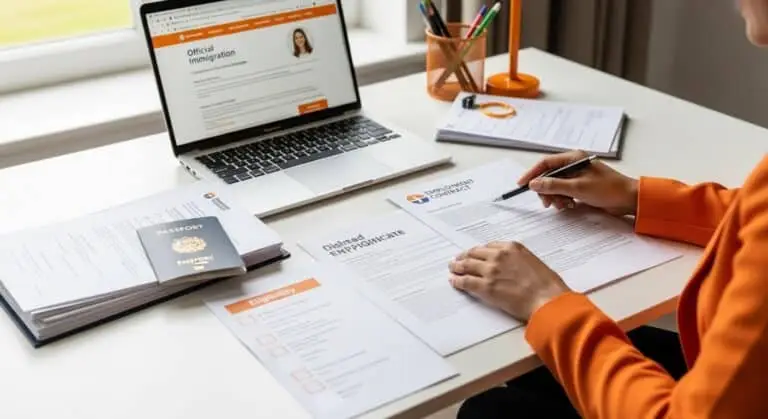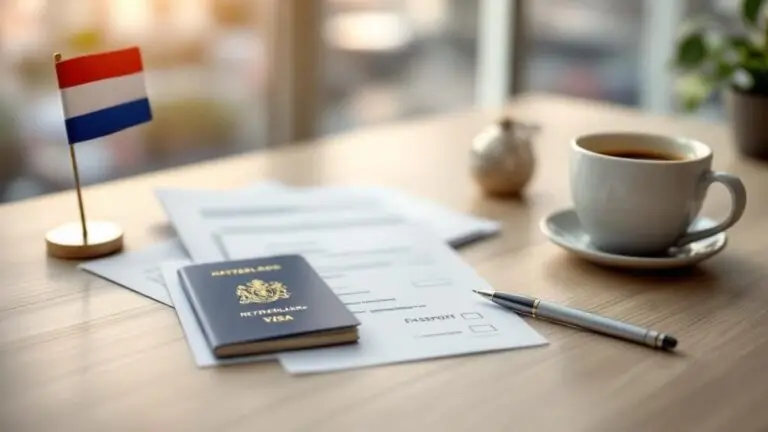
A Netherlands visa application for a short stay follows a fixed sequence: check whether your nationality needs a visa, choose between a short-stay Schengen visa and a long-stay MVV, file the documents that match your purpose, give your fingerprints in person, and wait for the decision. The key exception: a short-stay visa allows at most 90 days in any 180-day period in the whole Schengen area and never gives you the right to work.
Most refusals come from details: a missing bank statement, insurance that ends before the return flight, an appointment in the wrong country, or a miscount of the 90 days. A refusal must be disclosed on every later application, and you have four weeks to object to it under Article 69 of the Aliens Act 2000 (Vreemdelingenwet 2000, Vw).
Table of contents
Do you need a visa for the Netherlands?
That depends on your passport, not on your plans. Short-stay entry is governed by EU law: the Schengen Borders Code sets the entry conditions and the EU Visa Code (Regulation (EC) No 810/2009) governs the application, which the Dutch authorities apply.
Nationals of the EU, the EEA and Switzerland need no visa. Nationals of countries on the EU visa-exemption list, such as the United Kingdom, the United States, Canada, Australia and Japan, may travel without a visa for up to 90 days in any 180-day period. Everyone else needs a short-stay visa before travelling. A residence permit issued by a Schengen state also removes the visa requirement; a permit from a non-Schengen country does not.
How does the 90/180 rule work?
It is a rolling calculation, not a yearly allowance. On any day you count back 180 days and add up the days you spent in the Schengen area; the total may not exceed 90. Twenty days in Amsterdam in January still count in May and only drop out 180 days after they were used. The European Commission publishes a short-stay calculator; use it before you book.
Short-stay visa or MVV: which one do you need?
If you will stay up to 90 days without working, you need a short-stay Schengen visa (type C). If you will stay longer, work or study a full programme, you need a residence permit and, for most nationalities, an MVV (machtiging tot voorlopig verblijf, provisional residence permit).
The short-stay visa covers tourism, family visits, business meetings, conferences, short training and medical treatment. It cannot be converted into a residence permit from inside the Netherlands. Our glossary entry on the Schengen visa sets out the category in more detail.
The MVV and the residence permit are normally applied for together in the entry and residence procedure (TEV). In most cases the Dutch sponsor (referent) files that application with the Immigration and Naturalisation Service (IND): an employer, an educational institution or a family member. Under Article 2a Vw a sponsor can be a Dutch national, a lawfully resident foreign national or a company registered in the trade register. Nationals of some countries, including the United States, Canada, Japan, Australia and New Zealand, are exempt from the MVV but still need the residence permit. Our guide to the MVV and TEV procedure explains that route, and our overview of Dutch visas compares the options.
Where and when do you apply?
You apply in the country where you legally live, at the Dutch embassy or consulate or at the external service provider it has appointed, such as VFS Global or TLScontact. If your trip covers several Schengen states, you apply to the state of your main destination; if the stay is evenly divided, to the state whose external border you cross first.
An application filed with the wrong state is refused on competence, and the fee is not refunded. Proof of lawful residence in the country where you apply is part of the file.
The Visa Code sets an earliest and a latest date for lodging the application and a standard decision period that can be extended when further checks are needed. The embassy or Netherlands Worldwide website states the periods that apply to you. Around school holidays, Easter and summer, appointment slots at busy centres are gone weeks in advance. A planning window of four to eight weeks before departure works in practice. Book a refundable flight reservation for the file; do not buy non-refundable tickets before the visa is in your passport.
Which documents do you need?
Every document must prove something the Visa Code asks about: who you are, why you come, where you stay, how you pay, that you are insured and that you will leave again. Assessors read inconsistent dates between the flight reservation, the hotel booking and the insurance as a sign that the stated purpose is not the real one.
| Document | Notes |
|---|---|
| Schengen application form, signed | Signed by the applicant, or by the parents or guardian for a minor |
| Passport and previous passports | Issued within the last ten years, valid long enough beyond your departure from the Schengen area, with two blank pages; check the embassy checklist for the exact validity rule |
| Two passport photographs (35 x 45 mm) | Recent, plain light background, face uncovered |
| Proof of lawful residence | Residence permit or visa for the country where you apply |
| Flight reservation | Showing return or onward travel |
| Proof of accommodation | Hotel booking, or the Dutch declaration of sponsorship and private accommodation (garantverklaring) signed by your host |
| Travel medical insurance | Covering urgent medical care and repatriation up to the Visa Code minimum, valid in all Schengen states for the whole stay |
| Proof of means of subsistence | Bank statements for the last three months, payslips, or a sponsor guarantee with the sponsor’s evidence |
Purpose-specific evidence comes on top. A business trip needs an invitation on the Dutch company’s letterhead, an extract from the trade register of the Chamber of Commerce (KVK) and a letter from your employer. A family visit needs the declaration of sponsorship and a copy of the host’s ID or residence permit. Medical treatment needs the appointment letter from the Dutch hospital and proof of payment.
How much money and insurance must you show?
The means requirement is an amount per person per day of stay, set by the Dutch authorities and revised periodically; check the current figure on Netherlands Worldwide for the year you travel. Under the Visa Code a solvent host in the Netherlands can guarantee your costs by signing a declaration of sponsorship. Assessors look for a pattern over three months: regular income and a stable balance count, a lump sum deposited the week before the appointment does not.
The insurance must run for the entire period of the visa. Policies with a high excess are often rejected. If your travel dates change, amend the policy before the visa is issued, because the validity of the visa sticker follows the insurance.
Which fields on the form go wrong most often?
The member state of first entry is where you physically cross into the Schengen area, which is not always your main destination. Ask for multiple entries only if your itinerary needs them. Count the length of stay in calendar days, not nights. For a child travelling with one parent, add a consent letter from the other parent.
What happens at the appointment?
Your application is only lodged once you have handed in the file and given your fingerprints and photograph in person. You book the slot through the portal of the embassy or its service provider; enter your details exactly as in your passport, or check-in fails on the day.
A clerk checks your passport and residence proof, takes ten fingerprints and a photograph, reviews the file and collects the fee. Fingerprints are stored in the EU Visa Information System and reused for later applications for several years. The few questions asked test whether your story matches the paperwork: the purpose of the trip, who pays and whether you travelled in the Schengen area before.
The visa fee is set in the Visa Code and is the same in all Schengen states; check the current amount on the embassy website. Young children pay less or nothing, and some groups are exempt, such as family members of EU citizens who exercise free-movement rights. A service provider charges its own non-refundable service fee on top. Keep the barcoded receipt: it is your proof of payment and your tracking reference.
How do you check the decision and the visa sticker?
Open the envelope at the counter and check the sticker at once. Compare your name and passport number, the validity dates, the number of entries and the duration of stay against your passport and itinerary; errors are corrected on the spot, but not at the airport.
The validity dates are the window in which you may travel; the duration of stay is the number of days you may spend inside that window. A single-entry visa is used up the moment you leave the Schengen area. The visa never overrides the 90/180 rule: the border officer decides on admission and can refuse entry if the conditions of the Schengen Borders Code are not met on the day.
What changes at the border with EES and ETIAS?
Since 12 October 2025 the EU Entry/Exit System (EES) has been introduced at the external Schengen borders, and the Dutch Aliens Circular (Vreemdelingencirculaire 2000) was amended from that date. EES replaces passport stamps for non-EU travellers with an electronic record of each entry and exit, including a facial image and fingerprints.
In practice you register at your first crossing, often at a self-service kiosk, and the system calculates your 90/180 days automatically. Border control at Schiphol and other Dutch external borders is carried out by the Royal Netherlands Marechaussee (KMar), which may ask for your insurance, accommodation, return ticket and proof of means. Carry those documents in your hand luggage.
ETIAS, the EU travel authorisation for visa-exempt travellers, is a separate system that is not yet operational at the time of writing. It will not apply to holders of a Schengen visa or a Schengen residence permit, and it is not a visa.
What must you do after arriving with an MVV?
Register with your municipality within five days of arrival if you expect to spend at least two-thirds of the next six months in the Netherlands. This duty follows from the Personal Records Database Act (Wet basisregistratie personen); the registration gives you the citizen service number (BSN) you need for health insurance, a bank account and DigiD. The IND then invites you to collect your residence card.
What happens if you overstay?
An overstay recorded by EES at departure can lead to a fine, annulment of the visa and an entry ban for the whole Schengen area. Under the Aliens Circular an entry ban can in serious cases last up to ten years, and an overstay must be declared on every later application to any Schengen state.
The visa can be extended in exceptional cases, such as force majeure, humanitarian reasons or serious personal reasons (Article 33 of the Visa Code). In the Netherlands you apply for an extension at an IND desk before the visa expires, not afterwards. If illness or a cancelled flight threatens to push you past your last permitted day, act while you are still lawfully present.
What can you do if your visa is refused?
You can file a corrected new application or lodge an objection (bezwaar) within four weeks of the date of the decision (Article 69(1) Vw). The refusal comes on a standard EU form with the grounds ticked, and each ground points to a specific gap in the file.
Typical grounds are: the purpose of the stay was not shown, insufficient means, inadequate insurance, the 90 days were already used, unreliable documents, or reasonable doubt about your intention to leave before the visa expires. The last ground is an assessment, not a missing document; you answer it with evidence of ties to your home country: a job, studies, property, family and a clean travel history.
- A new application is usually quickest when a document was missing or weak. There is no waiting period, but the new file must answer the ground given; the same file produces the same refusal.
- An objection fits when the refusal is wrong on the facts or the law, or when a refusal on your record would harm later applications, for example for a residence permit. Address each ground and attach evidence. If the objection fails, you can appeal to the district court (rechtbank), again within four weeks.
Our article on the most common mistakes in a Dutch visa application covers the gaps that cause most refusals.
What should you check as the applicant?
- Count your Schengen days in the last 180 days before you choose your travel dates.
- Apply in your country of residence, to the state of your main destination.
- Check that flight, accommodation and insurance dates match exactly.
- Show three months of bank statements with a regular pattern, not a last-minute deposit.
- Gather proof of ties to your home country: employment letter, enrolment, property or family.
- Disclose any earlier refusal or overstay honestly on the form.
What should you check as the Dutch host or inviting company?
- Put the invitation on company letterhead with the purpose, dates and who pays.
- Attach a recent extract from the KVK trade register.
- If you guarantee the costs, sign the declaration of sponsorship and attach your income evidence.
- For a stay longer than 90 days or any work, start the TEV procedure with the IND instead.
- Keep copies: the IND can recover costs from a guarantor under the declaration.
What can we do for you with a Dutch visa application?
Our immigration lawyers assist applicants, families and companies with visa and residence files.
- We review your visa file against the refusal grounds of the Visa Code before you book the appointment.
- We assess whether your plans need a short-stay visa or the MVV/TEV route.
- We draft the objection against a visa refusal and file it within the four-week deadline.
- We file an appeal with the district court if the objection is rejected.
- We advise Dutch companies acting as sponsor on invitations, guarantees and the TEV application.
Summary
- A short-stay Schengen visa allows up to 90 days in any 180-day period and no work.
- For longer stays or work you need a residence permit and usually an MVV, applied for by your sponsor with the IND.
- Apply in your country of residence, to the state of your main destination, with consistent documents.
- Since 12 October 2025 EES records every entry and exit electronically.
- You can object to a refusal within four weeks (Article 69 Vw) or file a corrected new application.
Frequently asked questions
Can I work in the Netherlands on a Schengen visa?
No. A short-stay Schengen visa allows business meetings and conferences, but no paid work. For work you need a residence permit, usually applied for by your employer with the IND, and in many cases a work permit.
How long do I have to object to a visa refusal?
Four weeks from the date of the decision, under Article 69(1) of the Aliens Act 2000. If the objection is rejected, you can appeal to the district court within four weeks as well.
Can I extend a Schengen visa while I am in the Netherlands?
Only in exceptional cases, such as force majeure, humanitarian reasons or serious personal reasons. You apply at an IND desk before your visa expires; an extension applied for after expiry is too late.
Does ETIAS replace the visa?
No. ETIAS is a travel authorisation for travellers who do not need a visa. It is not yet operational, and it does not apply to holders of a Schengen visa or a Schengen residence permit.