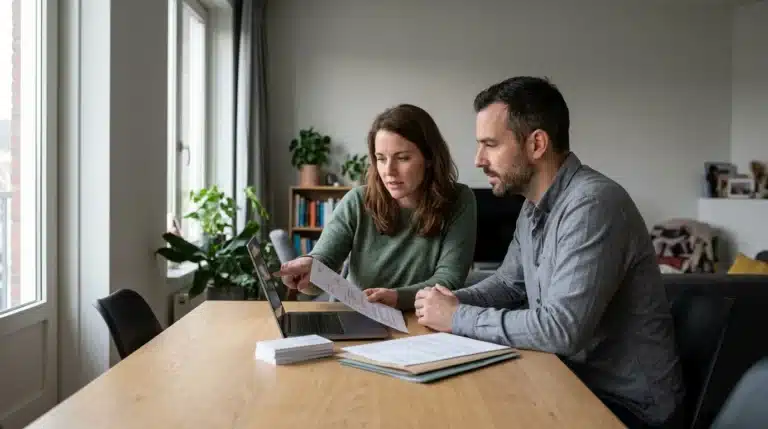
You settle a divorce amicably in the Netherlands by making agreements with your spouse on all issues and filing a joint petition with the court. The court then usually decides on the documents alone, which is considerably faster and less stressful than a divorce in which one spouse files against the other.
What makes the amicable route work is not only goodwill but complete information. Both of you need a full picture of income, assets, debts and pensions. An agreement based on incomplete or incorrect figures can be challenged afterwards, as explained below.
Table of contents
What is the difference between a joint and a one-sided divorce?
In a joint divorce you file one petition together, with agreements on everything. In a one-sided divorce one spouse files, the other is served and can respond, and the court decides the points on which you disagree.
A joint petition (gemeenschappelijk verzoek) can be filed by one lawyer acting for both of you. A divorce in the Netherlands always requires a lawyer to file the petition. The only ground is that the marriage has irretrievably broken down (Article 1:151 of the Dutch Civil Code (BW)); you do not need to prove fault.
In a one-sided divorce, the petition is served on the other spouse by a bailiff, who then has a period of six weeks to file a defence. An oral hearing usually follows, and further rounds are possible if there are disputes about maintenance, the children or the property. This takes months rather than weeks. The Dutch judiciary explains both routes on rechtspraak.nl.
Start by getting a complete financial picture
Collect all information on income, assets, debts and pensions before you negotiate. Agreements that both of you understand and that rest on the same figures are the basis of an amicable divorce.
In practice this means gathering recent salary slips and tax returns, bank and savings statements, mortgage documents, investment accounts, information on pensions and any business interests. Check which property regime applies. Couples who married on or after 1 January 2018 without a prenuptial agreement (huwelijkse voorwaarden) have a limited community of property; couples who married earlier without one generally have a full community of property. A prenuptial agreement can change the picture completely.
Transparency is also a legal matter. A spouse who deliberately conceals or withholds assets that belong to the community loses their share in those assets to the other spouse (Article 1:135 BW). And a division of assets can be annulled if one spouse was prejudiced by more than a quarter because of a mistake about the value of the assets (Article 3:196 BW). Full disclosure protects both of you.
Discuss the key issues calmly and in the right order
Start with the children, then the home, then maintenance and the rest of the property. Discussing the most important issues first often makes the rest easier.
Choose a setting in which you can talk without escalation, and make brief notes of what you agree after each meeting. Those notes later become the divorce settlement and, if you have minor children, the parenting plan that Article 815 of the Dutch Code of Civil Procedure (Rv) requires.
If certain subjects keep leading to arguments, bring in a mediator or a lawyer early. A lawyer can also tell you what the court would probably decide on a disputed point, for example the five-year maximum for spousal maintenance, which often makes the discussion more realistic.

How can a mediator help?
A mediator is a neutral third party who helps you reach agreements yourselves. The mediator does not decide and does not represent either of you, but guides the discussion and makes sure all topics are covered.
Many family mediators in the Netherlands are lawyers who are also trained as mediators. They can draft the agreements and, as a lawyer, file the joint petition. If you use a mediator who is not a lawyer, you still need a lawyer to file the petition. Each of you can also ask your own lawyer to review the draft agreements before you sign them. That is sensible if the financial interests are large or complex.
Mediation is voluntary and works only if both of you are willing. If there has been domestic violence or a serious imbalance of power between you, mediation is often not suitable. Each of you then needs your own lawyer, and the divorce proceeds on a one-sided petition, with the six-week period for a defence described above.
What must you agree on if you have children?
If you have minor children, a parenting plan (ouderschapsplan) is required by law. Without it, the court cannot deal with your petition.
Under Article 815 of the Dutch Code of Civil Procedure (Rv), the parenting plan must at least cover how you divide care and upbringing, how you will inform and consult each other about important matters concerning the children, and the costs of care and upbringing. You must also state how you involved the children in drawing up the plan. After the divorce, both parents in principle keep joint parental responsibility (gezag) (Article 1:251 BW).
Be concrete. Agree on a regular schedule, on holidays and special days, on who pays which costs and on how you will change the arrangements when the children grow older. Child maintenance (kinderalimentatie) is usually calculated using the guidelines of the Dutch judiciary’s expert group on maintenance, which take into account the needs of the children and the financial capacity of both parents. A clear plan prevents disputes later.
Child maintenance does not stop when a child turns 18. Under Article 1:395a BW, both parents remain obliged to contribute to the costs of living and study of a child aged 18, 19 or 20, and from the age of 18 the child is entitled to receive that maintenance directly. Agree in the settlement how you will deal with this, for example whether the payments go to the child or into a study account.
Maintenance amounts are adjusted every year by statutory indexation (Article 1:402a BW), unless you exclude this in writing. Mention in the parenting plan or settlement whether indexation applies, so that neither of you is surprised later.
How do you divide the home, assets and pensions?
You divide what falls in the community of property, in principle in equal shares (Article 1:100 BW), unless you agree otherwise. You can make a different division if you both agree, as long as each of you knows what you are giving up.
For the family home there are three common options: selling it, one spouse taking it over and paying the other, or keeping it jointly for a while. If one spouse takes over the house, the mortgage lender must agree to release the other spouse from the mortgage. Transferring a share in a house also requires a notarial deed, so involve a civil-law notary in time.
If you rent your home, spouses are by law joint tenants of the marital home (Article 7:266 BW). You can agree who continues the tenancy, and if you cannot, the court can decide this at the request of one of you. The court can also allow one spouse to continue living in the marital home for six months after the divorce has been registered (Article 1:165 BW), which gives time to find other accommodation.
Pensions accrued during the marriage are in principle divided equally under the Pension Rights Equalisation on Divorce Act (Wet verevening pensioenrechten bij scheiding), unless you agree otherwise. You must notify the pension fund within two years after the divorce, otherwise you cannot claim a direct payment from the fund. Tax consequences, for example on a business or a substantial shareholding, fall outside what we do; for those, consult a tax adviser.
Do you need to agree on spousal maintenance?
Yes, if one of you cannot support themselves after the divorce. Spousal maintenance (partneralimentatie) depends on the needs of the recipient and the capacity of the paying spouse.
For divorce petitions filed on or after 1 January 2020, the maximum duration is in principle five years (Article 1:157 BW). There are exceptions, for example for long marriages and for a spouse who cares for young children. You can agree on a lower amount, a shorter period or no maintenance at all. The main exceptions are these. If there are children under 12, maintenance continues until the youngest child turns 12. If the marriage lasted more than 15 years and the recipient will reach state pension (AOW) age within ten years, maintenance lasts until that age. And if the marriage lasted more than 15 years and the recipient was born on or before 1 January 1970, the maximum is ten years. Put such an agreement in writing. Without further arrangement, either of you can ask the court to change the amount if circumstances change (Article 1:401 BW).
Put everything in a divorce settlement
All financial agreements are recorded in a divorce settlement (echtscheidingsconvenant), signed by both of you. The parenting plan is a separate document or part of it.
The settlement does not have to be notarised. It is a private agreement that you both sign. Only for specific acts, such as transferring real estate, is a notarial deed needed. The lawyer files the settlement and the parenting plan together with the joint petition, and the court usually includes the agreements in its decision. This makes them enforceable, for example if maintenance is not paid.
Draft the settlement precisely. It should state who keeps which assets, who takes on which debts, what happens to the house and mortgage, the maintenance and indexation, and how you will resolve future disagreements, for example by first going back to the mediator. If you want spousal maintenance to be fixed, state explicitly that the court may not change it later (Article 1:159 BW).

How does the court finalise the divorce?
The court assesses the joint petition, usually without a hearing, and pronounces the divorce. The divorce only takes effect once the decision has been registered in the civil status register (Article 1:163 BW).
After the decision, there is an appeal period of three months. With a joint petition you can both sign a statement that you will not appeal (akte van berusting), so that the decision becomes final sooner. The lawyer then arranges registration with the municipality. The decision must be registered within six months after it has become final; otherwise it lapses and you remain married.
How long the whole process takes depends mainly on how quickly you reach agreement. Once the documents are complete, a joint petition is usually dealt with considerably faster than a one-sided divorce, which involves service by a bailiff, a six-week defence period and often an oral hearing.
What if you agree on most but not all issues?
Then you can still keep the procedure largely amicable. You record what you have agreed and ask the court to decide only the remaining points.
One spouse files a petition that includes the agreements already made and asks the court to rule on the rest, or you file jointly and set out the points on which you differ. If you need arrangements quickly, for example about who stays in the home or temporary maintenance, you can ask the court for provisional measures (voorlopige voorzieningen) under Article 822 Rv while the divorce is pending.
What if one of you lives abroad or you have different nationalities?
Then check first whether a Dutch court has jurisdiction and which law applies to the divorce, the property and the maintenance. The answers can differ per issue.
A Dutch court can often deal with the divorce if one or both of you live in the Netherlands. Your property regime may, however, be governed by the law of another country, depending on where you lived when you married and whether you chose a law. For marriages concluded on or after 29 January 2019, the EU Matrimonial Property Regimes Regulation (Regulation (EU) 2016/1103) applies. Also check whether the divorce will be recognised in the other country, for instance if you want to remarry there. International elements do not rule out an amicable divorce, but they make careful drafting even more important.
What can we do for you with an amicable divorce?
As divorce lawyers, we guide Dutch and international couples through the joint procedure, from the first financial overview to registration.
- We draw up a complete overview of your assets, debts and pensions and check which property regime applies to you.
- We draft the divorce settlement (echtscheidingsconvenant) and the parenting plan required by Article 815 Rv.
- We calculate child and spousal maintenance using the guidelines of the judiciary’s expert group on maintenance.
- We act as one lawyer for both of you and file the joint petition with the court.
- We prepare the deed of acquiescence (akte van berusting) and arrange registration within the six-month period.
- If you each prefer your own lawyer, we review the draft agreements for one of you before you sign.
Summary
- With a joint petition and complete agreements, the court usually decides on the documents alone.
- Full financial disclosure is essential; concealing assets can cost you your share, and an unbalanced division can be annulled.
- If you have minor children, a parenting plan is required by law.
- Record all financial agreements in a signed divorce settlement; it does not need to be notarised.
- The divorce takes effect only after registration, which must happen within six months after the decision becomes final.
Frequently asked questions
What is the first step to settle a divorce amicably?
Get a complete and shared financial picture: income, assets, debts and pensions. Then discuss the children, the home and maintenance, if necessary with a mediator.
Can we use one lawyer for an amicable divorce?
Yes. With a joint petition, one lawyer can act for both of you and file the petition. Each of you can still ask your own lawyer to review the agreements.
Is a parenting plan mandatory?
Yes, if you have minor children (Article 815 Rv). The plan must at least cover care and upbringing, how you inform and consult each other, and the costs of the children.
Does the divorce settlement have to be notarised?
No. It is a private agreement that both spouses sign. A notarial deed is only needed for specific acts, such as transferring a share in a house.