Family Reunification Visa Netherlands: Requirements And Steps | Law & More
In short: family reunification lets a partner, child or other close relative join you in the Netherlands once you hold a valid residence permit. You act as the sponsor and file the application with the IND, usually combined with an MVV entry visa. You will have to show sufficient and sustainable income, and your family member normally has to pass the civic integration exam abroad. Holders of an asylum permit have a separate route with its own three-month window.
You received your residence permit in the Netherlands. Your family is still abroad. The distance feels unbearable and you need them here with you. Family reunification makes this possible, but the process comes with strict rules, deadlines, and paperwork that can feel overwhelming. Seeking professional advice can help you navigate these complexities and increase your chances of a successful application.
Family reunification is available to various groups, including asylum seekers who have received a residence permit in the Netherlands. Different rules apply depending on your individual circumstances, such as your status, nationality, and the type of permit you hold. The right to family life and family reunification is also protected under international human rights agreements.
The Dutch Immigration and Naturalisation Service (IND) allows you to bring your spouse, partner, and children under 18 to join you. You must meet specific requirements about your income, age and relationship. Your family members need the right documents and must apply through official channels. The process has clear steps, but missing one detail can delay everything or lead to rejection.
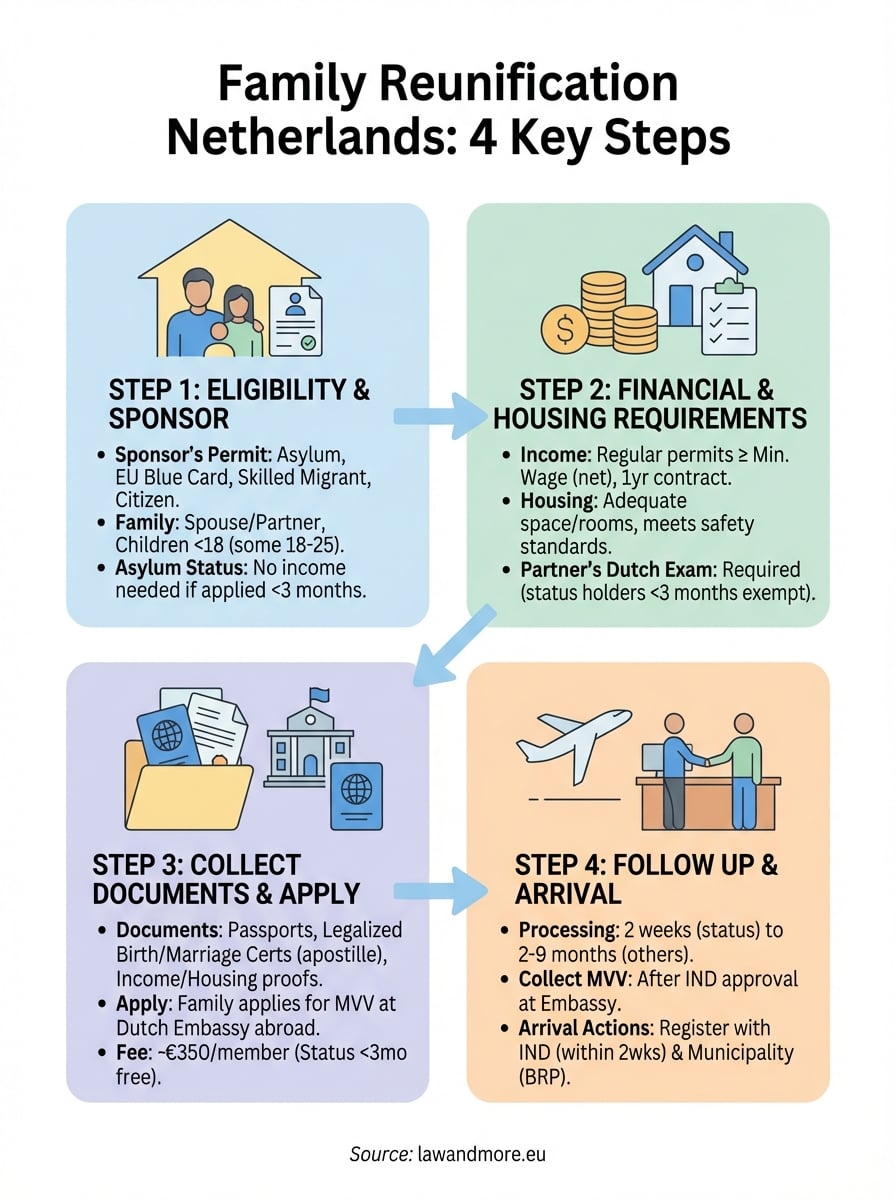
This guide walks you through family reunification from start to finish. You’ll learn who qualifies, what financial requirements you must meet, which documents to prepare, and how to submit your application. We also cover processing times, costs, and what happens after approval so you can bring your family to the Netherlands without costly mistakes.
What is family reunification in the Netherlands
Family reunification in the Netherlands is the legal process that allows you to bring close family members to live with you. The IND grants this right when you hold a valid residence permit and want your spouse, registered partner, or children under 18 to join you. As part of the eligibility criteria, the IND requires proof of a genuine family relationship to verify kinship and ensure compliance with immigration law. Your family members receive their own residence permits through this procedure. Relatives such as partners, children, and sometimes other family members may be eligible, depending on the permit type.
The process and requirements for family reunification depend on your nationality. Dutch nationality, EU citizenship, and non-EU status each affect which rules and legal procedures apply. The application process for family reunification is different for EU and non-EU citizens. If you are an EU citizen, you can live and work in the Netherlands without a residence permit, and your family members from the EU/EEA or Switzerland do not need a Dutch residence permit. However, family members of non-EU citizens must apply for a Dutch residence permit (Netherlands family visa) to join a family member in the Netherlands. If you are a non-EU citizen joining an EU family member, you must apply for Verification against EU law. The document required for this process is called a family reunification permit, and the procedures are governed by both Dutch immigration law and EU law, depending on your situation. Nationality plays a key role in determining which requirements and documentation are necessary.
This process differs from family formation, where you create a new relationship with someone abroad after arriving. Family reunification applies to existing relationships that started before you moved to the Netherlands. Your relatives need a provisional residence permit (MVV) to travel here, then they collect their residence document from the IND and register with the municipality after arrival.
The IND has a decision period of 90 days, which it can extend, and processing times vary by permit type.
Family reunification Netherlands: requirements at a glance
Valid residence permit: the sponsor has lawful residence in the Netherlands, or is a Dutch national.
Age: for a partner, both the sponsor and the partner must be at least 21 years old.
Income: at least 100% of the statutory minimum wage, sustainable for at least one year (not required for family members of asylum permit holders who apply within three months).
Civic integration exam abroad: partners generally have to pass the basic exam at a Dutch embassy before the MVV application; the exam costs €150.
Documents: passports, legalised or apostilled birth and marriage certificates, and an antecedents certificate for everyone aged 12 and over.
Fees: in 2026, €254 for a partner or adult family member and €85 for a child.
Decision period: 90 days, which the IND can extend.
Family members of EU citizens who live in the Netherlands and use their free movement rights follow a separate EU route with different conditions.
Step 1. Confirm you and your family are eligible
Your first step involves verifying that both you and your family members meet the basic eligibility criteria for family reunification netherlands. The IND reviews your residence status, your relationship to your family members, and their ages before processing any application—certain conditions must be met for eligibility. The same rules apply to married couples, registered partners, and unmarried partners when proving eligibility for family reunification.
Start by checking your own permit type because different permits allow different family members to join you.
If your personal circumstances change and you no longer meet the conditions of your residence permit, the IND may consider revoking your permit.
Who can sponsor family members
You can sponsor family if you hold a valid asylum permit, asylum residence permit, EU Blue Card, highly skilled migrant permit, student permit, or Dutch citizenship. Your permit must remain valid for at least one year when you apply. Status holders with temporary asylum protection—that is, individuals who have received a residence permit as an asylum seeker—receive the most favorable conditions, including no income requirements if they apply within three months of receiving their permit. Family members must apply for reunification within three months after the asylum seeker’s residence permit is issued. The family reunification process is free of charge for status holders who apply within this period.
Temporary permit holders face stricter requirements. Your permit needs sufficient duration remaining and you must prove financial independence before the IND considers your application.
Who qualifies as family
Your spouse or registered partner qualifies automatically if you married or registered before coming to the Netherlands. Unmarried partners qualify when you prove a durable relationship through shared housing, joint accounts, or other evidence spanning at least six months. Unmarried partners must also provide evidence of a durable relationship, such as a rental contract or travel tickets.
A minor dependent child (child under 18) automatically qualifies for family reunification if they depend on you for care.
Adult children can join you only in exceptional cases, for example when they are still part of your family and there is more than normal emotional dependency, assessed under Article 8 of the European Convention on Human Rights. Parents qualify in exceptional cases involving severe dependency, but the IND approves these applications rarely. In some cases, other family members may be eligible for family reunification, depending on the specific circumstances and IND approval.
Family members of asylum permit holders
Holders of an asylum residence permit, both refugees and people with subsidiary protection, can apply for family reunification (in Dutch: nareis) for their partner and minor biological or adopted children. The sponsor submits the application in the Netherlands, and the family members then report to a Dutch representation abroad, such as an embassy, for an interview and identity checks. If documents are missing, the Dutch immigration service can offer a DNA test to prove the family relationship. Parents, brothers and sisters and other relatives generally do not qualify, unless there are exceptional circumstances.
Other rules apply if the sponsor is one of the Dutch citizens who have lived in another EU country, or an EU citizen living in the Netherlands: in that case, family members may fall under EU free movement rules. Same sex couples are treated in the same way as other couples, whether they are married, registered partners or unmarried partners in a durable relationship.
Step 2. Meet financial and other requirements
You must prove sufficient and sustainable income to support your family members before the IND approves family reunification netherlands applications. The requirements vary based on your residence permit type and whether you apply as a status holder or regular permit holder. Each permit category faces different income thresholds that change twice yearly, so verify current amounts before you start your application.
Income thresholds you must meet
Your income must be at least 100% of the statutory minimum wage. The IND uses gross amounts: from 1 July 2026 the income requirement for a partner is €2,337.00 gross per month without holiday allowance (€2,523.96 including holiday allowance). A lower amount applies to a single parent who brings a family member (€1,635.90 without holiday allowance). The income must be sustainable: your employment contract must remain valid for at least one year after the application date, or you must show that you have had sufficient income for the past three years. Self-employed sponsors must also show sufficient and sustainable income, usually with annual accounts, tax returns and their Chamber of Commerce registration.
Status holders applying within three months of receiving asylum face no income requirements. After this period expires, you must meet the same financial criteria as other permit holders. The IND calculates your income using:
Gross salary from your employment contract
Net profit from your business if self-employed
Sustainable income expected to continue for at least one year
The IND adjusts the required amounts every January and July, so check the current threshold before applying.
Housing and registration
Under current IND rules there is no minimum housing size requirement for family reunification with a partner or child. Your family member must, however, register at your address in the Personal Records Database (BRP) of the municipality after arrival, and municipal rules on occupancy and your rental agreement still apply. Political proposals to introduce stricter conditions, including for family members of asylum permit holders, have been debated, so check the current rules before you apply.
Additional requirements for partners
Partners joining you through family reunification, including your spouse, registered partner, or unmarried partner, must pass a basic Dutch language and society exam at the Dutch embassy abroad before traveling. This civic integration exam costs approximately €150 and tests elementary Dutch skills. Status holders’ family members receive an exemption from this requirement when they apply within the three-month window.
Step 3. Collect documents and apply
Your application requires specific documents that prove your identity, relationship, and financial situation. Before you start, carefully review the application form, as it provides specific instructions and requirements for supporting documents and the overall process. The IND rejects incomplete applications, so gather everything before you start. Missing documents cause delays of several months while you wait for new appointment slots or correspondence from the IND.
Required documents for your application
You must submit identity documents for both yourself and your family members including valid passports or birth certificates. If a birth certificate or other documentary evidence is unavailable to prove your family relationship, a DNA test may be required as an alternative method to establish kinship in the family reunification process. Your relationship documents depend on your situation. Married couples need a legalized marriage certificate with an apostille stamp, while unmarried partners need proof of cohabitation, shared financial accounts, joint lease agreements, and travel records showing regular visits.
Financial documents include your employment contract, recent payslips covering the last three months, and bank statements showing steady income. Self-employed sponsors must provide tax returns, annual accounts and their Chamber of Commerce registration.
The standard document checklist includes:
Valid passports for all family members (copies of all pages)
Birth certificates for children with apostille certification
Marriage certificate or registered partnership document with apostille
Proof of relationship for unmarried partners (minimum 6 items spanning 6 months)
Employment contract valid for at least 1 year
3 most recent salary slips
Bank statements from the last 3 months
Rental agreement or property ownership documents
Municipal housing inspection certificate
How to submit your application
Your family members apply for an MVV at the Dutch embassy or consulate in their home country while you remain in the Netherlands. They schedule an appointment online through the embassy website, pay the application fee, and submit all documents in person. The embassy forwards the complete application to the IND, and Dutch authorities are responsible for reviewing and approving the application.
Submit your family reunification netherlands application at the embassy in the country where your family members legally reside.
Application fees vary by permit type. Status holders applying within three months pay nothing, while regular applicants pay the IND fee for each family member: in 2026 this is €254 for a partner or adult family member and €85 for a child under 18, for the MVV and residence permit combined.
Step 4. Follow up and prepare for arrival
The IND processes family reunification netherlands applications within specific timeframes depending on your permit type. The legal decision period is 90 days, and the IND can extend it, for example when documents need to be checked. In practice, applications from family members of asylum permit holders currently often take much longer. Your family cannot travel until the IND approves the MVV and the embassy issues it; the residence permit is officially granted by the IND upon approval.
Track your application status
You can check your application progress through the IND website using your case number from the embassy receipt. The IND contacts you directly if they need additional documents or information. Your family members receive their MVV at the embassy once the IND approves the application, typically within 2 weeks of approval.
Processing delays occur when documents are incomplete or require verification. Contact the embassy if your application exceeds standard processing times without updates.
Prepare for your family’s arrival
Book flights only after your family receives the MVV because they cannot board without it. Your family members must register with the IND within 2 weeks of arrival at the designated location in Zevenaar or Ter Apel. They receive their final residence permit decision at this appointment.
Register each member in the Netherlands in the Personal Records Database (BRP) at your local municipality immediately after their IND appointment, as this is essential for legal residence.
Arrange housing, health insurance, and school enrollment before they arrive to ensure a smooth transition to life in the Netherlands.
What to do next
Family reunification netherlands requires careful planning and complete documentation. You now understand the eligibility criteria, financial requirements, and application process to bring your family here. Start by confirming your permit status and gathering your documents before your family visits the embassy. Legal mistakes in your application create delays that keep your family abroad longer. Every personal situation is unique and may require tailored legal guidance for family reunification. Contact Law & More for professional guidance through your family reunification case and ensure your application meets every IND requirement.