Gun ownership and criminal law: where legal ends and illegal begins

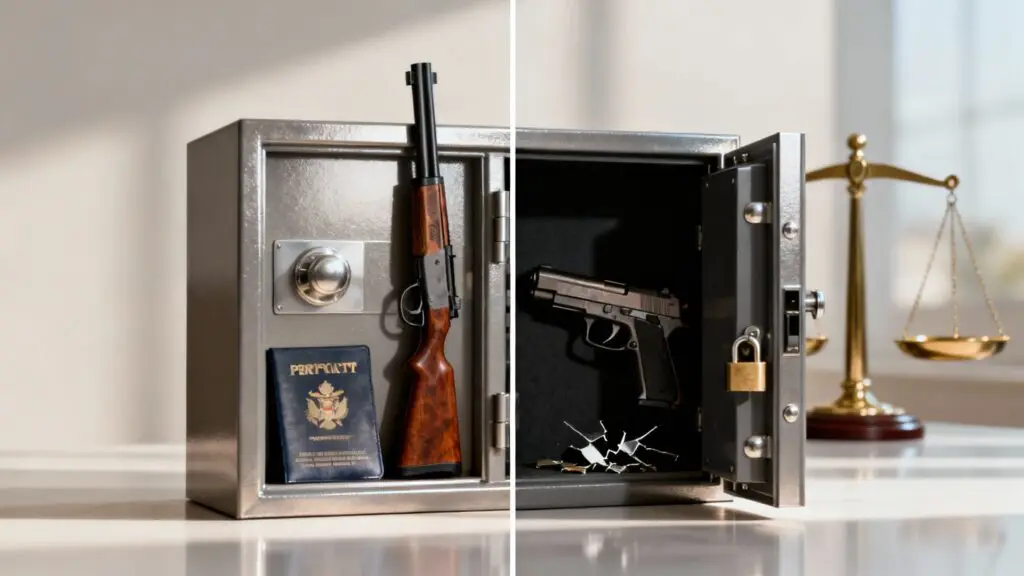
An open gun safe containing firearms and paperwork

Gun ownership in the Netherlands starts from a prohibition. The Wet wapens en munitie (Weapons and Ammunition Act) forbids possessing, carrying or transferring a weapon unless the Act itself creates an exception, and for firearms that exception is a permit, the verlof, issued by the chief of police. There is no right to bear arms and no general licence: permission is tied to one purpose, sport shooting or hunting, and to specific, registered weapons. The moment a condition attached to that permission is broken, possession becomes unlawful again.

That is the whole architecture, and it explains why so many prosecutions involve people who thought of themselves as law-abiding. This article sets out how the Act classifies weapons, how a permit is granted and withdrawn, which everyday situations turn a licensed owner into a suspect, which objects count as weapons without anyone realising it, what the penalties are, and what to do if you inherit a weapon or find yourself under investigation. For the wider context, see our criminal law practice and our guide to criminal procedure in the Netherlands.

A person holding up a sign with a crossed-out handgun, symbolising strict gun control.

The four weapon categories under the Weapons and Ammunition Act

A close-up of a firearm with a legal document and gavel, illustrating the intersection of weapons and the law.

Art. 2 of the Act divides weapons into four categories, and the category decides the regime. This is where most misunderstandings begin, because the numbering does not run from most to least dangerous in the way people assume: firearms sit in Categories II and III, not in Category I.

Category I

Category I contains objects that the legislature regards as having no legitimate civilian use. It covers stilettos, flick knives and butterfly knives, certain folding knives, knuckledusters, coshes and garrottes, throwing stars, and objects that so closely resemble a weapon that they are suitable for threatening or extorting someone, which is how replica and imitation firearms are caught. Possession, carrying, trade and transfer of a Category I object are prohibited outright. There is no permit that makes them lawful; the only route is a specific exemption in the Regeling wapens en munitie, which is how organised airsoft is made possible for members of a recognised association under strict conditions.

Category II

Category II is the heavy end. It covers automatic firearms, firearms that have been made or altered so that carrying them is less visible, firearms disguised as another object, electroshock weapons other than medical devices, devices designed to disperse an incapacitating or irritant substance, which is how pepper spray and tear gas are classified for civilians, and weapons that work by explosion. Firearms that do not fall within any other category also land here. A Category II weapon can in principle be held only on the basis of an exemption or consent that is granted very rarely and never for personal purposes.

Pepper spray deserves a sentence of its own, because it is the single most common mistake. It is legal to carry in a number of neighbouring countries and it is a Category II weapon here. Buying it abroad and bringing it home is enough to be prosecuted for possessing a Category II weapon.

Category III

Category III contains the firearms that a private individual can realistically be permitted to own: shotguns and rifles, revolvers and pistols, certain alarm and starting pistols, and throwing knives. These are the weapons for which a verlof or a hunting licence is granted. Category III is not a lighter regime in practice: it simply means that a route to lawful possession exists, and that route is narrow.

Category IV

Category IV covers items that may be held at home without a permit but may not be carried in a public place: swords and sabres, other double-edged blades that do not fall in Category I, batons, air, gas and spring-operated weapons that do not resemble a real firearm, crossbows and harpoons, and a catch-all for objects that, given their nature or the circumstances in which they are found, can reasonably be assumed to be intended to cause injury or to threaten. That last clause is broader than it looks and is examined below.

Parts, accessories and ammunition

The Act treats parts and accessories that are specifically designed for a weapon in the same way as the weapon itself. A silencer, a frame, a barrel or a magazine for a firearm is therefore not a neutral object; it follows the category of the weapon it belongs to. Ammunition has its own classification, with ammunition intended exclusively for Category II firearms, armour-piercing and incendiary rounds, and certain expanding rounds subject to the strictest regime. Holding ammunition for which you have no permitted firearm is an offence in its own right, and it is one of the most common findings during a routine permit inspection.

How a permit is granted, and how it is lost

A verlof for a Category III firearm is granted by the chief of police of the region where the applicant lives. It is issued for a limited period and has to be renewed, it names the specific firearms it covers, and it is granted only to someone who has a reason for possession that the Act recognises. There are essentially two: membership of a shooting association and hunting.

Sport shooting

The sport shooting route begins with membership of an association affiliated to the Koninklijke Nederlandse Schietsport Associatie. An applicant must have been a member for a minimum period, in practice at least a year, must have taken part in a minimum number of recorded shooting sessions during that period, and must have completed the association introductory programme. The precise requirements, including the number of sessions and the maximum number of firearms a sport shooter may hold, are set out in the Circulaire wapens en munitie, the policy rules that the police apply. The association keeps the attendance record, and a lapse in attendance is a ground for the police to refuse renewal.

Hunting

The hunting route runs through the hunting licence, the jachtakte, which is also issued by the chief of police and is governed by nature-protection legislation rather than by the Weapons and Ammunition Act itself. Obtaining it requires a recognised hunting examination, insurance, and access to a hunting field of the minimum size prescribed by law. The jachtakte permits possession of the firearms and ammunition that hunting requires, and it is subject to the same reliability test as a verlof.

The reliability test

Both routes turn on a single statutory standard: a permit is refused, and an existing permit is withdrawn, where there is reason to fear misuse of the weapon or of the permit. That test, in art. 7 of the Act, is deliberately low. The police do not have to prove that the holder will misuse a firearm; they need a reasoned suspicion based on facts, and the case law accepts that even a limited risk is unacceptable where firearms are concerned.

What counts in practice is broader than a criminal record. A conviction, a pending criminal investigation, a report of domestic violence, a mental health crisis, a suicide attempt, a threat made in anger, aggressive behaviour towards police officers, an alcohol or drug problem, financial distress, or a divorce accompanied by reports of conflict have all been accepted as reason to fear misuse. So has dishonesty in the application itself. The decision does not require a conviction and is not suspended while a criminal case runs; the permit can go first and the criminal case can follow.

Challenging a refusal or withdrawal

A decision to refuse, withdraw or not renew a permit is an administrative decision, and it can be challenged. The route runs through an administrative appeal to the Minister of Justice and Security, and from there to the administrative court. The weapons are usually surrendered immediately, because withdrawal takes effect at once and continued possession after withdrawal is a criminal offence in its own right; the fight is about getting the permit back, not about keeping the guns in the meantime.

Two practical points decide these cases. The first is speed: the appeal periods are short, and a missed deadline ends the matter regardless of the merits. The second is evidence. Because the test is a fear of misuse, the applicant has to show that the facts the police rely on either did not happen or no longer create a risk, which usually means medical or psychological reports, evidence of treatment completed, and a complete and candid account rather than a denial that the file contradicts.

The duties that come with a verlof

A permit is a conditional permission, and the conditions are printed on it. The table below sets out where the boundary runs in the situations that actually generate prosecutions.

AspectWhat is permittedWhat makes possession unlawful
AuthorisationA current verlof or jachtakte covering the specific weapon.An expired, withdrawn or suspended permit, or a weapon that is not listed on it.
PurposeSport shooting at a recognised range, or hunting where a hunting licence allows it.Any other use, including personal protection or informal target practice.
StorageIn a certified, locked safe at the registered address, with ammunition stored separately.A display mount, a cupboard, a car, a second home, or any address the police have not approved.
TransportUnloaded, in a locked case, by the direct route between the registered address and the range or hunting field.A detour, an accessible weapon in the cabin of a vehicle, or ammunition loaded or within reach.
AccessThe permit holder alone, apart from supervised use at a range within the association rules.Lending the weapon, letting an unlicensed person handle it, or leaving keys or codes accessible.
TransferTransfer only to a licensed dealer or to a person whose permit covers that weapon, with the paperwork done.Selling, giving or bequeathing a weapon to anyone else, including a family member.

Alongside these there are duties that catch people out because they involve doing something rather than refraining from it. You must allow the police to inspect the storage arrangements at your home; refusing an inspection is itself a ground to withdraw the permit. You must notify a change of address, because the permit is tied to the address where the safe stands. You must report a loss or theft immediately. And you must keep the association membership or hunting licence that supports the permit alive; when the underlying reason falls away, so does the permission.

How a lawful owner becomes a suspect

A firearm resting on a legal document next to a pair of handcuffs, symbolising the fine line between legal ownership and criminality.

Prosecutions of licensed owners rarely involve any intention to break the law. They follow from ordinary lapses, and the pattern is consistent enough to be listed.

The permit lapses. A renewal is submitted late, or the association membership is not renewed, and for the days or weeks in between the holder possesses firearms without authorisation. The Act does not recognise a grace period.

The route is not direct. A shooter stops at a supermarket on the way back from the range, or takes a weapon to a second address for the weekend. Transport is permitted only between the registered address and the place where the weapon may be used, and a deviation removes the basis for having it in the car at all.

Ammunition and firearm travel together. Keeping cartridges in the glove compartment while the pistol is in the boot is a breach even though both are in locked containers, because the separation requirement is about accessibility rather than about tidiness.

Something is modified. Fitting a sound suppressor, altering a semi-automatic mechanism, or adding an aiming device that is separately regulated changes the legal character of the weapon. The permit covers the weapon as registered; it does not cover what the weapon has become.

Someone else gets access. A partner or an adult child who knows where the key is kept, a friend allowed to hold a pistol at home, a weapon lent for a weekend to an experienced but unlicensed acquaintance. Each of these is treated as making the weapon available to a person without a permit, and both parties commit an offence.

Life changes. A divorce, a serious illness, a period of depression, a police visit after an argument at home. None of these is a crime, but each can produce a report that reaches the police and triggers a withdrawal, after which continued possession is unlawful. The correct response to an incident of that kind is to surrender the weapons voluntarily and to deal with the permit afterwards, not to wait and see.

Objects you may not realise are weapons

Most weapons prosecutions in the Netherlands have nothing to do with firearms. They involve objects that the person carrying them did not think of as weapons at all, and the Act reaches further than intuition suggests.

Knives are the largest group. A flick knife, a butterfly knife or a stiletto is a Category I object and is prohibited outright, wherever it is. An ordinary folding knife is not prohibited to own, but carrying it in a public place can still be an offence under the Category IV catch-all, because an object becomes a weapon where the nature of the object or the circumstances in which it is found make it reasonable to assume that it is intended to cause injury or to threaten. A kitchen knife in a shopping bag on the way home from a shop is one thing; the same knife in a jacket pocket at night in a city centre is another, and it is the circumstances that decide.

Self-defence products are the second group, and the confusion is understandable. Pepper spray, tear gas and electroshock devices are Category II weapons. Telescopic batons and similar impact tools are prohibited to carry, and depending on their construction fall in Category I or Category IV. None of them can be lawfully carried by a private individual for protection.

Replicas and toys are the third. An imitation firearm that is realistic enough to be used for threatening someone is a Category I object even if it cannot fire. Airsoft replicas are covered by that rule, which is why organised airsoft depends on a specific exemption tied to membership of a recognised association and on strict transport conditions. A realistic replica carried loose in a bag is an offence, and pointing one at someone is treated as a threat with a weapon.

Two further points affect where and how these rules are enforced. A municipality can designate a security risk area in which the police may carry out preventive searches without any individual suspicion, and those designations exist in the centres of the larger cities. And carrying a weapon in combination with another offence aggravates that offence considerably; a threat made while holding a knife is prosecuted very differently from a threat made with words, as our article on assault charges in the Netherlands explains.

Why self-defence is not a reason to own a weapon

Dutch law does recognise self-defence. A person who defends themselves or another against an immediate unlawful attack acts lawfully where the defence was necessary and proportionate, and the criminal law provides for that in the doctrine of noodweer. What the law does not do is allow anyone to prepare for that situation by arming themselves.

The two rules operate independently, and the consequence is often misunderstood. Successfully invoking self-defence in relation to an assault does not make the possession of the weapon lawful; those are separate offences and the weapons charge stands on its own. Worse, carrying a weapon in anticipation of trouble undermines the defence itself, because it makes it harder to argue that the confrontation was unavoidable and that the response was proportionate. In practice a person who carries a knife for protection and uses it is prosecuted twice: once for the weapon and once for what they did with it. Our article on grounds for exclusion of criminal liability sets out how noodweer is actually assessed.

The same reasoning applies to the home. There is no category of firearm that may be kept for household protection, and a permit granted for sport shooting does not become a defensive weapon because an intruder appears. A pistol taken out of its safe for that purpose is being used outside its permitted purpose, and that is an offence whatever happens next.

Penalties, and what a firearms prosecution looks like

The Act sets out its own penalties in art. 55, and they are graduated by category and by conduct. Offences involving Category I and Category IV objects are at the lower end, offences involving a Category III firearm are serious, and offences involving Category II weapons, or trafficking in weapons, are at the top. Possession of a firearm together with ammunition for it is treated more severely than possession of either alone. Rather than quote maximum sentences that depend on the precise charge, the useful point is the shape of the response: firearms offences are prosecuted as criminal offences, they are dealt with by the criminal court rather than by an administrative fine, and the weapon is withdrawn from circulation whatever the outcome for the defendant.

Sentencing practice follows the guidelines of the Public Prosecution Service, and two features stand out. Carrying a firearm in a public place attracts an unconditional prison sentence as a starting point, even where the weapon was never used and no one was threatened. And the sentence rises steeply where the weapon was loaded, where it was carried in the context of another offence, or where the defendant has previous convictions. Licensed owners prosecuted for a compliance failure are usually in a different bracket, where a fine, a community sentence or a conditional sentence is realistic, but the loss of the permit is effectively certain and is often the more serious consequence.

The consequences beyond the sentence

Three follow-on effects matter more to most clients than the sentence itself. A conviction is registered in the judicial documentation system, which affects the certificate of good conduct required for many jobs; our article on what a criminal record entails explains how long it stays there and what it blocks. For non-Dutch nationals, a conviction can affect the right to stay, and a weapons conviction is exactly the kind of offence that triggers a review; see our article on a criminal conviction and your right to stay in the Netherlands. And a permit once withdrawn on the ground of a fear of misuse is difficult to obtain again, because the withdrawal itself becomes part of the file the police assess next time.

If the police come

Weapons cases usually begin with a search, either of a home after a report or of a person in the street. Three things are worth knowing before that happens. You are not obliged to answer questions, and in a case that turns on what you knew and intended, an unconsidered explanation at the roadside is frequently the most damaging piece of evidence in the file. You are entitled to consult a lawyer before the first police interview and to have one present during it. And whether the search itself was lawful is a genuine issue in many of these cases, because a finding obtained through an unlawful search can be challenged. Our articles on what to do if you are suspected of a criminal offence and on when you need a criminal defence lawyer set out the first steps, and our guide to the summons and the hearing covers what follows.

Collectors, dealers and businesses

Sport shooting and hunting are the two routes an individual can realistically take, but they are not the only lawful positions under the Act, and the alternatives are frequently misunderstood.

Collectors can obtain a permit for a collection, which allows firearms to be held for their historical or technical interest rather than to be used. The conditions are different from those attached to a shooter permit and are stricter in one respect that surprises people: a collection permit does not permit shooting. Ammunition for the collected weapons is generally not allowed, the weapons must be stored to the prescribed standard, and the collection has to have a describable theme rather than being an accumulation. The scope of the permit is set out in the police policy rules, and a collector who fires a collected weapon at a range is using it outside the permitted purpose.

Businesses operate under a different instrument again. Manufacturing, altering, repairing or trading in weapons and ammunition requires a recognition, the erkenning under art. 9 of the Act, granted to the business and tied to a named person who is responsible for compliance. Gunsmiths, dealers, transporters and companies that handle weapons for film, theatre or museum purposes all need one, and the obligations that come with it include registration of every weapon that passes through, storage requirements and inspection. Working with weapons in a professional context without a recognition is prosecuted as trading in weapons, which sits at the serious end of the scale.

A further route exists for cases that fit none of these categories, in the form of an exemption granted by the Minister of Justice and Security. It is used for research institutions, specialist industry and a small number of comparable situations. It is not a route to a personal firearm, and applications founded on a desire for protection are refused as a matter of course.

Illegal firearms and the criminal market

A gritty, urban scene with discarded shell casings on the ground, hinting at street-level gun crime.

The strict licensing regime governs a small and closely monitored population of sport shooters, hunters and collectors. It has almost nothing to do with the firearms that appear in serious crime, and it is worth being clear about the distinction, because the enforcement effort and the sentencing practice are driven by the second group.

Illegal firearms in the Netherlands do not come from the licensed market. They are smuggled, converted or stolen. The main sources are trafficking from other parts of Europe, the conversion of alarm and blank-firing weapons into working firearms, and increasingly weapons assembled from parts bought separately. The country position as a logistics hub, with major ports and dense road connections, makes it both a destination and a transit route, and the trade is closely intertwined with drug-related organised crime, which is where most of the demand comes from.

Two features of the criminal market shape the law that applies to it. Convertible alarm weapons are why the Act treats certain starting pistols as Category III firearms and why the technical specifications matter: a weapon that can be converted is regulated as though it had been. And the trade in parts is why parts and accessories designed for a firearm are treated as the weapon itself, so that ordering a barrel or a slide online is not a lesser offence than acquiring a complete gun.

Possession of an illegal firearm is charged on the basis of possession alone. The prosecution does not have to show that the weapon was going to be used, and explanations that the weapon was being held for someone else, was found, or was inherited do not remove the offence, although they can matter to the sentence. Where a firearm is found in a shared space, a car or a house with several occupants, the real dispute is usually about who had the weapon at their disposal, and that is a question of evidence rather than of gun law.

Inheriting a weapon, and handing one in

Inheriting a firearm is the situation in which honest people most often become unlawful possessors without noticing. A permit is personal and does not pass with the estate. From the moment a weapon comes into your possession as an heir or as an executor, you hold it without authorisation, and the fact that the deceased was fully licensed makes no difference.

There are three lawful routes, and they should be taken quickly. Report the weapon to the police and hand it in, in which case it is registered and destroyed. Arrange a transfer through a licensed dealer to a person whose permit covers it. Or apply for a permit in your own name, which is realistic only if you already meet the requirements as a sport shooter or hunter. Contact the police before you move the weapon rather than after, and never transport it to a station without telling them you are coming; arriving unannounced with a firearm is not a good idea.

The same approach applies to a weapon that is found, or to a Category I or II object acquired abroad in ignorance. Voluntary surrender does not automatically extinguish the offence, but a person who reports and hands in a weapon of their own accord is in a very different position from one who is found with it, and the Public Prosecution Service takes that into account. Take advice before you make the call if the circumstances are complicated, for instance where the weapon was found in a business or where more than one person had access to it.

What to do if this affects you

If your permit has been withdrawn or refused, note the appeal deadline first and gather the material that addresses the fear of misuse second: medical or psychological evidence where health played a part, the outcome of any criminal case, and a factual account of the incident that prompted the decision. If you are a licensed owner and something has changed in your circumstances, deal with it before an inspection does. And if you are being investigated for a weapons offence, say nothing about the facts until you have taken advice; possession cases are frequently decided by what the suspect volunteered in the first hour.

Antique and deactivated firearms

Two exceptions to the permit requirement generate a steady stream of questions. Firearms manufactured before 1870 fall within an exemption in the Regeling wapens en munitie and can be held without a verlof, but the exemption is narrow, it depends on the weapon and its ammunition rather than on how old it looks, and a reproduction of an antique design is not an antique. Deactivated firearms are exempt only where they have been deactivated to the standard laid down in European legislation, marked accordingly and accompanied by a deactivation certificate. Removing a firing pin or welding a part is not deactivation. A weapon that could be restored to firing condition is treated as a live firearm, and the burden of showing that the exemption applies rests on the person holding it, which is why the certificate should be kept with the weapon rather than filed away.

Frequently asked questions

Is owning a gun legal by default in the Netherlands?

No. The starting premise is that owning a gun is illegal. Legal ownership is a rare privilege granted by the state under strict scrutiny, almost exclusively for controlled activities such as sport shooting and hunting under the Weapons and Ammunition Act.

How strictly must a licensed gun owner store their firearm?

Very strictly: the firearm must be stored in a certified, locked gun safe, and storing it improperly, such as in a bedside table or an unlocked cabinet, breaches the legal requirements.

Can I use a licensed firearm for something other than its permitted purpose?

No. A licensed firearm may only be used for the specific purpose outlined in the permit, for example at a registered shooting range, so carrying a sport pistol for self-defence or using a hunting rifle outside of a hunt is not allowed.

Can I lend or give my licensed firearm to someone else?

Only to another individual who holds a proper, valid licence. Selling, lending or giving a firearm to anyone not licensed to possess it breaches the rules.

How Law and More can help

Law and More advises licensed firearm holders and people suspected of weapons offences in the Netherlands. We challenge the refusal, withdrawal or non-renewal of a verlof or jachtakte through administrative appeal and before the administrative court, defend prosecutions under the Weapons and Ammunition Act, and advise on inherited or discovered weapons before they become a criminal matter. If your permit is under review or the police have contacted you about a weapon, contact our office before you respond.

Need Legal Assistance?

Contact Law & More for expert guidance on your legal matters. Our multilingual team is ready to help.

Related articles

The difference between murder and manslaughter in Dutch law is premeditation, and nothing else. Manslaughter,

Liability for AI systems in the Netherlands always lands on a person or a company,

A pro forma hearing is a court session in a criminal case at which the

Reputational damage often costs a company more than the fine that caused it, and in

Grounds for exclusion of criminal liability (strafuitsluitingsgronden) are circumstances that make a proven criminal act

The Netherlands has seen a marked rise in explosions and shootings directed at business premises

Stay Updated on Dutch Law

Subscribe to our newsletter for the latest legal insights, regulatory updates, and practical advice.