Under Dutch law, a contract is formed by an offer and its acceptance, and in principle by nothing more: no writing, no signature and no formality is required (Articles 3:37 and 6:217 of the Dutch Civil Code). The exception is the small group of contracts for which the law prescribes a form, such as a consumer’s purchase of a home or the transfer of real estate, which require a written document or a notarial deed.
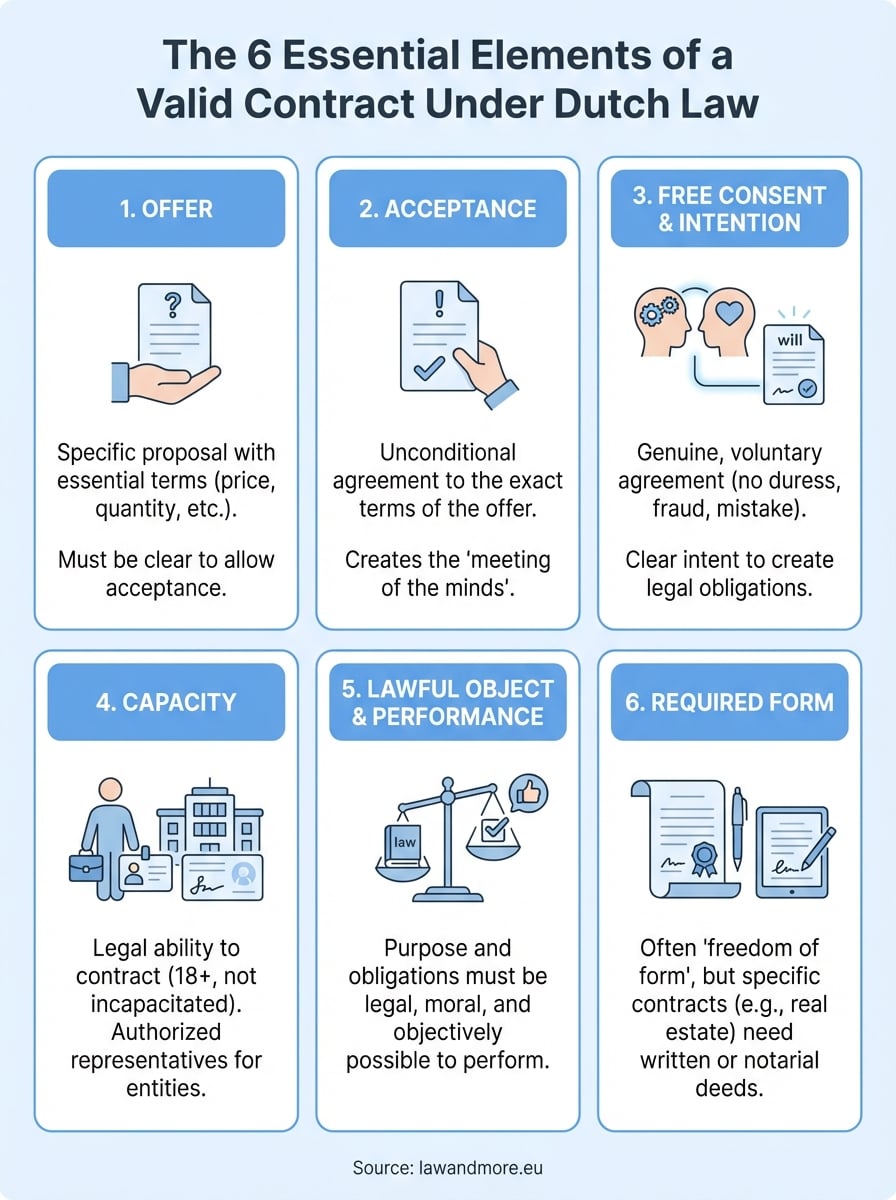
That freedom of form is why an agreement made by email or over the phone binds just as firmly as one on paper. What makes agreements fail is almost never the missing document. It is one of six elements: offer and acceptance, will and declaration, capacity, consent free of defects, a lawful and determinable content, and, where the law requires it, the right form.
Table of contents
What are the six elements of a valid contract?
A valid contract under Dutch law needs: (1) an offer and a matching acceptance, (2) a will that matches what was declared, or justified reliance on the declaration, (3) parties with legal capacity, (4) consent free of mistake, threat, fraud and abuse of circumstances, (5) a lawful and sufficiently determinable content and (6) the prescribed form, if any.
Unlike English or American law, Dutch law does not require consideration, meaning something given in return. A gratuitous promise can also be binding. And a written contract is usually not a condition for validity, but it is the best evidence of what was agreed.
The consequences of a defect differ. Some defects make the contract void (nietig): it never had legal effect. Others make it voidable (vernietigbaar): it is valid until the protected party annuls it, by a written statement or through the court (Article 3:49 and 3:50 of the Civil Code).
1. Is there an offer and a matching acceptance?
A contract is formed when an offer is accepted (Article 6:217 of the Civil Code). The acceptance takes effect when it reaches the person who made the offer (Article 3:37(3)).
Together, offer and acceptance create the meeting of the minds (wilsovereenstemming) that is the basis of every contract. Without it, there is no enforceable agreement, however detailed the written terms may be.

What is an offer under Dutch law?
An offer (aanbod) is a proposal that is specific enough that the other party can create a contract simply by saying yes. It must contain the essential terms, such as the goods or services, the price and, where relevant, quantity and delivery.
A clear offer would be: “I will sell you 1,000 units at €5 each, delivered to your warehouse by 15 March.” A vague statement such as “I can supply at a good price soon” is not an offer but an invitation to negotiate.
Dutch law differs here from English law. An advertisement, price list or webshop listing with a price can be an offer under Dutch law. Sellers therefore often add that their offers are without obligation (vrijblijvend) or subject to availability. Such an offer can in principle still be revoked immediately after acceptance.
Can an offer be revoked?
In principle yes, as long as it has not been accepted. The revocation must reach the other party before the acceptance has been sent (Article 6:219 of the Civil Code).
An offer cannot be revoked if it contains a period for acceptance or otherwise states that it is irrevocable. An oral offer lapses if it is not accepted immediately. A written offer lapses if it is not accepted within a reasonable time (Article 6:221).
How can an offer be accepted?
In any form: orally, in writing, by email, by clicking a button or by conduct, such as starting work. What matters is that the acceptance clearly relates to the offer and reaches the other party.
An electronic acceptance, for example by clicking “I agree”, creates a binding contract if the offer was clear enough. For contracts made online, the seller must confirm receipt of the acceptance electronically without delay (Article 6:227c of the Civil Code). The form matters less than whether both parties agreed to the same terms.
What if the acceptance differs from the offer?
Then it is in principle a new offer. However, if the acceptance differs only on minor points, it still counts as an acceptance and the contract is formed on the terms of the acceptance, unless the offeror objects to the differences without delay (Article 6:225(1) and (2)).
Dutch law therefore does not apply a strict mirror image rule. For example, if a buyer accepts a quote but asks for delivery one day later, that may be a minor deviation. A change in the price or in the liability clause usually is not.
If offer and acceptance each refer to different general terms and conditions, the second reference has no effect if it does not expressly reject the first party’s terms (Article 6:225(3)). This is the first-shot rule. For contracts with parties from other countries, the Vienna Sales Convention (CISG) may apply, which has different rules.
2. Do the will and the declaration match?
A legal act requires a will aimed at a legal effect, expressed in a declaration (Article 3:33 of the Civil Code). If the will and the declaration do not match, the other party is protected if he reasonably relied on the declaration (Article 3:35).
You are usually bound by what you said or signed, even if you meant something else, as long as the other party could reasonably understand your words as you said them. A clear mistake that the other party must have noticed, such as a price obviously missing a zero, does not bind you.
The will must also be aimed at a legal effect (rechtsgevolg). In business dealings that is almost always assumed. For social or family arrangements, such as a promise to give a friend a lift, it often is not.
3. Do both parties have legal capacity?
Everyone aged 18 or older (Article 1:233 of the Civil Code) has full legal capacity (handelingsbekwaamheid), unless a court has restricted it. A contract concluded by someone without capacity is voidable (Article 3:32 of the Civil Code).
What are the rules for minors and protected adults?
A minor can conclude a contract with the consent of his or her legal representative, usually the parents (Article 1:234). Consent is presumed for contracts that are normal for minors of that age, such as small everyday purchases.
For adults, the court can impose three protective measures. Under guardianship (curatele, Book 1, Title 16), the adult loses legal capacity and a guardian (curator) acts on his behalf. Under protective administration (beschermingsbewind, Title 19), an administrator (bewindvoerder) manages the person’s assets. Under mentorship (mentorschap, Title 20), a mentor decides on care and personal matters. Contracts about property under administration require the administrator’s cooperation.
Who may sign for a company or organisation?
Only someone who is authorised to represent it. A contract signed by someone without authority does not bind the company, unless the company ratifies it or created the appearance of authority.
For a private limited company (BV), the board represents the company, and the articles of association may require two directors to sign jointly (Article 2:240 of the Civil Code). Others can act on the basis of a power of attorney.

Under Article 3:61(2) of the Civil Code, a company is still bound if it gave you reasonable grounds to assume that the signatory was authorised. Do not rely on that. It is better to check beforehand.
How do you check capacity and signing authority?
Check the extract from the Commercial Register of the Chamber of Commerce (KVK) to see who may represent the company and whether there are restrictions. For significant contracts, ask for written proof of authority, such as a board resolution or a power of attorney, before you sign. For private individuals, you can ask for identification and, where relevant, check the public register of guardianship and administration (curatele- en bewindregister).
4. Is the consent free of defects?
A contract can be annulled if it was concluded under threat, fraud or abuse of circumstances (Article 3:44 of the Civil Code) or on the basis of a mistake (Article 6:228). The contract is then voidable, not automatically void.

When is there a mistake (dwaling)?
A mistake exists if you would not have concluded the contract had you known the true facts. Under Article 6:228, you can annul the contract if the mistake was caused by incorrect information from the other party, if the other party should have told you something but kept silent, or if both parties made the same wrong assumption.
There are limits. You cannot annul if the mistake relates only to a future circumstance, or if it is your own risk given the nature of the contract, common opinion or the circumstances. A buyer also has a duty to investigate: someone who could easily have checked the facts has less room to invoke mistake.
When is there fraud, threat or abuse of circumstances?
Fraud (bedrog) exists when the other party deliberately induces you to conclude the contract by giving incorrect information, keeping silent about something he should have told you, or using another trick. Threat (bedreiging) exists when someone makes you conclude a contract by unlawfully threatening you or a third party with harm.
Abuse of circumstances (misbruik van omstandigheden) exists when the other party knows or should understand that you are acting under special circumstances, such as a state of emergency, dependence, recklessness, abnormal mental condition or inexperience, and still induces you to conclude a contract that he should have stopped you from concluding. All three are in Article 3:44.
The right to annul is time-barred three years after the threat or abuse of circumstances has ceased, or after the fraud or mistake has been discovered (Article 3:52 of the Civil Code). So do not wait too long.
5. Is the content lawful and sufficiently determinable?
A contract whose content or purpose is contrary to good morals or public order is void (Article 3:40(1) of the Civil Code). The obligations must also be determinable (Article 6:227).
What makes a contract unlawful?
Examples are contracts for illegal services, agreements designed to facilitate fraud, or agreements that restrict competition in breach of competition law. Such contracts breach public order (openbare orde) or good morals (goede zeden) and have no legal effect.
A contract that breaches a mandatory statutory provision is void as well. However, if that provision is only meant to protect one of the parties, the contract is merely voidable, and only that party can invoke it (Article 3:40(2)). Many consumer protection rules work this way.
How certain must the obligations be?
The obligations must be determinable when the contract is concluded (Article 6:227). That does not mean everything must be spelled out: a price can be determined later using a formula or an index, for example. But if it is impossible to establish what the parties must do, there is no enforceable contract.
Dutch law does not treat a contract as void merely because performance turns out to be impossible from the start. The consequences are dealt with under the rules on mistake or non-performance.
What are the risks in regulated sectors?
In sectors such as financial services, healthcare and gambling, performing without the required licence can affect the contract. Whether it is void or only voidable depends on the purpose of the licence requirement (Article 3:40(2) of the Civil Code), so check the licence before you sign.
What happens if a contract is void?
Neither party has to perform, and what has already been paid or delivered must in principle be returned as an undue payment (onverschuldigde betaling, Article 6:203 of the Civil Code). If returning a service is impossible, its value must be compensated, although the court may limit that for contracts contrary to good morals.
6. Does the contract have the required form?
Most contracts are free of form (vormvrij): they are valid without any document (Article 3:37). A few contracts require a written document or a notarial deed, and without it they are void or voidable.

When does Dutch law require a written or notarial form?
The most common examples are:
- The transfer of real estate and the creation of a mortgage require a notarial deed registered in the public registers (Articles 3:89 and 3:260 of the Civil Code).
- The incorporation of a BV or NV and the transfer of its shares require a notarial deed (for a BV Articles 2:175 and 2:196, for an NV Articles 2:64 and 2:86).
- A consumer’s purchase of a home must be in writing (Article 7:2). The consumer then has a three-day cooling-off period.
- In employment contracts, a probation period and a non-compete clause are only valid if agreed in writing (Articles 7:652 and 7:653).
- A suretyship given by a private individual can only be proven by a document signed by that individual (Article 7:859).
Which clauses should every contract contain?
At least the parties, the obligations, price and payment terms, delivery dates, liability, termination, force majeure and dispute resolution.
The Civil Code fills gaps in what the parties agreed, and the requirements of reasonableness and fairness (redelijkheid en billijkheid, Article 6:248) can add or set aside obligations. A clear contract limits that uncertainty.
You can find more on this in our article on types of commercial agreements and on whether verbal agreements can be enforced.
Which language, law and court should you choose?
You can draft a contract in any language. A choice-of-law clause determines which country’s law governs the contract; a jurisdiction clause determines which court handles disputes.
Within the EU, the Rome I Regulation governs the choice of law and the Brussels I bis Regulation governs the choice of court.
What about cross-border contracts with a Dutch element?
Even if you choose another law, mandatory Dutch rules that protect consumers and employees may still apply. A consumer or employee cannot lose the protection of the mandatory law of the country where he lives or usually works by a choice of law (Articles 6 and 8 of the Rome I Regulation).
Are e-signatures valid, and how long should you keep contracts?
Yes. An electronic signature has the same effect as a handwritten one if the method is sufficiently reliable (Article 3:15a of the Civil Code). A qualified electronic signature under the EU eIDAS Regulation always has that effect.
Keep signed originals or reliable copies for the full term of the contract plus the limitation period. A claim for performance is generally time-barred five years after it became due (Article 3:307 of the Civil Code). Businesses must also keep their records for seven years for tax purposes.
What should you check as the party making the offer?
Under Article 6:217 of the Civil Code your offer becomes a contract as soon as it is accepted. Check these points before you send it:
- State a period for acceptance, or mark the offer as without obligation (vrijblijvend) if you want to keep the right to revoke it (Article 6:219).
- Include the essential terms: the goods or services, the price, quantity and delivery date.
- Declare your general terms and conditions applicable and provide them before or when the contract is concluded.
- Check whether the acceptance deviates from your offer; object without delay to deviations you do not accept (Article 6:225).
- Check in the KVK extract that the person accepting for the other company is authorised to sign.
What should you check as the party accepting or signing?
Once your acceptance reaches the other party, you are bound (Article 3:37(3) of the Civil Code). Check these points before you sign any contract:
- Check which offer you accept and on which terms, including any general terms and conditions referred to.
- Check whether a form requirement applies, such as a notarial deed for real estate or shares.
- Check the other party’s representation in the KVK Commercial Register.
- Check the choice of law and court, especially in a cross-border contract.
- Keep the negotiation correspondence: it shows what each party knew and was told if you later invoke mistake (Article 6:228).
What can we do for you with contract formation and validity?
Our corporate lawyers draft and review contracts in Dutch and English for businesses in the Netherlands and abroad:
- We give independent legal advice on a draft contract or offer and point out the gaps before you sign.
- We check the representation of the other party in the KVK Commercial Register.
- We draft general terms and conditions and make sure they are validly included.
- We draft choice-of-law and jurisdiction clauses for cross-border contracts.
- We send a written annulment for mistake, fraud, threat or abuse of circumstances within the three-year period of Article 3:52.
Summary
- Under Dutch law a contract is formed by offer and acceptance; in principle no writing or signature is required.
- The declaration counts: you are usually bound by what you said or signed if the other party reasonably relied on it.
- Contracts concluded without capacity, or under mistake, threat, fraud or abuse of circumstances, are voidable; the right to annul lapses after three years.
- Contracts contrary to good morals, public order or mandatory law can be void.
- Some contracts need a written document or notarial deed, such as a consumer’s home purchase, a real estate transfer and a non-compete clause.