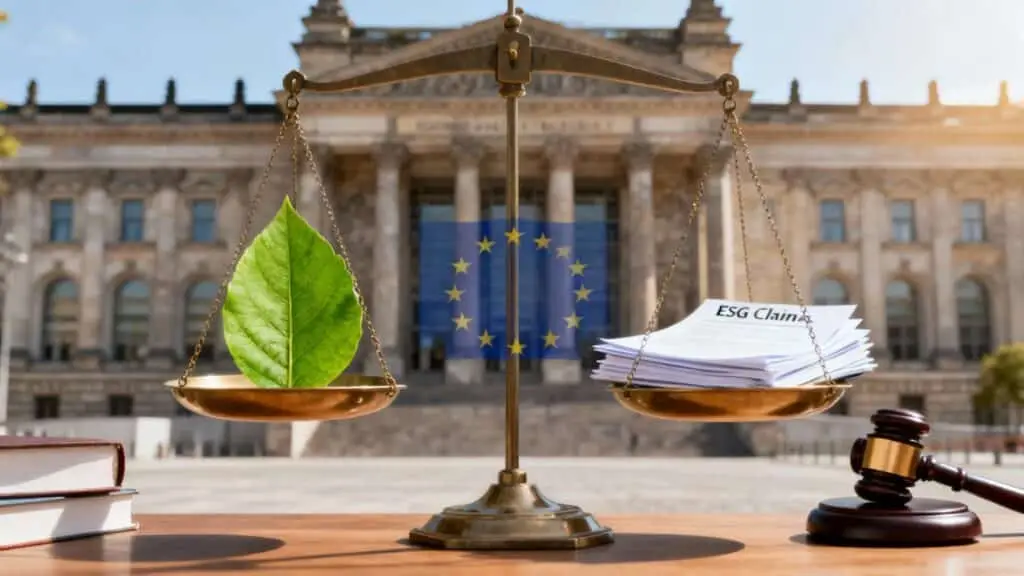
Greenwashing legal risks in the EU no longer sit with the marketing department. A misleading environmental claim is an unfair commercial practice under articles 6:193a to 6:193j of the Burgerlijk Wetboek, enforceable by the Autoriteit Consument en Markt and actionable by consumers, competitors and NGOs before the civil courts. From 27 September 2026 the Empowering Consumers Directive tightens the rules further, adding specific prohibitions on generic green claims, offset-based neutrality claims and self-invented sustainability labels.
What counts as greenwashing in Dutch and EU law
Greenwashing is not a separate offence with its own statute. It is a label for a category of conduct that Dutch law already prohibits: creating a false impression about the environmental characteristics of a product, a service or a company. The legal hook is the regime on unfair commercial practices, transposed into Dutch law in Book 6 of the Burgerlijk Wetboek.
Article 6:193c BW makes a commercial practice misleading where it contains information that is factually incorrect, or where the information is factually correct but presented in a way that deceives or is likely to deceive the average consumer about, among other things, the characteristics or benefits of the product. Article 6:193d BW does the same for misleading omissions: leaving out material information that the average consumer needs in order to make an informed decision. Article 6:193b BW then makes such practices unlawful.
Two features of that regime shape the whole subject. The first is that the test is the overall impression on the average consumer, not the literal truth of each individual word. A claim can be technically accurate in every element and still be misleading in the impression it creates. The second is the reversal in article 6:193j BW: the trader bears the burden of proving that the factual statements in the commercial practice are correct. In a dispute about a green claim, it is the company that has to produce the evidence.
In an unfair commercial practices claim the trader proves the claim is true; the consumer does not have to prove it is false. That single rule explains why a green claim without a file behind it is a liability.
The parallel route is misleading advertising between businesses, articles 6:194 and 6:194a BW, which a competitor can use, and the general tort provision in article 6:162 BW, which NGOs use. Our guide to unfair commercial practices sets out the framework in detail.
The claims that get companies into trouble
Enforcement practice in the Netherlands and elsewhere in the EU keeps returning to the same handful of patterns.
- Generic claims without substance. Terms such as eco-friendly, green, conscious or responsible, used without saying what specifically is better and by how much, communicate a benefit the company cannot evidence.
- Selective truths. Highlighting a genuine but marginal improvement while remaining silent about the dominant environmental impact of the product. Recyclable packaging on a product whose footprint sits in production is the standard example.
- Aspirations presented as achievements. A target for 2035 stated in the present tense. This is the pattern the Dutch courts have been least willing to tolerate.
- Offsetting sold as neutrality. Describing a product as climate neutral because emissions have been compensated elsewhere, without making the compensation and its limits visible.
- Imagery and self-made labels. Forests, leaves and green colouring that suggest an environmental benefit with no substantiated link, and quality marks the company designed itself.
How the ACM approaches sustainability claims
The Autoriteit Consument en Markt is the supervisor for unfair commercial practices in the Netherlands and has made sustainability claims an explicit priority. Its sector sweeps in energy, clothing and dairy found a large proportion of claims that were vague or insufficiently substantiated, and several of those investigations ended with companies changing or withdrawing their claims rather than with a formal decision.
The ACM published a Leidraad Duurzaamheidsclaims, a guidance document setting out five rules of thumb that are the practical benchmark for any company advertising in the Dutch market.
- Make clear what sustainability benefit the product actually has.
- Substantiate sustainability claims with facts and keep that substantiation up to date.
- Comparisons with other products, services or companies must be fair.
- Be honest and concrete about the sustainability efforts of your company.
- Make sure visual claims and quality marks help consumers rather than confuse them.
The guidance is not legislation, but it tells you exactly how the regulator will read your advertising, and a company that has followed it is in a far better position when a claim is challenged. The ACM has enforcement powers under the Instellingswet ACM, including binding instructions and administrative fines, and it can also accept binding commitments that end an investigation without a penalty.
Substantiation must exist before the claim is published, not be assembled after the regulator asks. A file compiled in response to a request for information is evidence of a problem, not a defence to it.
Alongside the ACM sits the Reclame Code Commissie, the self-regulatory advertising body. Its rulings are not binding and it cannot fine, but complaints there are quick, cheap and public, and its Milieu Reclame Code applies specifically to environmental claims. For many companies the reputational effect of an adverse ruling is the more immediate risk. We deal with the parallel issues in online promotion in our article on legal pitfalls in influencer marketing.
The Empowering Consumers Directive and what changes on 27 September 2026
Directive (EU) 2024/825, generally called the Empowering Consumers Directive, amends the Unfair Commercial Practices Directive and the Consumer Rights Directive specifically to deal with green claims. It entered into force on 26 March 2024, member states had to transpose it by 27 March 2026, and the national rules apply from 27 September 2026.
The Netherlands transposed it through the Implementatiewet richtlijn betere duurzaamheidsinformatie voor consumenten, which was adopted by the Tweede Kamer on 23 April 2026 and by the Eerste Kamer on 26 May 2026 and published in the Staatsblad on 24 June 2026. Entry into force is set by royal decree and may differ per provision. The Act amends Book 6 of the Burgerlijk Wetboek, so the new prohibitions land in the same unfair commercial practices regime described above.
What matters most is the extension of the blacklist, the list of practices that are unfair in all circumstances and therefore need no assessment of their effect on the consumer. The additions include the following.
- Generic environmental claims for which the trader cannot demonstrate recognised excellent environmental performance relevant to the claim.
- Claims about the whole product where the benefit concerns only one aspect of it.
- Claims of neutral, reduced or positive environmental impact based on offsetting of emissions.
- Sustainability labels that are not based on a certification scheme or established by public authorities.
- Claims about future environmental performance without clear, objective, publicly available and verifiable commitments, a detailed and realistic implementation plan, and independent monitoring.
The last of those is the one that reaches into corporate communication rather than product labelling. A net-zero pledge that is not backed by a concrete plan and independent verification becomes a blacklisted practice, and a blacklisted practice is unlawful without any further enquiry into whether consumers were actually misled.
From 27 September 2026 a climate-neutral claim resting on offsets is prohibited outright. It is not a question of better wording; the practice itself is on the blacklist.
Reporting: what remains of the CSRD after Omnibus I
The Corporate Sustainability Reporting Directive was the second pillar of the EU approach: mandatory, audited sustainability reporting under the European Sustainability Reporting Standards, built around double materiality, meaning both how sustainability matters affect the company and how the company affects people and the environment.
That framework survives, but its reach was cut sharply. The Omnibus I directive, published in the Official Journal on 26 February 2026 and in force from 18 March 2026, narrowed the scope of the CSRD to undertakings that exceed both one thousand employees and a net turnover of 450 million euro. Listed small and medium-sized enterprises were taken out of scope altogether, and the phased introduction that would have drawn in progressively smaller companies was dropped.
Two further changes matter for companies that fall outside the new threshold. Assurance remains at the limited level rather than moving to reasonable assurance. And there is a value chain cap: an in-scope company may not demand from smaller undertakings in its value chain more information than the voluntary reporting standard contains. That cap is the provision an SME should have to hand when a large customer sends a sustainability questionnaire.
The same directive reshaped the Corporate Sustainability Due Diligence Directive. The harmonised civil liability regime was removed, so claims will be decided under national law, and the penalty ceiling was set at three per cent of consolidated worldwide turnover. Transposition is due by 26 July 2028 and application follows on 26 July 2029. We deal with the due diligence obligations separately in our article on the Corporate Sustainability Due Diligence Directive, and with the wider picture in ESG regulation in 2026.
The EU Taxonomy Regulation continues to supply the definitions. It classifies economic activities as environmentally sustainable where they contribute substantially to one of six environmental objectives, do no significant harm to the others, and meet minimum social safeguards. For a company in scope of the CSRD it produces a hard number: the proportion of turnover, capital expenditure and operating expenditure aligned with the Taxonomy. That figure is difficult to spin, which is exactly why it is useful.
What happened to the Green Claims Directive
A separate proposal, the Green Claims Directive, would have required companies to have explicit environmental claims verified by an accredited body before publishing them. The European Commission announced in June 2025 that it intended to withdraw the proposal, days before the final negotiations, and the file has been at a standstill since.
Nothing should be planned on the assumption that it will arrive. The instruments that actually bind companies making green claims to consumers are the unfair commercial practices regime in Book 6 BW and, from 27 September 2026, the additions made by the Empowering Consumers Directive.
How the instruments fit together
| Instrument | What it governs | Who it applies to | Status |
|---|---|---|---|
| Unfair commercial practices (art. 6:193a-6:193j BW) | Every environmental claim made to consumers, with the burden of substantiation on the trader. | Any trader addressing Dutch consumers, of any size. | In force; enforced by the ACM and through the civil courts. |
| Empowering Consumers Directive (EU) 2024/825 | Adds specific prohibitions on generic claims, offset-based neutrality, self-made labels and unbacked future pledges. | Any trader addressing consumers in the EU. | Applies from 27 September 2026; Dutch implementing Act in the Staatsblad since 24 June 2026. |
| CSRD, as amended by Omnibus I | Audited sustainability reporting under the ESRS, on a double materiality basis. | Undertakings above one thousand employees and 450 million euro turnover. | In force; scope narrowed by the directive of 26 February 2026. |
| EU Taxonomy Regulation | Defines which economic activities count as environmentally sustainable. | Companies in scope of the CSRD and financial market participants. | In force. |
| Green Claims Directive (proposal) | Would have required prior verification of explicit environmental claims. | Would have applied to traders making voluntary green claims. | Withdrawal announced by the Commission in June 2025; not law. |
What the Dutch courts have decided
Regulation sets the standard; litigation shows where the line actually falls. The Netherlands has produced two decisions that anyone drafting a sustainability claim should know.
Fossielvrij NL against KLM
On 20 March 2024 the Rechtbank Amsterdam held that a series of KLM advertisements were misleading under the unfair commercial practices rules (ECLI:NL:RBAMS:2024:1512). The claims concerned CO2 compensation schemes and sustainable aviation fuel, and the court found that they painted an overly rosy picture of the environmental effect of measures whose actual contribution is small and uncertain.
The reasoning is what makes the judgment useful. The court accepted that an airline may talk about its efforts to reduce emissions, but held that it must do so in a way that gives the consumer a realistic picture: claims must be concrete and honest about what the measure achieves and what it does not. Suggesting that a flight can be made sustainable, or that compensation neutralises its impact, went beyond that. Aspiration presented as present-day fact was the core of the problem.
No damages were awarded and no fine imposed. The declaration that the advertisements were unlawful was the remedy, and for a consumer-facing brand that is a substantial one. It also created a template: the same reasoning applies to any sector where a compensation scheme is offered as an answer to an unavoidable footprint.
A claim about a future goal has to read as a goal. The Amsterdam court’s objection was not that KLM had ambitions but that its advertising presented them as achieved results.
Milieudefensie against Shell
The other landmark decision moved in the opposite direction on appeal. In 2021 the Rechtbank Den Haag ordered Shell to reduce its group emissions by a set percentage. On 12 November 2024 the Gerechtshof Den Haag set that order aside, while holding that a company does owe a duty of care in relation to climate change; the court found it could not determine a specific reduction percentage for this company. Cassation proceedings are pending before the Hoge Raad.
The nuance matters for anyone reading headlines about the case. The reversal did not dispose of the underlying duty of care, and the litigation has not ended. What it did establish is that translating a general duty into a quantified obligation for one company is a harder step than the first instance judgment assumed. Our article on the ruling in the climate case against Shell sets out the reasoning.
What the case law teaches
Read together, the Dutch decisions produce a short and practical set of rules. Substantiate before you publish, because the burden is yours under article 6:193j BW. Keep the comparison honest, including about the baseline. Describe a goal as a goal and an achievement as an achievement. Do not let a compensation scheme carry the weight of a neutrality claim. And judge the message by the impression it leaves, not by whether each sentence is individually defensible.
Who can act against a green claim, and what it costs
The exposure is broader than a regulator’s fine, because four different routes lead to the same claim.
The ACM can investigate on its own initiative or after complaints, and can impose binding instructions and administrative fines, publishing its decisions as it goes. The publication is frequently the more expensive part.
Consumers have a direct civil remedy. A misleading commercial practice is unlawful towards the consumer under article 6:193b BW, which opens the way to damages and, in some circumstances, to annulment or termination of the contract. Collective actions are available under the WAMCA, the Dutch collective redress regime, which allows a representative organisation to bring a claim for damages on behalf of a defined group.
Competitors can act under the misleading advertising provisions in articles 6:194 and 6:194a BW, usually in interim relief proceedings and usually seeking a rectification and an order to stop. This route is quick and is used more than most companies expect.
NGOs use the general tort provision and the collective action regime, as Fossielvrij NL did. Their objective is rarely money; it is a declaration and the publicity that comes with it.
On top of that sit the consequences that do not come from a court at all: financing conditions tied to sustainability performance, procurement exclusions, contractual warranties in supply agreements, and the ESG representations now standard in transactions. We look at how to draft those in our article on ESG clauses in contracts and on supplier codes of conduct.
Building a claims process that survives scrutiny
The compliance problem is narrower than it looks. It is not about proving that the company is sustainable; it is about making sure that every claim it publishes is one it can evidence. Four steps do the work.
Inventory every claim
Start with a complete list of the environmental statements the company currently makes, across the website, packaging and labels, advertising and social media, product descriptions on third-party marketplaces, tender documents, investor communications and the sustainability report itself. Claims made by resellers and by influencers on the company’s instructions belong on the list too, because the trader remains responsible for them.
For each claim, record what exactly is being asserted, about what scope, on what evidence, and when that evidence was last verified. Anything with a gap in one of those four columns is a claim to change or withdraw.
Test each claim against the new prohibitions
Run the surviving claims past the blacklist that applies from 27 September 2026. Is the claim generic, and if so, can recognised excellent environmental performance be demonstrated? Does it describe the whole product where the benefit sits in one component? Does it rest on offsetting? Is the label used a genuine certification scheme? Is a future pledge supported by a plan and by independent monitoring?
Claims about a percentage improvement need a stated baseline and a stated scope. Recycled content, emissions per unit, water use per litre produced: each needs a figure, a method and a date. Where a lifecycle assessment underpins the claim, its assumptions are part of the substantiation and have to be available.
Put a governance step between marketing and publication
The single most effective control is a sign-off requirement: no environmental claim is published without approval from a small standing group drawn from legal, the sustainability function and the product side. The group needs a mandate, a written standard to apply and a record of its decisions. That record is the file that answers the regulator later.
Set a review cycle as well. Substantiation ages, supply chains change and a claim that was accurate at launch can become misleading without anyone touching the copy.
Use certification carefully
Third-party certification adds credibility and evidence, but it is not a shield. A certificate covers a defined scope, and a claim that stretches beyond that scope is misleading whatever the certificate says. Under the new rules a label must rest on a certification scheme or be established by a public authority, which removes self-designed marks from the toolkit entirely.
Certification proves what it certifies and nothing more. The greenwashing risk is almost always in the gap between the scope of the certificate and the breadth of the claim built on it.
What smaller companies actually have to do
An SME outside the CSRD threshold still makes claims to consumers, and the unfair commercial practices rules apply to it in full. What it does not have to do is build a reporting apparatus. The proportionate approach is to make fewer and more specific claims, to keep the evidence for each in one place, and to invoke the value chain cap when a large customer asks for more information than the voluntary standard requires.
Being honest about the state of the journey is also a legitimate strategy. A company that says what it has done and what it has not is far harder to attack than one that reaches for a superlative it cannot support.
Sector rules that sit on top of the general regime
The unfair commercial practices regime applies to everyone, but several sectors carry additional rules that reach the same conduct from a different direction, and a claim that survives one can still fail the other.
Energy labelling is regulated at EU level and prescribes the form and content of the label; deviating from it or supplementing it with a self-designed marking is an infringement in its own right. Ecodesign and the rules on textiles impose product information duties that overlap with green claims, and the digital product passport will progressively make the underlying data visible to consumers rather than leaving it in a company file.
Food and drink carry a separate layer, because nutrition and health claims are governed by their own EU regulation and only claims from an authorised list may be used. An environmental claim on a food package therefore has to be assessed twice.
Financial products have the strictest regime of all. The Sustainable Finance Disclosure Regulation governs how funds and portfolios may present their sustainability characteristics, and both national supervisors and the European supervisory authorities have taken action against funds whose names and marketing promised more than the strategy delivered. A fund name containing a sustainability term now carries expectations about the portfolio behind it.
None of these regimes displaces the general rules in Book 6 BW. They add to them, which means that a company selling a labelled product to a consumer through an advertised campaign is potentially answerable to more than one supervisor for the same sentence.
What to do when a claim is challenged
Challenges arrive in one of four forms, and the right first move differs for each.
A request for information from the ACM is not yet an accusation, but it sets the frame for everything that follows. The response should be accurate, complete and internally consistent, because inconsistencies between what is said to the regulator and what appears on the packaging are damaging out of proportion to their size. There is an obligation to cooperate with the ACM, and the deadline set in the request is real.
A complaint to the Reclame Code Commissie is answered in writing within a short period. The proceedings are public and the outcome is published, so the response deserves the same care as a court filing even though nothing binding follows from it. Voluntarily amending the advertisement before the hearing is often the sensible course.
A summons in interim relief proceedings, typically from a competitor or an NGO, moves fast. The claimant will usually seek an order to stop the campaign and to publish a rectification. The defence is the substantiation file, and it has to exist already; there is no time to build one.
A collective action under the WAMCA is the slowest and the largest. It begins with an admissibility phase in which the representative organisation must show that it meets the governance and representativeness requirements, which gives a defendant a real opportunity to narrow the case before the merits are reached.
Whatever the forum, the first practical step is the same: freeze the position, collect the substantiation as it stood when the claim was published, and stop repeating the claim while the matter is assessed.
Two mistakes recur. The first is quietly removing the claim from the website without recording what was there, which destroys the ability to show what was actually said. The second is treating the matter as a communications problem and issuing a statement before the legal position is clear; the statement then becomes evidence.
Frequently asked questions
What is the most common mistake in sustainability claims?
Using a broad, undefined term without saying what specifically is better and by how much. Eco-friendly, green and sustainable communicate a benefit across the whole product and the whole lifecycle, and the trader has to be able to prove exactly that under article 6:193j BW. From 27 September 2026 a generic claim of this kind is prohibited outright unless recognised excellent environmental performance relevant to the claim can be demonstrated. The remedy is specificity: name the attribute, the figure, the baseline and the scope.
Can we still call a product climate neutral?
Not on the basis of offsetting. The Empowering Consumers Directive adds to the blacklist any claim that a product has a neutral, reduced or positive impact on the environment as a result of the compensation of emissions. A claim about actual reductions the company has achieved in its own operations or supply chain remains possible, provided it is substantiated and its scope is stated. The safe formulation describes what was reduced, by how much, against which baseline, and treats any compensation as a separate and clearly labelled measure.
Does a certification protect us against a greenwashing claim?
It helps, but only within its scope. A certificate for responsibly sourced cotton supports a claim about that cotton; it does not support a claim that the company is sustainable. Under the new rules a sustainability label must be based on a certification scheme or established by public authorities, so marks created by the company itself may no longer be used. Make the scope and the limits of any label visible to the consumer.
Who can take action against a misleading green claim?
The ACM through administrative enforcement, consumers individually or collectively under the WAMCA, competitors through the misleading advertising provisions in articles 6:194 and 6:194a BW, and NGOs through the general tort provision. The Reclame Code Commissie handles complaints under the advertising codes without binding effect. In practice a company faces the regulator and the civil courts at the same time, and a finding in one forum is used in the other.
Is our company still in scope of the CSRD?
Only if it exceeds both one thousand employees and 450 million euro in net turnover, following the narrowing of the scope by Omnibus I. Listed SMEs are out of scope. Companies below the threshold may still receive information requests from larger customers, but those requests are capped at the content of the voluntary reporting standard, and that cap can be invoked.
Law & More advises companies operating in the Netherlands on sustainability claims, the unfair commercial practices rules, ACM investigations and proceedings before the civil courts and the Reclame Code Commissie. If you want your claims reviewed against the rules that apply from 27 September 2026, or if a claim has already been challenged, we can assess the file and set out the options. Please contact us to discuss your situation. Our corporate law guides cover the surrounding obligations.