The Dutch Notice-and-Take-Down Code of Conduct (Gedragscode Notice-and-Take-Down) is a voluntary code that tells hosting providers and other internet intermediaries how to handle reports of unlawful content. It creates no new legal obligations: the binding rules on liability and notice handling now come mainly from the EU Digital Services Act (DSA), which applies to all intermediaries since 17 February 2024.
A hosting provider is not liable for what its users post as long as it does not know that the content is illegal (Article 6 DSA). Once it knows and does not act expeditiously to remove it or disable access, that protection falls away.
Table of contents
What is the Dutch Notice-and-Take-Down Code?
It is a self-regulatory procedure, drawn up on the initiative of the government and market parties, for intermediaries that receive a request to remove information from the internet. It describes how reports should be made and handled, so that removal decisions are made carefully.

The Code covers unlawful and criminal content on the Dutch internet, such as material that infringes copyright, defamatory statements, fraud and child sexual abuse material. It also leaves room for intermediaries to act against content they consider undesirable under their own terms and conditions. An addendum from 2018 added the Dutch expertise centre on online child abuse (Expertisebureau Online Kindermisbruik, EOKM) as a notifier. The text is published on the website of the Notice-and-Take-Down Code.
What are the key principles?
The intermediary is not a judge. Its role is to process reports carefully and make a reasonable decision on the information it has.
The Code balances three interests: those of the notifier, the person who posted the content and the intermediary. Clearly unlawful or criminal content is removed. In unclear cases, the Code encourages the intermediary to bring the notifier and the content provider into contact, so that they can resolve the dispute themselves or before a court. Following the Code does not give immunity, but it helps show that you acted carefully under Article 6 DSA.
Which rules apply besides the Code?
The Digital Services Act (Regulation (EU) 2022/2065) sets binding rules on liability and on how notices must be handled. The Code now works within that framework.
Under Article 6 DSA, a hosting provider is not liable for information stored at a user’s request, provided it has no actual knowledge of illegal content and, once it obtains such knowledge, acts expeditiously to remove it or disable access. There is no general obligation to monitor content (Article 8 DSA). Hosting providers must, however, offer an easy electronic mechanism through which anyone can report illegal content (Article 16 DSA), and they must give the user whose content is removed or restricted a clear statement of reasons (Article 17 DSA). Online platforms must also offer an internal complaint-handling system (Article 20 DSA). The full text is available on EUR-Lex.
Criminal law adds a further layer. The Public Prosecution Service (Openbaar Ministerie, OM) can, with authorisation from the examining magistrate, order an intermediary to make certain data inaccessible (Article 125p of the Dutch Code of Criminal Procedure, Sv). An intermediary that complies with such an order is protected against prosecution for that content as an intermediary (Article 54a of the Dutch Criminal Code, Sr).
Does the Code apply to your business?
It is aimed at intermediaries: businesses that transmit, store or make available information from others. If you publish your own content and control what appears on your site, you are the publisher, not an intermediary.

Intermediaries include hosting providers that store content on their servers, access providers that connect users to the internet, and platforms such as marketplaces, forums and social networks. The DSA distinguishes between mere conduit, caching and hosting services, with the heaviest obligations for online platforms and very large platforms. Check your service agreements and technical set-up to determine which category applies to you.
Your position matters for liability. The more you edit, select or promote content, the more likely you are regarded as having knowledge of or control over it, and the harder it becomes to rely on the hosting exemption in Article 6 DSA. Our overview of legal advice on Dutch business law sets out the wider framework.
How do you set up a takedown procedure?
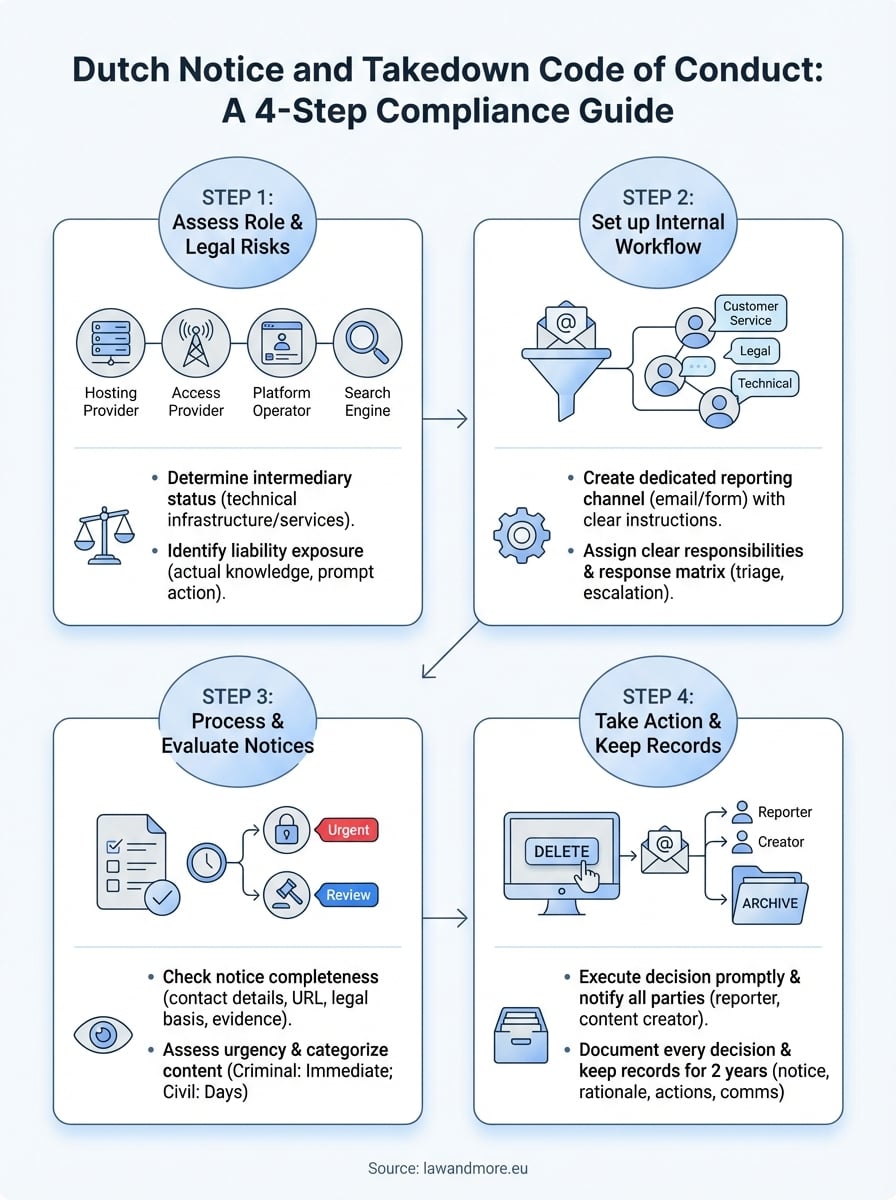
Create one clear reporting channel, decide who assesses notices and record every step. A consistent procedure reduces legal risk and makes it easier to show that you acted carefully.
Create a reporting channel
Set up a web form or a dedicated email address for reports of illegal content, separate from general customer service. State it clearly in your terms and conditions and on your website.

Under Article 16 DSA, the mechanism must make it possible to submit a sufficiently precise and substantiated notice. A notice should contain:
- an explanation of why the notifier considers the content illegal;
- the exact electronic location of the content, such as the URL;
- the name and email address of the notifier, except in reports of child sexual abuse material;
- a statement that the notifier believes in good faith that the information in the notice is accurate and complete.
Confirm receipt of each notice. If a notice is incomplete, ask the notifier for the missing information before you assess it on the merits.
Assign responsibilities
Appoint a person or team that receives all notices, assesses their urgency and tracks follow-up. Agree in writing who handles which type of content and when legal advice is needed. Criminal content may require immediate escalation; a claim about defamation or copyright usually requires a more careful legal assessment.
How do you assess a notice?
Check whether the notice is complete, whether the content is clearly unlawful and how urgent the matter is. Act faster as the potential harm increases.

Content that is clearly criminal, such as child sexual abuse material or a threat to someone’s life, requires immediate action. If you become aware of information giving rise to a suspicion of a criminal offence involving a threat to the life or safety of persons, you must inform the police or the Public Prosecution Service without delay (Article 18 DSA). Neither the Code nor the DSA sets fixed deadlines in days for other content; the test is that you act expeditiously and diligently.
For civil disputes, such as alleged defamation or infringement of intellectual property, the question is whether the content is unmistakably unlawful. If it is, remove it. If not, ask the content provider for a response or put the notifier in touch with them. Record your reasoning: what supports the notice, whether the content clearly breaks Dutch law and what complicates the decision.
What do you do after the decision?
Carry out the decision promptly, inform both parties and keep a record. The user whose content is removed is entitled to know why.
If you remove content or disable access, do so for the specific content concerned. Inform the notifier of your decision. Give the user who posted the content a statement of reasons, stating what was restricted, on what legal or contractual ground and what redress is available (Article 17 DSA). Online platforms must also allow the user to challenge the decision through their internal complaint-handling system.
Keep a file on each notice: the original notice and attachments, your assessment, the date and time of any removal or rejection, the correspondence with both parties, any objection and the final outcome. Such records help if your decision is challenged later, and they support the transparency reporting that the DSA requires of many providers.
How does it work in practice?
Most notices concern a few recurring situations: alleged copyright infringement, defamatory reviews or posts, phishing and fraud sites and, less often, criminal material. A standard procedure per category, recorded as the DSA requires for each statement of reasons under Article 17, saves time.
An example to illustrate: a hosting provider receives a notice from a company claiming that a customer’s website defames it. The statements are sharply critical, but not obviously unlawful. The provider informs its customer, asks for a response and sends the company a reasoned decision not to remove the content for now. The company can then address the customer directly or ask the court in summary proceedings (kort geding) for an order. A clear phishing page, by contrast, would have gone offline straight away.
What should you check as an intermediary?
As a hosting provider or platform, your liability exemption under Article 6 DSA depends on how you handle notices. Check these points:
- Is there an easy electronic notice mechanism that asks for the information listed in Article 16 DSA?
- Is one person or team responsible for assessing notices and tracking deadlines?
- Do you report threats to life or safety to the police or the OM without delay (Article 18 DSA)?
- Does every user whose content you remove receive a statement of reasons (Article 17 DSA)?
- Do your terms and conditions state which content you remove and how users can object (Articles 14 and 20 DSA)?
What should you check as a notifier?
If you want content removed, a complete and well-reasoned notice gets the fastest response. Check these points:
- Have you given the exact URL of each item of content?
- Have you explained which Dutch rule the content breaks, for example defamation (Article 6:162 BW) or copyright?
- Have you included your name and email address, and a statement that the notice is accurate and complete?
- Have you kept screenshots with date and time as evidence?
- If the intermediary refuses, do you know the content provider’s identity, so that you can address them or go to court?
What can we do for you with a notice-and-takedown issue?
Our IT lawyers assist both intermediaries and parties who want content removed:
- We draft or review your notice-and-takedown procedure against the Code and Articles 16, 17 and 20 DSA.
- We assess a difficult notice and advise whether the content is unmistakably unlawful.
- We write the statement of reasons to the user or the reasoned decision to the notifier.
- We draft a substantiated notice or a cease-and-desist letter on your behalf.
- We start summary proceedings (kort geding) for removal of content or disclosure of the poster’s identity.
Summary
- The Notice-and-Take-Down Code is voluntary and creates no new legal obligations; it describes a careful procedure for handling reports.
- A hosting provider is exempt from liability only if it acts expeditiously once it knows content is illegal (Article 6 DSA).
- The DSA requires a notice mechanism, a statement of reasons to affected users and, for platforms, an internal complaints system.
- Remove clearly unlawful or criminal content at once; in unclear civil cases, involve the content provider or let the parties resolve it.
- Document every notice and decision.
Frequently asked questions
Is the Notice-and-Take-Down Code mandatory?
No. The Code is voluntary. The binding obligations for intermediaries follow from the Digital Services Act and Dutch civil and criminal law.
Must I remove content as soon as someone reports it?
No. You assess whether the content is illegal. Clearly unlawful or criminal content must be removed expeditiously; if the case is unclear, you can involve the content provider and let the parties resolve the dispute.
Do I have to monitor my platform actively?
No. The DSA contains no general monitoring obligation. You must, however, act once you have actual knowledge of illegal content, for instance through a valid notice.