
Dutch construction law differs from most international systems because much of the risk allocation is not in the Dutch Civil Code (BW) but in standard conditions the parties adopt: the UAV 2012 for traditional contracts and the UAV-GC 2005 for integrated design-and-build contracts. The Civil Code provides the framework, and since 1 January 2024 it makes contractors liable for defects in buildings discovered after delivery unless the defect is not attributable to them (Article 7:758(4) BW).
For a foreign party used to FIDIC or common-law contracts, the practical consequence is that the chosen standard conditions, not the Code alone, determine liability, variations, delay and dispute resolution.
Table of contents
Which rules govern a Dutch construction project?
The legal framework has three layers. The first is the Civil Code: Title 7.12 BW on the contract for work (aanneming van werk), starting at Article 7:750 BW. The second is public law: since 1 January 2024 the Environment and Planning Act (Omgevingswet) governs permits and spatial planning, and the Building Works Living Environment Decree (Besluit bouwwerken leefomgeving) has replaced the Building Decree 2012 for technical requirements.
The third layer is the standard conditions. UAV 2012 applies when the client provides the design and the contractor builds it. UAV-GC 2005 applies to integrated contracts in which the contractor also takes on design. They apply only if the contract declares them applicable.
How does the Civil Code allocate risk?

Under Article 7:754 BW the contractor must warn the client about errors in the assignment and about defects in materials, soil, plans or calculations supplied by the client. For building works the warning must be in writing, unambiguous and include the possible consequences; with a consumer client this cannot be set aside.
Under Article 7:760 BW the client bears the consequences of defects in what it supplied, including the soil on which the work is built, unless the contractor breached the duty to warn or otherwise fell short in expertise or care. This gives a different starting point for ground conditions than many international contracts, where the allocation is set entirely by the contract.
Under Article 7:755 BW the contractor can only charge more for changes the client requested if it warned the client in time about the price increase. Article 7:753 BW allows the court to adjust the price for unforeseen cost increases not attributable to the contractor.
What changed with the Quality Assurance for Building Act?
The Quality Assurance for Building Act (Wet kwaliteitsborging voor het bouwen, Wkb) took effect on 1 January 2024. Since then Article 7:758(4) BW makes the contractor of a building liable for defects not discovered at delivery, unless they are not attributable to the contractor.
With a consumer client this rule cannot be set aside. With a business client it can only be set aside if this is expressly included in the contract. Claims for defects in a building become time-barred two years after the client’s complaint, and in any event 20 years after delivery (Article 7:761 BW).
How do Dutch rules compare with international standards?

Dutch contracts share features with international forms such as FIDIC, but differ in several respects that foreign parties often overlook.
- Reasonableness and fairness: under Article 6:248(2) BW a contract term does not apply where that would be unacceptable by standards of reasonableness and fairness, a broader judicial correction than in many common-law systems.
- Statutory duties: the duty to warn (Article 7:754 BW) and the rule on extra work (Article 7:755 BW) apply even if the contract is silent.
- Delivery: if the client does not inspect and accept or reject within a reasonable time after notice of completion, the work is deemed accepted (Article 7:758(1) BW).
- Disputes: UAV 2012 and UAV-GC 2005 refer disputes to arbitration by the Arbitration Board for the Building Industry (Raad van Arbitrage voor de Bouw) instead of the ordinary courts.
What does this mean for international parties?
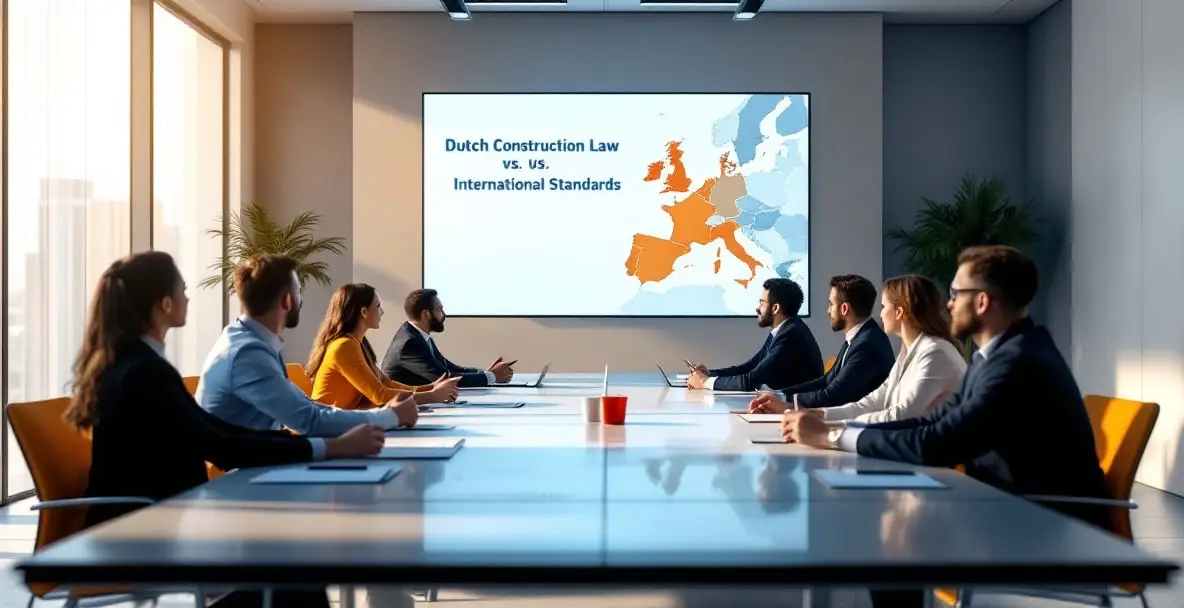
Choosing between Dutch standard conditions and an international form such as FIDIC is a project decision. Dutch conditions fit Dutch statutory rules and the practice of Dutch courts and arbitrators; an international form may need amendments to work alongside the mandatory rules of Title 7.12 BW. In both cases the contract should state which law applies and which forum decides disputes.
Permits are applied for under the Environment and Planning Act through the national digital system (Omgevingsloket). Local planning rules are set in the municipality’s environmental plan (omgevingsplan), so the same building can face different requirements in different municipalities.
What should you check as the client?
- Check whether UAV 2012, UAV-GC 2005 or another form applies, and that it is declared applicable in the contract.
- Check how the risk of soil conditions and your own plans is allocated (Article 7:760 BW).
- Check whether the contractor has excluded the Wkb liability of Article 7:758(4) BW, and whether you accept that.
- Agree an inspection procedure at delivery, so the work is not deemed accepted by silence.
- Complain about defects in writing promptly; the two-year limitation runs from your complaint.
What should you check as the contractor?
- Warn the client in writing and unambiguously about errors in plans, materials or soil (Article 7:754 BW).
- Warn about the price effect of changes before carrying them out (Article 7:755 BW).
- Check your liability for hidden defects under Article 7:758(4) BW and your insurance cover.
- Check the dispute clause: arbitration by the Raad van Arbitrage voor de Bouw or the ordinary courts.
- Document notice of completion and the client’s response.
What can we do for you with a construction contract?
Our construction lawyers advise Dutch and international clients and contractors.
- We review your construction contract and the applicable standard conditions.
- We compare an international form such as FIDIC with the mandatory Dutch rules and draft amendments.
- We draft warnings, change requests and notices of completion.
- We assess claims for defects after delivery under Articles 7:758 and 7:761 BW.
- We conduct arbitration before the Raad van Arbitrage voor de Bouw and court proceedings.
Summary
- In Dutch construction, standard conditions such as UAV 2012 and UAV-GC 2005 allocate much of the risk.
- The Civil Code adds mandatory duties: the duty to warn (Article 7:754 BW) and the rule on extra work (Article 7:755 BW).
- Since 1 January 2024 contractors are liable for hidden defects in buildings unless not attributable to them (Article 7:758(4) BW).
- Since 1 January 2024 permits fall under the Environment and Planning Act and technical rules under the Bbl.
Frequently asked questions
What are the UAV 2012 and UAV-GC 2005?
They are Dutch standard conditions for construction contracts. UAV 2012 is used when the client supplies the design; UAV-GC 2005 for integrated contracts where the contractor also designs. They only apply if the contract declares them applicable.
Who bears the risk of poor ground conditions under Dutch law?
Under Article 7:760 BW the client bears the consequences of defects in the soil it provides, unless the contractor breached its duty to warn under Article 7:754 BW or otherwise lacked expertise or care. The contract can allocate this differently.
Is a contractor liable for defects found after delivery?
For building works, since 1 January 2024 the contractor is liable for defects not discovered at delivery unless they are not attributable to it (Article 7:758(4) BW). With a business client this can be excluded expressly in the contract.
Can I use a FIDIC contract for a project in the Netherlands?
Yes, but mandatory Dutch rules such as the duty to warn still apply under Dutch law. The contract should be checked and amended to fit those rules and should state the applicable law and forum.