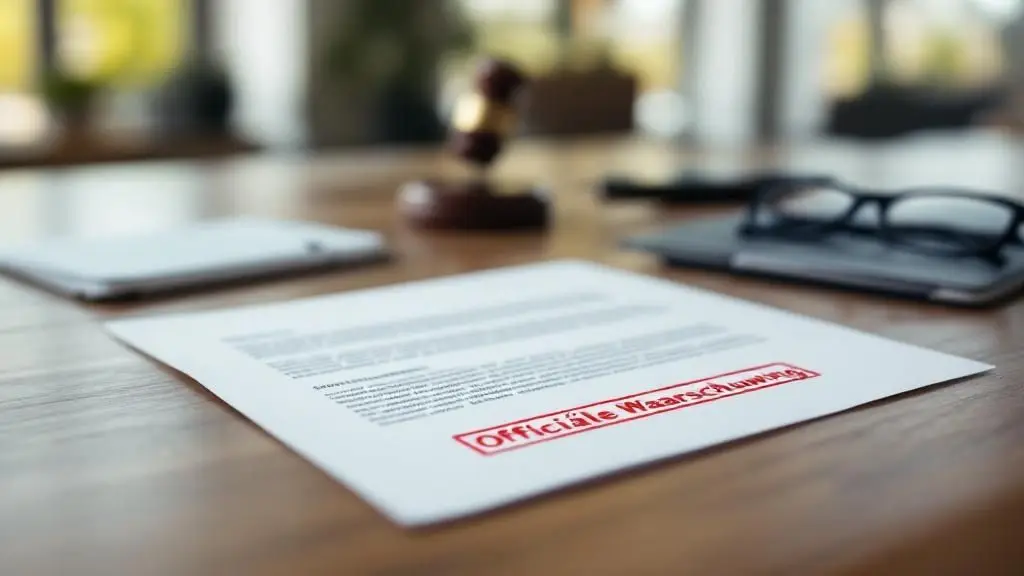
An official warning from your employer (officiële waarschuwing) is a written notice that records specific misconduct or underperformance, states what must change and by when, and says what happens if it does not. It does not end your employment and is not a penalty in itself, but it goes into your personnel file, and that file is what the subdistrict court (kantonrechter) examines if your employer later asks for your contract to be dissolved. The main exception: for serious misconduct such as theft or violence, your employer can dismiss you on the spot without any prior warning.
Table of contents
What is an official warning under Dutch law?

It is a piece of evidence, not a separate legal act. The Dutch Civil Code (Burgerlijk Wetboek, BW) has no article on warnings and prescribes no form.
What the Civil Code does contain are two rules that explain why warnings exist. According to article 7:611 BW, employer and employee must both behave as a good employer and a good employee. And article 7:669 BW sets out a closed list of grounds on which an employment contract may be ended. An employer who wants to end your contract for underperformance or culpable conduct must show the court that you were told what was wrong, that you were given a real chance to put it right, and that you did not. The warning is the evidence of the first two steps.
Can you appeal against a warning?
No, there is no procedure to have a warning quashed. You can put your own written response in the file, and you can use your rights under the General Data Protection Regulation (GDPR, in Dutch AVG).
Article 15 GDPR gives you the right to inspect your personnel file. Article 16 GDPR gives you the right to have inaccurate personal data corrected, and article 17 GDPR can support erasure. If your employer refuses and the warning is demonstrably unfounded, you can ask the court to order its removal from the file, and courts do grant such orders. Our guide to the limits of what a good employer may do sets out how far an employer may go.
What does a valid warning contain?
A usable warning names the facts, the rule, the improvement required, a realistic period with support, and the consequence. Because the warning is evidence, its quality decides its value: a letter saying you must “improve your attitude” tells a judge nothing. The elements below make a warning usable, and a missing element is the first thing to point out in your response.
| Component | What it means | Why it matters |
|---|---|---|
| A concrete description of the problem | What happened, on which dates, with examples that can be checked. | A general complaint cannot be disproved, and for that reason cannot be relied on either. |
| The rule or standard breached | The clause of the contract, the staff handbook, the collective labour agreement (cao) or the instruction that was not followed. | It shows the issue is a breach of an agreed standard rather than a personal disagreement, and lets you check whether the rule was ever communicated. |
| The improvement required | What the employer expects instead, expressed so that it can be measured. | Without a measurable target, neither side can later establish whether the employee improved. |
| A realistic period and the support offered | The time allowed to improve, and any coaching, training or supervision the employer will provide. | For a dismissal for underperformance, the law requires that the employee had sufficient opportunity to improve. A deadline nobody could meet defeats the warning. |
| The consequence of no improvement | What follows: a further warning, a formal improvement plan, or an application to dissolve the contract. | You must know what is at stake, and a court will check that the employer said so in advance. |
An employer who leaves out the improvement period and the support usually has a warning that will not carry the weight it expects. If you receive a warning that contains all five elements, treat it as the serious document it is.
Why does the personnel file decide the outcome?

Because Dutch dismissal law is closed and reasoned: your employer needs a statutory ground, and for performance or conduct grounds it must prove that ground to the court. An employer cannot simply give notice.
For most grounds the employer needs your written consent, permission from the Employee Insurance Agency (UWV), or a court order dissolving the contract. Redundancy and long-term incapacity for work go to the UWV. Everything about your own performance or conduct goes to the subdistrict court.
Three grounds in article 7:669(3) BW turn on the file:
- Underperformance (d-ground). The employer must prove that you are unsuitable for the job for reasons other than illness, that you were told so in good time, and that you had sufficient opportunity to improve. The unsuitability must also not be caused by a lack of care from the employer for training or working conditions.
- Culpable conduct (e-ground). Your conduct must be such that the employer cannot reasonably be required to continue the contract.
- A seriously and durably disturbed working relationship (g-ground). Employers often fall back on this ground when the file on the first two is thin.
Since 1 January 2020 there is also a cumulative ground (i-ground). The court may dissolve the contract when circumstances from several grounds together make continuation unreasonable. If the court uses this ground, it may award you an additional payment of up to half of the transition payment (transitievergoeding), on top of that payment (Article 7:671b BW). In practice, a weak file costs the employer money rather than blocking the dismissal entirely.
Building the file is called dossieropbouw. It is not sinister in itself: the law requires an employer to do this before it may end a contract for performance reasons. What matters to you is that the file is accurate and that it contains your side of the story. Our guides on how employment is terminated in the Netherlands and on when underperformance is legally proven set out what a court expects to see.
What are the common reasons for an official warning?

A warning is about either underperformance (the work is not good enough) or culpable conduct (a rule was broken). The distinction matters because the law attaches different requirements to each ground. An employer that labels a conduct problem as underperformance, or the other way round, weakens its own position.
What do performance warnings cover?
These typically concern missed targets over a sustained period, recurring errors, incomplete delivery of core duties, or failing to meet standards set out in the job description or an appraisal. What makes such a warning valid is also what makes it fair. The standard must have been communicated before it was enforced. And you must be given a genuine period, with support, in which to reach it. A single bad quarter is not underperformance.
What do conduct warnings cover?
These cover repeated lateness or unexplained absence, refusal to carry out a reasonable instruction, breach of safety rules, misuse of company systems, aggressive or inappropriate behaviour towards colleagues or clients, breach of confidentiality, and conflicts of interest. Whether an instruction was reasonable is judged objectively. You may refuse an instruction that is unlawful or that falls outside the agreed work. If the employer wants to change the job itself, different rules apply; our guide on a change of role at work explains when you must accept it.
When is no warning needed at all?
For an urgent cause (dringende reden), such as theft, fraud, violence, serious intimidation or falsified qualifications. Such conduct can justify summary dismissal under articles 7:677 and 7:678 BW, and a prior warning is not required. Our article on lying about a degree deals with one such case.
At the other end, illness is not misconduct. If you are off sick, you may be warned for not following the absence rules, but not for being ill. What your employer may ask you about your illness is limited by data protection law, as our guide on sick leave and privacy explains.
How does the procedure run?

There is no statutory procedure, but there is an established practice, and departures from it are what you should look for. A warning normally follows a conversation in which your employer raises the problem and you can respond. Confirming it in writing afterwards, with a reference to that conversation and to what you said, turns a discussion into a record. A warning issued without any prior conversation is not invalid, but it is weaker, and it sits uneasily with the duty to act as a good employer.
Does a verbal warning count?
It can, but it is weak as evidence. A verbal warning is sometimes used for a first, minor issue. If nobody recorded it, then as far as a later file is concerned it did not happen. Employers who rely on verbal warnings and then apply to dissolve the contract regularly lose on that point.
Should you sign the warning?
Yes, but for receipt only. Employers hand over the letter in person against signature, send it by registered post, or email it and ask you to confirm receipt. Next to your signature, write “voor ontvangst, niet voor akkoord” (for receipt, not for agreement). That is standard practice in the Netherlands and no employer can reasonably object to it. Refusing to sign achieves nothing: the employer will simply record that the letter was handed over in the presence of a witness.
Does your employer have its own disciplinary rules?
Check this first. Many collective labour agreements and staff handbooks contain a disciplinary procedure. It may set out who may issue a warning, whether you may bring someone to the meeting, how long a warning stays on file, and whether there is an internal complaints route. If such a procedure exists, your employer is bound by it. An employer that breaks its own rules hands you one of your strongest arguments.
What are your rights, and how should you respond?
Stay calm, ask for the specifics, and respond in writing. You do not have to accept your employer’s version of events, and you should not be pushed into an immediate reaction. Three rights matter most: the right to know exactly what you are accused of, the right to put your own account in the file, and the right to inspect and correct your personal data.
What should you say in the first conversation?
Acknowledge receipt, say that you will respond in writing, and ask for the details you need: dates, times, documents, and where possible the names of anyone who reported the incident. Do not accept a warning that refers to complaints without saying what they were. Do not resign, and do not sign a settlement agreement (vaststellingsovereenkomst) in the same meeting. Both are hard to undo, and neither is required of you.
How do you write a good response?
Keep it short, factual and calm. Record the date on which you received the warning, answer each allegation in turn, give your account with the supporting evidence, and ask expressly for your letter to be added to your personnel file. If the warning is partly right, say so. A response that denies everything is less credible than one that concedes what is true and corrects what is not. If your employer offered no support or improvement period, point that out, because that omission matters later.
Silence is the one response with no upside. In later proceedings, an unanswered warning is treated as one you did not contest, and that is exactly the impression the file is designed to create.
What may an employer attach to a warning?
Very little: a warning is a communication, not a sanction. Some measures employers link to a warning are lawful, others are not.
Can you be suspended or sent home?
Suspension or being sent home (schorsing or op non-actiefstelling) is allowed as a temporary measure, for example while an incident is investigated. It does not stop your wage. Under article 7:628 BW, the employer keeps paying when you do not work for a reason that falls within its own sphere of risk, and a suspension the employer imposes falls in that sphere. An employer that stops your wage during a suspension is usually in breach.
Can your employer fine you?
Only within narrow limits. Under article 7:650 BW, a fine requires a written employment contract that lists the offences and the amounts, and further restrictions apply if you earn around the statutory minimum wage. In practice most Dutch employers cannot lawfully fine an employee at all, and deducting wages as punishment for a warning-level issue is not permitted.
Can you be demoted or transferred after a warning?
This is a unilateral change to your contract. Under article 7:613 BW, an employer may only impose it if the contract contains a written unilateral amendment clause and the employer has a compelling interest. Without such a clause, the change must be so reasonable that, as a good employee, you cannot refuse it. Presenting a demotion as the consequence of a warning does not remove those requirements.
What happens after a warning?
Usually nothing more: you make the changes within the period given, and the warning loses weight over time. Ask your employer to confirm in writing that the matter is closed; that confirmation is the counterweight to the warning itself.
If the problem continues, the escalation is predictable:
- A second, more strongly worded warning.
- A formal improvement plan with objectives, milestones and scheduled reviews. For underperformance, courts in effect expect one, and it should include the training or coaching the employer will provide.
- If that fails, an application to the subdistrict court to dissolve the contract.
At that hearing, the file is the case. Specific, dated warnings, a genuine improvement period with support, and documented evaluations will usually persuade a court that the employer did what the law asks. Vague complaints, warnings issued after the decision to part ways had already been made, or an improvement plan that never really ran, will not.
If the court dissolves the contract, you are in principle entitled to the statutory transition payment. Under article 7:673(7) BW you lose it only if you acted with serious culpability (ernstig verwijtbaar), a high threshold reserved for exceptional cases. If it is the employer that acted seriously culpably, the court can award you fair compensation (billijke vergoeding) on top.
Which time limits matter?
Two. First, if you are summarily dismissed, you must ask the court to annul the dismissal or claim compensation within two months of the date the contract ended (article 7:686a(4) BW). Missing that deadline ends the claim, however strong it is, so take advice the same week.
Second, courts have made clear that underperformance, however persistent, is not in itself an urgent cause for summary dismissal. Our report on a case in which poor performance was held not to be an urgent cause shows how that plays out. Employers facing a genuinely damaging employee will find the lawful route in our guide on how to dismiss a toxic employee legally, and the general procedure in our guide on how to handle employee dismissal legally.
What if a warning is really about something else?
Then the timing is your strongest argument. Warnings sometimes appear shortly after an employee has reported unwanted behaviour, complained about pay or working hours, become pregnant, reported sick, or raised a suspicion of wrongdoing. In that pattern, the warning may not be a disciplinary document but the opening move in a file, and the legal analysis changes.
Several protections can then apply:
- Victimisation. Dutch equal treatment legislation prohibits both discrimination and victimisation. Your employer may not treat you less favourably because you invoked the equal treatment rules or helped someone who did.
- Dismissal prohibitions. Under article 7:670 BW, you are protected against notice of termination during illness, during pregnancy and maternity leave, and in connection with membership of a works council.
- Whistleblower protection. Since the Dutch Whistleblower Protection Act (Wet bescherming klokkenluiders) took effect on 18 February 2023, an employee who reports a suspicion of wrongdoing internally or externally is protected against any reprisal, including negative assessments and disciplinary measures. The employer must prove that a measure was not connected to the report.
None of this makes a warning automatically unlawful: employees who complain can also underperform. But if a warning arrives within weeks of a protected act, record that sequence in your response, together with the fact that the same behaviour was never criticised before. It is the single fact that most often changes the way a file reads.
Does a warning matter on a fixed-term contract or during probation?
Less than you might think, because the dismissal protection described above assumes an ongoing contract. Employees regularly overestimate their position in both situations.
What if you are in your probation period?
During a valid probation period (proeftijd), either party may end the contract with immediate effect under Article 7:676 BW, without notice and without a court; you may ask for the reason in writing. Under Article 7:652 BW the clause is only valid if it was agreed in writing, is the same for both parties and stays within the statutory maximum of one or two months. A warning during probation is therefore mostly a courtesy; what matters is whether the clause holds, as our article on dismissal during the probation period explains.
What if you have a fixed-term contract?
A fixed-term contract ends on its end date without any dismissal procedure. Warnings during its term matter for another reason: they are the file your employer will point to when deciding not to renew. For contracts of six months or more, the employer must tell you in writing at least one month before the end date whether the contract will continue and on what terms (article 7:668 BW). If it fails to do so, the contract is not extended, but the employer owes you compensation of up to one month’s wage. Ending a fixed-term contract early is only possible if the contract contains an interim notice clause; without one, the employer needs the court.
What should you check as an employee?
Your response in the first two weeks decides how the file reads later. Check these points:
- Does the warning name dates, checkable facts and the rule or instruction you allegedly breached?
- Does it set a realistic improvement period and say what support you will get?
- Sign for receipt only, with “voor ontvangst, niet voor akkoord”.
- Ask for a copy of your personnel file under Article 15 GDPR and respond in writing, asking for your response to be added.
- Check the collective labour agreement or staff handbook for a disciplinary procedure your employer must follow.
- Note whether the warning came shortly after sick leave, a pregnancy, a complaint or a whistleblowing report.
What should you check as an employer?
Employers lose dissolution applications on the file far more often than on the facts. Check these points before you issue a warning:
- Write the warning on the day, about conduct rather than character, with dates and checkable facts.
- Name the standard that was breached and show that it was communicated beforehand.
- State the improvement required, a fair period and the support you will give, as Article 7:669(3)(d) BW requires for underperformance.
- Follow your own disciplinary procedure and treat comparable conduct by other employees in the same way.
- Evaluate at the end of the improvement period and record the outcome in writing.
- Keep the file to what is necessary; health information belongs with the company doctor, not in the personnel file.
What can we do for you with an official warning?
Our employment lawyers assist employees and employers at every stage of a warning and the file that follows. More background is in our Dutch employment law guides and our overview of Dutch employment law.
- We review the warning and your personnel file and assess how a subdistrict court would read them.
- We draft your written response, point by point, with the supporting evidence.
- We draft a request to inspect, correct or erase file data under Articles 15 to 17 GDPR.
- We check whether a suspension, fine or demotion complies with Articles 7:628, 7:650 and 7:613 BW.
- For employers, we draft warnings and improvement plans that meet the requirements of Article 7:669 BW.
- We act in dissolution proceedings and file a request within the two-month deadline after a summary dismissal.
Summary
- An official warning is evidence for a later file, not a dismissal or a penalty; Dutch law prescribes no form.
- A usable warning states the facts, the rule breached, the improvement required, a realistic period with support, and the consequence.
- Sign for receipt only (“voor ontvangst, niet voor akkoord”) and always respond in writing; an unanswered warning is treated as accepted.
- A warning cannot lawfully come with a fine outside the narrow limits of Article 7:650 BW, and a suspension does not stop your wage.
- If you are summarily dismissed, you have two months to go to court (Article 7:686a BW).
Frequently asked questions
Is there a three strikes rule for dismissal in the Netherlands?
No. Dutch law has no fixed number of warnings after which dismissal follows. The subdistrict court looks at the quality of the file: were you told clearly and in good time what was wrong, and did you have a real opportunity and support to improve?
Can my employer dismiss me without any warning?
Only for an urgent cause such as theft, fraud or violence, and only if the dismissal and the reason are given immediately (Articles 7:677 and 7:678 BW). For underperformance or ordinary mistakes, dismissal without a prior warning and a chance to improve will not hold.
How long does a warning stay in my file?
There is no statutory period, unless your collective labour agreement or staff handbook sets one. Under Article 5(1)(e) GDPR personal data may not be kept longer than necessary, which gives you a ground to ask for an old, spent warning to be removed.
Can I be warned for something that happened months ago?
Yes, but the delay weakens the warning. For summary dismissal the rule is stricter: the dismissal must follow immediately after the employer discovers the urgent cause.
Does a warning affect my transition payment or unemployment benefit?
A warning on its own affects neither. You lose the transition payment only if the court finds serious culpability (Article 7:673 BW), and the UWV can refuse or reduce unemployment benefit (WW) if you are culpably unemployed.