
A non-solicitation clause (relatiebeding) prevents someone from approaching your clients or business relations for a set period after they leave. Under Dutch law, such a clause in an employment contract must be agreed in writing, and in a fixed-term contract it is void unless it includes a written justification of your weighty business interests.
You find these clauses in employment contracts and in agreements with contractors and business partners. Below we explain when a non-solicitation clause is valid, how the courts assess it, and which mistakes make it unenforceable. We also give example wording you can adapt, with the points to check before you use it.
Table of contents
Why use a non-solicitation clause?
A non-solicitation clause protects the client relationships you have built from being taken by someone who got to know them through working for you. It gives you time to secure those relationships after a key person leaves.

A departing employee knows which clients generate most revenue and how your pricing works. Without a clause, that employee may in principle contact your clients the day after leaving, as long as they do not act unlawfully, for example by using confidential client lists. A non-solicitation clause gives you a contractual basis to stop that for a limited period. It is narrower than a non-compete clause (concurrentiebeding), because the person may still work for a competitor, just not for your clients.
How do you include a non-solicitation clause?
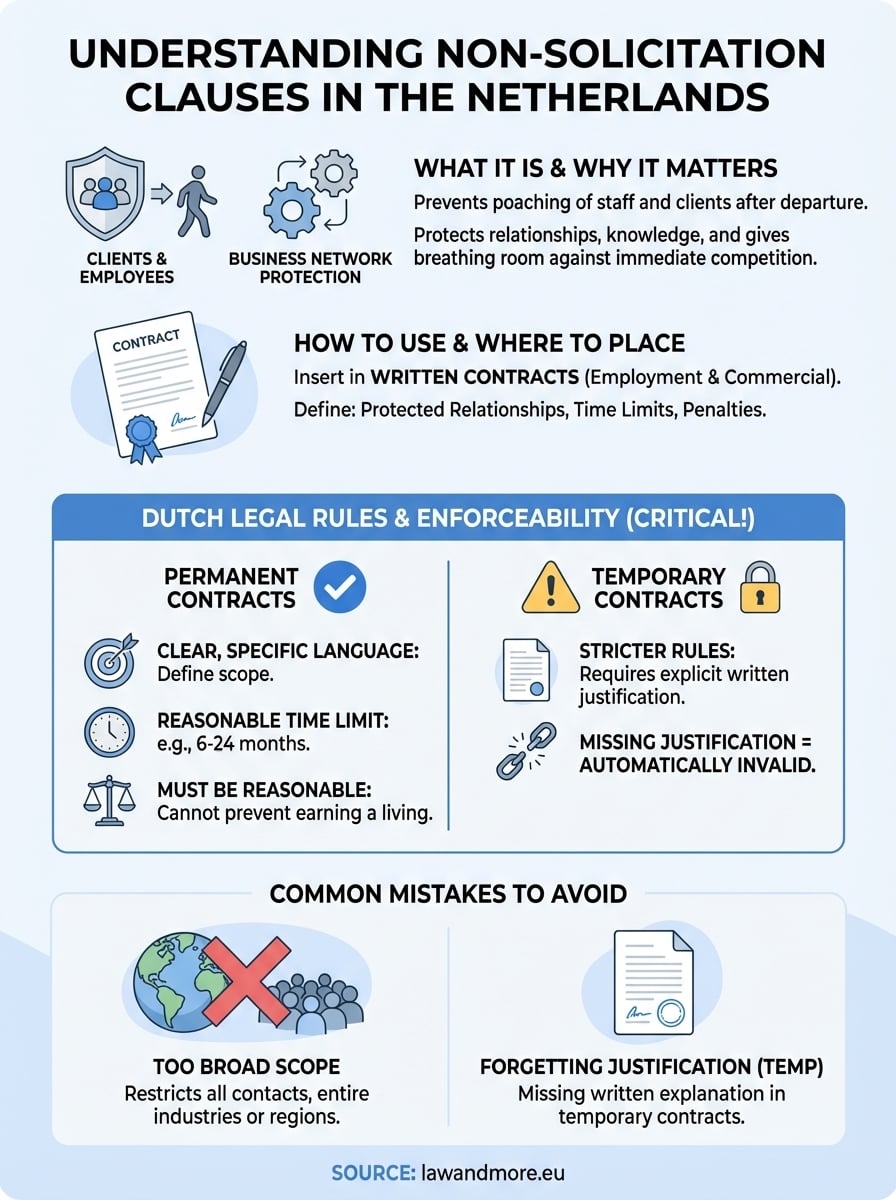
Put the clause in the written contract and have it signed before the person gets access to your client relationships. State clearly which relations are protected, how long the restriction lasts and what happens in the event of a breach.
Include the clause in employment contracts with staff who deal with clients, and in agreements with contractors, consultants or partners who gain insight into your client base. Agreeing it at the start is easiest. Adding it later is possible, but then the employee must agree to it in writing, and they are not obliged to do so.
In employment contracts
Specify which relations the employee may not approach after leaving: clients, suppliers, prospects, or only the relations they dealt with personally. Set the period during which the restriction applies. Periods of six months to a year are common; a longer period needs a stronger justification under Article 7:653 BW.
Also describe what counts as solicitation. Think of direct contact, contact through social media such as LinkedIn messages, and indirect approaches through third parties. The clearer your definitions, the easier it is for the court to apply the clause.
In commercial agreements
Agreements with contractors or partners need different wording, because they are agreements between businesses. State that the other party may not approach your clients for competing services during the agreement and for a defined period afterwards. Article 7:653 BW does not apply here, so the protection depends entirely on your wording.
Your contract cannot directly bind the other party’s employees, because they are not parties to it. Instead, include an obligation for the other party to ensure that its employees and other people it engages also respect the restriction, with the other party being liable if they do not.

When is a non-solicitation clause valid under Dutch law?
In an employment contract, the clause is treated as a non-compete clause under Article 7:653 of the Dutch Civil Code (BW). It must be agreed in writing with an adult employee, and the court can annul it wholly or partly if it disadvantages the employee unreasonably.

Dutch case law consistently applies the rules on non-compete clauses to non-solicitation clauses in employment contracts. The text of the rules is in Article 7:653 of Book 7 BW. The requirements differ between permanent and fixed-term contracts.
Permanent employment contracts
In a permanent contract, the clause is valid if it has been agreed in writing with an adult employee. The court can, however, annul it wholly or partly if the employee is unreasonably disadvantaged compared with your interest in protection. The court weighs, among other things, the employee’s position, how much client contact they had, the period and scope of the restriction, and the effect on their chances in the labour market.
The court can also limit the clause, for example by shortening the period or restricting it to clients the employee actually dealt with. If the clause significantly hinders the employee from working elsewhere, the court can order you to pay compensation for the duration of the restriction. It is more common for the court to narrow a clause than to set it aside entirely, but a clause that makes it practically impossible to earn a living in the same profession will not hold.
A clause can also lose its force over time. If the employee’s position changes substantially, so that the clause becomes significantly more burdensome, you may need new written consent. You also cannot rely on the clause if the employment ends as a result of seriously culpable acts or omissions on your part. The approach to the geographical scope and duration of non-compete clauses applies in a similar way.
Fixed-term employment contracts
In a fixed-term contract, a non-solicitation clause is only valid if the contract itself states in writing why the clause is necessary because of weighty business or service interests (Article 7:653(2) BW). Without that justification, the clause is void.
A general statement about protecting your client base is not enough. Explain what makes this specific position so sensitive that a restriction on future client contact is needed. The justification must be given when the clause is agreed; it cannot be added afterwards. More on this in our article on non-compete clauses in temporary contracts.
Agreements between businesses
Article 7:653 BW does not apply to agreements between businesses. A non-solicitation clause in a commercial agreement is assessed under general contract law, including the standards of reasonableness and fairness, and must stay within competition law. A clause that goes far beyond protecting the relations you share can be challenged on those grounds.
Example wording you can adapt
The examples below give you a starting point. Replace the parts in square brackets with your own details, and adjust the scope and duration to what your business actually needs.
Use them as a basis, not as a finished clause. The right wording depends on the position, the type of contract and the relations you want to protect. A clause that is too broad is more likely to be limited by the court.
Example for an employment contract
This wording suits a standard employment contract for a position with client contact or access to your business network. It covers the points the court examines when assessing the clause.

“During the employment and for [12 months] after it ends, the Employee shall not, directly or indirectly, approach, solicit or do business with any client or business relation of [Company Name] with whom the Employee had contact during the last [12 months] of the employment. This includes contact through social media and through third parties. For each breach, the Employee shall pay [Company Name] an immediately due penalty of [EUR 5,000], plus [EUR 500] for each day the breach continues, without prejudice to [Company Name]’s right to claim full damages instead of the penalty.”
Three points to check. In a fixed-term contract, add the written justification of your weighty business interests, or the clause is void. A penalty clause replaces damages unless the contract states that you may claim damages as well, which is why the example says so. And the court can reduce a penalty if fairness clearly requires it (Article 6:94 BW), so a disproportionate amount offers less protection than it seems.
Example for a commercial agreement
Agreements with contractors or partners need wording that covers both the other company and the people it engages.
“During this agreement and for [18 months] after it ends, [Contractor/Partner] shall not solicit, or provide services that compete with those of [Company Name] to, any client of [Company Name] identified during the performance of this agreement, namely [all active clients / the clients listed in Annex A]. [Contractor/Partner] shall ensure that its employees and any persons it engages comply with this obligation, and is liable for any breach by them. For each breach, [Contractor/Partner] shall pay a penalty of [EUR 10,000], without prejudice to [Company Name]’s right to claim full damages.”
Listing the protected clients in an annex makes the clause easier to enforce, because there is less room for discussion about who is covered. Keep the list up to date during the relationship.
Which mistakes make a clause unenforceable?
The most common mistakes are a scope that is far too broad, a missing written justification in a fixed-term contract, and a clause that no longer fits the employee’s current role.
Making the clause too broad
A clause that prohibits every contact with anyone remotely connected to your business is vulnerable. Courts look critically at clauses that cover all clients of the company, including clients the employee never dealt with, or a whole sector or region. Limiting the clause to the relations the person actually dealt with makes it much stronger.
Where a clause is too broad, the Dutch court often narrows it rather than setting it aside, for example by limiting the period or the group of protected relations. You cannot rely on that, however: a clause that is unreasonable as a whole can still be annulled entirely.
Forgetting the justification or the change of role
A fixed-term contract copied from your permanent template without the written justification makes the clause void by law (Article 7:653 paragraph 2 BW). And a clause agreed at the start of employment may lose its force after a promotion to a role with much more client contact; have the employee sign a new clause when the role changes substantially.
Underestimating the burden of proof
Proving a breach is often the hardest part. You must show that the former employee actually approached your clients, not just that clients followed them. In a judgment of 4 August 2026, the subdistrict court (kantonrechter) in Amsterdam held that nine colleagues moving to a competitor together was not solicitation, because it could not be established who had persuaded whom. The employer did recover a penalty under the non-solicitation clause. Keep records of client contacts, emails and messages that show an approach.
What should you check as an employer?
Most clauses fail on form or scope, not on the facts of the breach.
- Check that the clause is in writing and signed by an adult employee (Article 7:653 paragraph 1 BW).
- In a fixed-term contract, check that the contract states the weighty business interests for this specific position.
- Limit the protected relations to clients the employee actually dealt with, for example in the last 12 months.
- Have a new clause signed after a substantial change of role.
- Keep dated records of client contacts, emails and LinkedIn messages that show an approach.
What should you check as an employee?
A clause that looks absolute on paper is often narrower in court.
- Check whether you signed the clause in writing and whether your contract is fixed-term or permanent.
- In a fixed-term contract, check whether a written justification is included; without it, the clause is void.
- Check whether your role has changed substantially since you signed.
- Check whether the employment ended through seriously culpable conduct of the employer; the employer then cannot rely on the clause (Article 7:653 paragraph 4 BW).
- Note which clients you dealt with personally and which contacted you on their own initiative.
What can we do for you with a non-solicitation clause?
As explained on our employment lawyer page, we act for employers and employees, and we also draft clauses for commercial agreements.
- We draft or review the clause for your employment contract or commercial agreement.
- We write the justification of weighty business interests for fixed-term contracts.
- We assess whether an existing clause is valid and enforceable against you or for you.
- We send or answer a demand letter about an alleged breach and the penalty claimed.
- We conduct summary proceedings before the subdistrict court (kantonrechter) to enforce, suspend or limit the clause.
Summary
- A non-solicitation clause stops a former employee or partner from approaching your clients for a set period.
- In an employment contract it falls under Article 7:653 BW and must be agreed in writing with an adult employee.
- In a fixed-term contract it is void without a written justification of weighty business interests.
- The court can limit or annul a clause that disadvantages the employee unreasonably, and can award compensation.
- Define the protected relations precisely and renew the clause after a substantial change of role.
Frequently asked questions
What is a non-solicitation clause?
A non-solicitation clause (relatiebeding) is a contract term that prevents a person, usually a former employee or business partner, from approaching or doing business with your clients or other business relations for a set period after the relationship ends. It protects your client base without banning the person from working for a competitor.
Is a non-solicitation clause enforceable in the Netherlands?
Yes, if it is properly drafted. In an employment contract it falls under Article 7:653 BW: it must be agreed in writing with an adult employee and, in a fixed-term contract, include a written justification. The court can annul the clause wholly or partly if it disadvantages the employee unreasonably compared with your interest.
How is a non-solicitation clause different from a non-compete clause?
A non-compete clause (concurrentiebeding) restricts working for a competitor or starting a competing business. A non-solicitation clause is narrower: it only prevents approaching or serving your clients or relations. Courts therefore tend to find it easier to justify, but the same statutory requirements of Article 7:653 BW apply in employment contracts.
What applies to non-solicitation clauses in fixed-term contracts?
In a fixed-term contract, the clause is only valid if it includes a written statement of the weighty business or service interests that make it necessary (Article 7:653(2) BW). Without that statement, the clause is void. A general reference to protecting the client base is not sufficient.