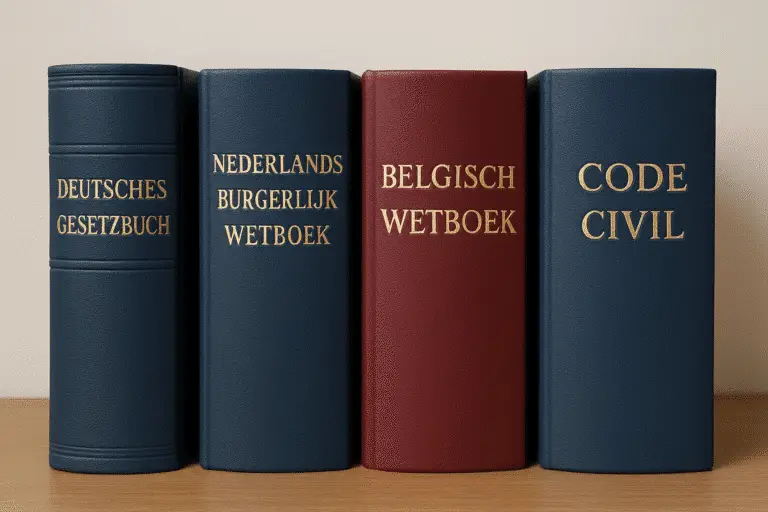
Cross-border legal issues are the questions that arise as soon as your contract, an employee, a shipment or a dataset crosses a national border: which court may hear a dispute, which law governs it, whether a judgment can actually be enforced where the assets are, and which regulatory regimes apply at the same time. If you operate from the Netherlands, the answers come mainly from directly applicable EU instruments, above all the Brussels I Recast Regulation on jurisdiction, the Rome I and Rome II Regulations on applicable law, the General Data Protection Regulation (GDPR) and the Dual-Use Regulation, supplemented by Dutch private international law in Book 10 of the Burgerlijk Wetboek (Civil Code).
Decide these questions in the contract, because once a dispute has arisen they are almost impossible to renegotiate. This guide follows that order: forum and governing law, enforcement and contract mechanics, and then trade and sanctions, employment and immigration, data protection and dispute resolution.
Table of contents
Which court may hear your cross-border dispute?
Within the European Union the Brussels I Recast Regulation decides. The starting point is that you sue a defendant in the courts of the member state where it is domiciled, but the Regulation adds special heads of jurisdiction that matter more in practice: for the sale of goods, the courts of the place where the goods were or should have been delivered, and for the provision of services, the courts of the place where the services were or should have been provided.
Claims in tort go to the courts of the place where the harmful event occurred, which includes the place where the damage was suffered. Some matters are reserved exclusively, regardless of what the parties agreed, including rights in rem in immovable property and the validity of decisions of a company organ.
A choice of court clause overrides most of this, and under the Regulation such a clause is presumed exclusive unless you say otherwise. Two limits matter. Consumers and employees enjoy protective regimes that a clause agreed in advance cannot take away, so an employment contract cannot validly send a Dutch-based employee to a foreign court before the dispute has arisen. And where proceedings are started in two member states about the same claim, the court seised second must stay its proceedings, except where the second court was designated in an exclusive choice of court agreement, which is the answer the Regulation gives to the tactic of racing to a slow forum.
Outside the EU the picture is different. The 2005 Hague Convention on Choice of Court Agreements makes an exclusive choice of court binding among its contracting states, which is a reason to name a court in a state that is party to it. Where neither the Regulation nor a convention applies, Dutch jurisdiction is governed by the opening articles of the Code of Civil Procedure (Wetboek van Burgerlijke Rechtsvordering), which broadly mirror the Regulation. For international commercial disputes the Netherlands Commercial Court in Amsterdam, a chamber of the district court and the court of appeal, hears cases in English and delivers judgment in English where you have agreed to it, which removes one of the standard objections to litigating in a foreign forum.
Which law governs your contract?
The Rome I Regulation lets the parties to a commercial contract choose the applicable law freely, and that choice is respected across the EU. Where you have not chosen, the Regulation supplies fixed rules: a contract for the sale of goods is governed by the law of the seller’s habitual residence, a service contract by the law of the provider’s habitual residence, and a contract concerning immovable property by the law of the country where the property is situated. Non-contractual claims are covered separately by the Rome II Regulation, whose general rule points to the law of the country where the damage occurs, with specific rules for product liability and unfair competition.
Choosing a law does not switch off everything else. A choice cannot deprive a consumer of the protection of the mandatory rules of the country where the consumer lives, nor an employee of the protection of the law of the country where the work is habitually carried out; and overriding mandatory provisions of the forum, the rules a state regards as crucial for safeguarding its public interests, apply whatever you agreed. In Dutch practice this is why an employee who habitually works in the Netherlands keeps the protection of Dutch dismissal law even under a contract governed by another law.
One point is missed more often than any other in international sales. The Netherlands is a party to the United Nations Convention on Contracts for the International Sale of Goods (CISG), which applies automatically to a commercial sale of goods between businesses established in different contracting states. Choosing Dutch law does not exclude it, because the Convention forms part of Dutch law; excluding it requires an express clause. The Convention differs from the Civil Code on several practically important points, including the notice a buyer must give of a non-conformity and the threshold for terminating the contract, so decide deliberately whether to keep it or exclude it, whichever side it favours. Our overview of international business law puts these choices in a wider commercial context.
How do you enforce the outcome where the assets are?
A judgment you cannot enforce is a cost, not a result, so ask the enforcement question at the start rather than at the end. Within the European Union it is straightforward: a judgment given in one member state is recognised in the others without any special procedure and is enforceable without a declaration of enforceability, on production of a certificate from the court of origin. Recognition can only be refused on narrow grounds such as manifest incompatibility with public policy or an irreconcilable earlier judgment. The EU also provides a European Account Preservation Order, which allows you, as a creditor, to freeze a debtor’s bank account in another member state without first alerting the debtor.
Beyond the EU, the 2019 Hague Judgments Convention, in force for the European Union since 1 September 2023, is steadily extending the circle of states in which a Dutch judgment can be recognised without a fresh examination of the merits. Where no treaty applies, Dutch law offers no direct enforcement of a foreign judgment: the Code of Civil Procedure requires you, as creditor, to bring fresh proceedings in the Netherlands. In practice the Dutch court will give binding effect to the foreign decision, without re-examining the merits, where the foreign court had jurisdiction on internationally acceptable grounds, the proceedings met the requirements of due process, recognition does not conflict with Dutch public policy, and the judgment is not irreconcilable with a Dutch decision or an earlier foreign decision between the same parties.
Arbitral awards are in a better position than judgments. The 1958 New York Convention obliges the courts of well over a hundred and fifty states to recognise and enforce an award, subject to a short list of defences, which is the strongest practical argument for an arbitration clause in a contract with a counterparty outside the EU. The Netherlands has its own case law on the enforcement of an award that has been set aside at the seat, which we discuss in our article on the recognition and enforcement of an annulled arbitral award. Whatever route you choose, map where the debtor’s bank accounts, stock and intellectual property rights are before you decide where to sue.
Which contract mechanics survive a border?
Start with the vehicle. Trading through a branch of your foreign parent company is quick to set up but leaves the parent fully liable and creates a permanent establishment for tax purposes almost immediately; a Dutch BV ring-fences the activity but requires its own governance, accounts and filings. Whichever you choose, check who may sign: in a Dutch BV the power of representation lies with the board and, unless the articles say otherwise, with each director alone, and any registered restriction is enforceable against the counterparty. An extract from the Trade Register (Handelsregister) costs almost nothing and prevents a contract that binds nobody.
Payment terms are regulated. Under Article 6:119a of the Dutch Civil Code a payment term between businesses may not exceed sixty days, unless a longer term is expressly agreed and is not grossly unfair to the supplier. Since 1 July 2022 a large company may not agree a term longer than thirty days with a small or medium-sized supplier; a longer term is void and is replaced by thirty days. Overdue commercial debts carry the statutory commercial interest rate, and you can claim reasonable collection costs separately. If you sell into the Netherlands from abroad, check your standard terms: a payment term that is normal in your home market may not hold here.
Three further clauses do more work in a cross-border contract than anywhere else. Retention of title is recognised in Dutch law and survives the buyer’s insolvency, but its effect abroad depends on the law of the country where the goods are when the question arises, so an extended retention of title clause that works in the Netherlands may be reduced to a simple one across the border. Incoterms 2020 allocate cost, risk and customs responsibilities between seller and buyer but they say nothing about when title passes, and pairing an Incoterm with the wrong delivery and insurance wording is a frequent source of loss. Finally, define force majeure yourself: the Civil Code test of an impediment that cannot be attributed to the debtor is narrower than most parties assume, and a bespoke clause with a renegotiation mechanism for extreme cost swings is worth the drafting time.
What do you need to know about trade compliance: export controls, customs and sanctions?
Three regimes bite at the border and they are enforced separately. Export controls on dual-use items, goods and technology that have both civil and military applications, are governed by the EU Dual-Use Regulation, which requires a licence for the items on its control list and, through catch-all provisions, sometimes for items that are not listed at all when you know or are informed of a military or proliferation end use. In the Netherlands licences are granted centrally and enforcement runs through the Douane (Customs Administration), and a breach is an economic offence, not an administrative slip. Technology counts: sending a controlled design file to a colleague outside the EU can be an export.
Customs is the second regime. The Union Customs Code governs classification, origin and valuation, and a wrong commodity code produces back-duties and penalties years later. Binding tariff information obtained in advance from the customs authorities gives you legal certainty about classification for a fixed period across the whole Union, and it is the cheapest form of insurance available in this field. The third regime is sanctions, which have moved from a compliance topic to a criminal enforcement priority: a breach of a sanction designated under the Sanctiewet 1977 (Sanctions Act 1977) is an economic offence punishable by imprisonment, and companies and their directors are prosecuted together. We set out that regime in detail in our article on the criminal enforcement of international sanctions. The single most common mistake is screening a counterparty’s name against the lists without checking whether it is owned or controlled by a listed person, which is a separate and stricter test.
What happens when your people cross borders: posting, employment and immigration?
Sending staff across a border triggers three separate questions: which employment law applies, where social security contributions are due, and whether a residence and work authorisation is needed. On the first, Rome I points to the law of the country where the employee habitually works, and a choice of another law cannot remove the mandatory protection of that law; on top of that, the EU rules on posted workers guarantee a hard core of host-country terms, including pay, working time and holiday, to a worker temporarily sent to another member state. In the Netherlands an employer posting workers here must notify the posting in advance through the online portal maintained for that purpose, and you, as the recipient of the services, have a duty to check that notification.
Social security follows its own logic. Under the EU coordination rules a worker posted temporarily to another member state can remain insured in the home state, evidenced by an A1 certificate that must be requested before departure and is in principle limited to twenty-four months. Without a valid A1, the host state authorities can require contributions locally, and the certificate has to reflect reality: the coordination rules require a genuine link with the sending employer and a posting that is not simply the replacement of an earlier posted worker.
Immigration is the third strand. Nationals of EU and EEA states and Switzerland need no permission to work in the Netherlands. For everyone else you, as employer, need an authorisation under the Wet arbeid vreemdelingen (Aliens Employment Act), unless the employee qualifies under the highly skilled migrant route, which requires you to be a recognised sponsor with the Immigratie- en Naturalisatiedienst (IND), or under the EU Blue Card. The salary criteria for those routes are set each year and published by the IND, so verify the current figures rather than relying on any number you find online. Employing someone without the required authorisation exposes your company to a substantial administrative fine per worker and, on repetition, to the closure of the business, which is why our immigration lawyers treat the check as a hiring gate rather than a formality.
Two Dutch particularities catch foreign employers. Dismissal is preventive: you cannot simply terminate, but need either the employee’s written consent, permission from the UWV (Employee Insurance Agency) for redundancy or long-term incapacity, or a decision of the subdistrict court (kantonrechter) on one of the statutory grounds. And a non-competition clause is subject to strict requirements, including a written agreement with an adult employee and, in a fixed-term contract, a written statement of the compelling business interests that justify it.
What do you need to know about data and digital operations across borders?
The GDPR follows the data rather than the establishment. It applies to processing in the context of an establishment in the Union wherever the processing takes place, and to a controller outside the Union that offers goods or services to people in the Union or monitors their behaviour here. The core obligations are the same for a Dutch business as for a foreign one: a record of processing activities, a lawful basis for each processing operation, a data protection officer where the processing is large-scale and systematic or concerns special categories, and a data protection impact assessment for high-risk processing. The Autoriteit Persoonsgegevens (Dutch Data Protection Authority) is the Dutch supervisory authority, and you must notify a personal data breach to it within seventy-two hours of becoming aware of it, with notification to the individuals concerned where the risk to them is high.
Transfers out of the European Economic Area need their own basis: an adequacy decision, the standard contractual clauses, or binding corporate rules within a group. Since the Court of Justice invalidated the earlier transatlantic framework, standard clauses have to be accompanied by an assessment of whether the law of the destination country actually allows the guarantees to be honoured, and by supplementary measures where it does not. In practice, deciding where a cloud service stores and processes your data is a legal decision as much as a technical one, and it is best taken with the contract rather than after it; our ICT lawyers review processing agreements and transfer arrangements as a package.
Cybersecurity is now a separate obligation. The Cyberbeveiligingswet (Cybersecurity Act), which implements the NIS2 Directive, has been in force since 15 August 2026. It requires entities in the designated essential and important sectors to register with the Nationaal Cyber Security Centrum, to take appropriate technical and organisational measures, and to report a significant incident with an early warning within twenty-four hours and a fuller notification within seventy-two hours. Group structures matter here: whether an entity falls within scope is assessed on the basis of its own size and sector, so your Dutch subsidiary of a foreign group can be in scope on its own account.
How do you resolve cross-border disputes from the Netherlands?
The Netherlands offers two instruments that are unusually effective and that foreign counterparties consistently underestimate. The first is summary proceedings (kort geding), a procedure before the provisional relief judge that can produce an enforceable order within weeks, and much faster where the urgency requires it. The second is pre-judgment attachment (conservatoir beslag): with leave from the provisional relief judge, obtained on a written application and normally without hearing the debtor, you, as creditor, can attach bank accounts, goods, shares or receivables before the main claim has been decided. Leave is granted on a summary assessment, and the court then fixes the period within which the main proceedings must be started. If your debtor has assets in the Netherlands, that combination is often more valuable than the choice of forum itself.
For evidence in another member state you can use the EU Taking of Evidence Regulation, and outside the EU the Hague Evidence Convention. Under the Dutch Code of Civil Procedure you can demand specific documents in which you have a legitimate interest, which is narrower than common-law disclosure. For arbitration, agree the institution, seat, language and number of arbitrators in the clause itself; a clause that leaves the seat open produces a dispute before the real one begins.
How do you turn this into an internal routine?
Give one person responsibility for the international file and the authority to stop a transaction. Build a few gates into your process: no new counterparty without an ownership and control check against the sanctions lists, no shipment of a technical product without a classification decision, no hire abroad without confirming the applicable law and the A1 position, and no IT supplier without a processing agreement. Keep licences, A1 certificates, binding tariff information, posting notifications and cybersecurity registrations in one register with expiry dates. For a specific transaction, see our note on cross-border legal advice; where an investigation follows, read about cross-border criminal investigations.
What can we do for you with cross-border legal issues?
Our corporate lawyers work in Dutch and English and coordinate with local counsel when a second country is involved:
- We review the jurisdiction, governing law and enforcement clauses in your international contracts, including whether to exclude the CISG.
- We advise on setting up a Dutch BV or branch and check who may sign on behalf of a counterparty.
- We check posting, A1 and work-permit requirements before staff cross a border.
- We draft processing agreements and assess data transfers outside the EEA.
- We apply for leave for pre-judgment attachment and conduct summary proceedings or arbitration.
Summary
- Decide your forum and governing law in the contract, not after a dispute starts: a well-drafted choice of court and choice of law clause is respected across the EU and, for arbitration, in over a hundred and fifty states under the New York Convention.
- Check enforcement before you sue: within the EU a judgment travels freely, outside it you depend on a treaty or on starting fresh Dutch proceedings, so map the debtor’s assets first.
- Build sanctions, export control and customs screening into your onboarding process, including ownership and control checks, not only a name match against the lists.
- Treat employment, posting and immigration as one file: the applicable employment law, the A1 certificate and the work authorisation each have their own conditions and deadlines.
- Data transfers and cybersecurity registrations under the GDPR and the Cyberbeveiligingswet belong in the contract stage, with a central register that tracks expiry dates.
Frequently asked questions
Which court hears a dispute with a business in another EU country?
Under the Brussels I Recast Regulation you normally sue the defendant in its home member state, unless the contract contains a choice of court clause, which is presumed exclusive. For sales and services, the court of the place of delivery or performance also has jurisdiction.
Does choosing Dutch law exclude the CISG?
No. The UN Convention on Contracts for the International Sale of Goods is part of Dutch law, so it applies to an international sale between businesses unless your contract expressly excludes it.
Can a Dutch judgment be enforced in another EU country?
Yes. Within the EU a judgment is recognised without a special procedure and is enforceable on production of a certificate from the court of origin. Outside the EU you depend on a treaty such as the 2019 Hague Judgments Convention.