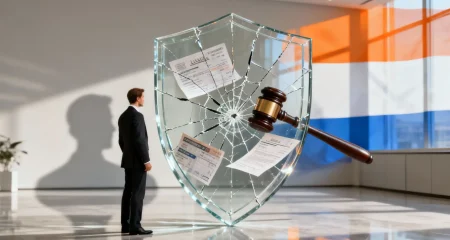
A corporate lawyer adds the most value at the moments where a business decision is hard to reverse: incorporation, the entry of an investor, a long-term contract and the first week of a dispute. The main exception is a purely commercial choice: no lawyer can turn a bad deal into a good one, but we can tell you which consequences you can still change afterwards and which you cannot.
In Dutch practice three areas account for most of that value. The first is company law: the articles of association and the shareholders’ agreement decide what a majority can force and what a minority can block, and directors are personally liable to the company under Article 2:9 of the Dutch Civil Code (BW). The second is contracting, where the validity of general terms and the form of a notice of default often decide a dispute. The third is regulatory compliance, where fines under the GDPR can reach €20 million or 4% of worldwide annual turnover without any counterparty having to complain.

Where does a corporate lawyer make the difference?
A corporate lawyer makes the difference in governance, contracts, compliance and disputes. In each area a small number of statutory rules decides most outcomes.
How are governance and director liability arranged?
The board of a Dutch private limited company (besloten vennootschap, BV) must perform its duties properly. Under Article 2:9 BW a director is liable to the company for serious personal blame (ernstig verwijt). In bankruptcy, Article 2:248 BW makes every director jointly liable for the deficit if the board manifestly performed its duties improperly in the three years before the bankruptcy and this was an important cause of it.
If the board did not keep proper records (Article 2:10 BW) or filed the annual accounts late with the Chamber of Commerce (KVK) under Article 2:394 BW, improper performance is presumed by law. A late filing therefore shifts the burden of proof to the directors. For a BV, Article 2:216 BW also requires the board to refuse a distribution to shareholders if it knows or should foresee that the company cannot then pay its debts.
Why are contracts and general terms decisive?
Many commercial disputes are decided by form rather than substance. Under Article 6:233 BW a clause in general terms and conditions (algemene voorwaarden) can be annulled if the other party was not given a reasonable opportunity to read the terms, usually by handing them over before or at the conclusion of the contract (Article 6:234 BW).
A party that does not perform is generally only in default after a written notice of default (ingebrekestelling) with a reasonable period to perform, under Article 6:82 BW. Without that notice, a claim for damages or termination may fail. Limitation-of-liability clauses are tested against reasonableness and fairness (Article 6:248 BW) and do not protect against intent or deliberate recklessness of management.
Which compliance obligations carry the largest risks?
The largest exposure lies with regulators rather than counterparties. The Dutch Data Protection Authority (Autoriteit Persoonsgegevens) can impose GDPR fines of up to €20 million or 4% of annual turnover. Institutions covered by the Anti-Money Laundering and Anti-Terrorist Financing Act (Wwft) must identify their customers and report unusual transactions to FIU-Nederland.
Companies must also register their ultimate beneficial owners (UBOs) with the KVK and keep those details up to date. Sector rules come on top of this, for example supervision by the Authority for the Financial Markets (AFM) or the Authority for Consumers and Markets (ACM).
How are business disputes resolved in the Netherlands?
Claims up to €25,000 go to the subdistrict court (kantonrechter) under Article 93 of the Dutch Code of Civil Procedure (Rv); larger claims go to the civil division of the district court, where representation by a lawyer is mandatory. Urgent matters can be brought in summary proceedings (kort geding) before the preliminary relief judge.
Disputes between shareholders have their own routes. A shareholder can ask for another shareholder to be expelled or bought out under the dispute settlement rules of Articles 2:335-2:343c BW. The Enterprise Chamber (Ondernemingskamer) of the Amsterdam Court of Appeal can order an inquiry into the policy of the company and take immediate measures under Article 2:345 and following BW.
When should you involve a corporate lawyer?
Involve a lawyer before the decision, not after the dispute. The moments below are the ones where a correction later costs much more than advice now.
- At incorporation: the BV is formed by notarial deed, and the articles of association set voting rights, share transfer restrictions and quorum rules.
- When an investor or new shareholder comes in: share classes, drag-along and tag-along clauses, and good leaver and bad leaver rules belong in the shareholders’ agreement.
- Before signing a long-term supply, distribution or licence agreement: termination notice periods and liability caps decide your exposure for years.
- When a counterparty does not pay or perform: the notice of default under Article 6:82 BW must be right the first time.
- When a regulator sends a letter: the deadline for a view (zienswijze) or an objection (bezwaar) is often short, and an objection must be filed within six weeks (Article 6:7 General Administrative Law Act, Awb).
What can a corporate lawyer do for individuals?
Individuals use a corporate lawyer mainly as directors, shareholders, founders or senior employees. For a director, the key questions concern personal liability under Articles 2:9 and 2:248 BW and the terms of dismissal; a statutory director of a BV can be dismissed by the general meeting at any time under Article 2:244 BW.
For a founder or freelancer, the choice between a sole proprietorship (eenmanszaak) and a BV affects personal liability and tax. For an employee, a non-compete clause in a fixed-term contract is only valid under Article 7:653 BW if the employer states in writing why it is needed for substantial business interests.

What should you check as a director?
- Is the bookkeeping complete and up to date, as Article 2:10 BW requires?
- Were the annual accounts filed with the KVK in time under Article 2:394 BW?
- Can the company still pay its debts after any proposed distribution (Article 2:216 BW)?
- Are board resolutions and any conflicts of interest documented in writing?
- Does the company have directors’ and officers’ (D&O) insurance, and what does it exclude?
What should you check as a shareholder?
- Which decisions require your consent under the articles of association or the shareholders’ agreement?
- Which transfer restrictions apply to your shares (offer obligation or approval requirement)?
- What happens to your shares if you leave the company, and at what price?
- Do you receive the information you need, including the adopted annual accounts?
- Which route is open if you and the other shareholders reach deadlock: mediation, the dispute settlement rules or the Enterprise Chamber?
What can we do for you with corporate law?
Our corporate lawyers in Eindhoven and Amsterdam work for Dutch and international companies, directors and shareholders. In practice we:
- Draft or review your articles of association and shareholders’ agreement before the notary executes the deed.
- Review your general terms and conditions and the way you make them available, so they hold up under Articles 6:233 and 6:234 BW.
- Draft the notice of default and the claim against a counterparty that does not pay or perform.
- Assess your personal liability as a director and the steps that reduce it.
- Represent you in shareholder disputes, summary proceedings and proceedings before the Enterprise Chamber.
- Check your compliance with the GDPR, the UBO register and sector rules, and help you respond to a regulator within the deadline.
For foreign companies we also explain the most common legal pitfalls of doing business in the Netherlands and why early legal advice is necessary.
Summary
- A corporate lawyer adds the most value before decisions that are hard to reverse: incorporation, investment, long-term contracts and the start of a dispute.
- Directors are liable to the company under Article 2:9 BW and, in bankruptcy, for the deficit under Article 2:248 BW.
- General terms must be handed over properly (Articles 6:233-6:234 BW), and a notice of default is usually required before you can claim damages (Article 6:82 BW).
- Regulatory risks, such as GDPR fines of up to €20 million or 4% of turnover, arise without any counterparty complaining.
- Shareholder disputes can go through the dispute settlement rules (Articles 2:335-2:343c BW) or the Enterprise Chamber.
Frequently asked questions
What are the main benefits of hiring a corporate lawyer in the Netherlands?
A corporate lawyer helps you get decisions right that are hard to reverse: the articles of association, the shareholders’ agreement, long-term contracts and the first steps in a dispute. Mistakes there, such as general terms that were not handed over (Article 6:233 BW) or a missing notice of default (Article 6:82 BW), often decide the outcome.
Can I be personally liable as a director of a Dutch BV?
Yes. Under Article 2:9 BW you are liable to the company for serious personal blame, and under Article 2:248 BW you can be liable for the deficit in bankruptcy if the board manifestly performed its duties improperly in the three years before. Late filing of the annual accounts creates a legal presumption of improper performance.
How can a corporate lawyer help with compliance?
We identify which rules apply to your business, such as the GDPR, the UBO register at the KVK and sector supervision by the AFM or ACM. We also help you respond to a regulator within the deadline; an objection against a decision must be filed within six weeks (Article 6:7 Awb).
Which court handles a business dispute in the Netherlands?
Claims up to €25,000 go to the subdistrict court (kantonrechter) under Article 93 Rv. Larger claims go to the district court, where a lawyer is mandatory. Shareholder disputes can also go to the Enterprise Chamber of the Amsterdam Court of Appeal.